
Open SDK access
Mentra Live exposes the speakers, microphone, and HD camera through one SDK so teams can build apps around capture, audio, and guided workflows.

Mentra Live open-source smart glasses for field teams and developers building camera-enabled workflows, AI assistants, and custom apps with MentraOS.
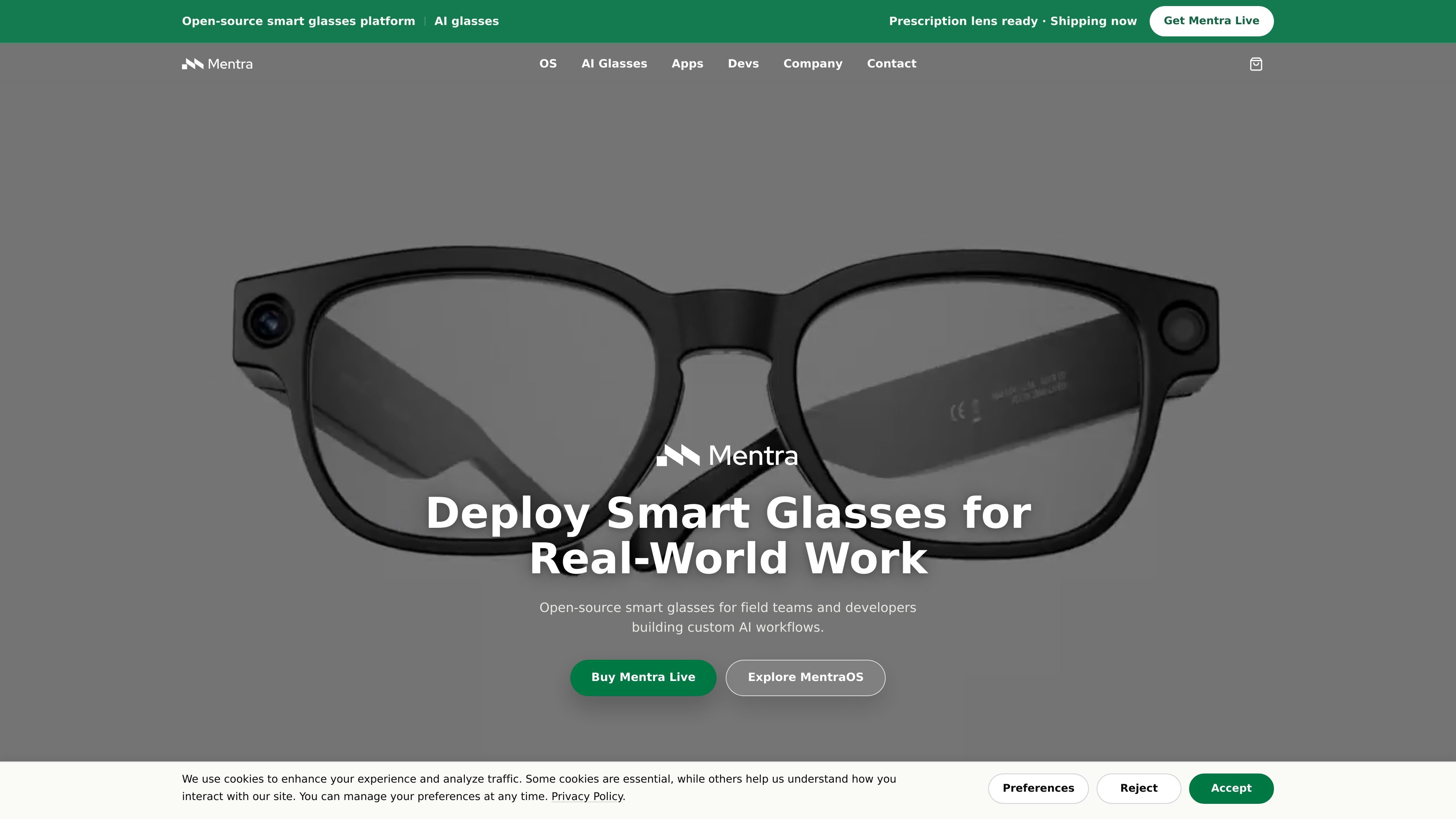
Mentra Live is a pair of smart glasses for field teams and developers who want to build camera-enabled workflows, AI assistants, and custom apps for real-world work. The product is positioned as an open-source platform built on MentraOS, with access to the speakers, microphone, and HD camera through a full SDK.
The site emphasizes use in physical-work settings such as remote support, field operations, technician assistance, and delivery workflows. MentraOS runs apps on the phone while the glasses handle input and output, and the platform includes an app store for browsing, installing, and running MiniApps from the phone app.
Mentra Live exposes the speakers, microphone, and HD camera through one SDK so teams can build apps around capture, audio, and guided workflows.
The glasses support camera use cases such as taking pictures and starting a livestream, which makes them suitable for field documentation and remote assistance.
MentraOS runs apps on the user’s phone, and the glasses handle input and output. The site says this helps extend battery life while supporting multiple apps at once.
The Mentra MiniApp Store lets users browse, install, and run apps from the phone app, giving the platform a distribution layer for smart glasses software.
Hardware details listed on the site include 12+ hour battery life, 43 g weight, stereo audio, three microphones, a 119° landscape camera field of view, and USB-C charging options.
The product page says Mentra Live is prescription lens ready and ships with a charging case and an Infinity Cable for extended use.
A technician can narrate a repair while the glasses record from their point of view, turning the session into notes, documentation, evidence, and next steps.
Teams can use the camera, microphone, and SDK to support remote troubleshooting or hands-free video calls when an expert needs to see the work in progress.
Developers can build custom MiniApps that use display control, transcription, camera commands, and voice input to create workflows for supported glasses.
Operators can use the phone-hosted runtime to run multiple apps at once, such as notes, translation, captions, or camera tools, without treating the glasses as a standalone computer.
Organizations deploying in the field can order hardware on the website, then contact Mentra for larger rollouts and private app deployment to teams.
MentraOS is an open-source operating system for smart glasses. The site says it includes a full SDK, an app store, and support for multiple hardware platforms, including Mentra Live, Even Realities, and Vuzix.
Yes. The MentraOS page says developers can use the SDK to build apps for supported glasses, and the home page says Mentra Live is built for custom apps and AI workflows.
The site describes the Mentra MiniApp Store as the distribution layer for smart glasses apps. Users can browse, install, and run apps from the phone app.
The pricing page says teams can order Mentra Live for their dev team on the website, then contact Mentra for deployments at scale. It also says private apps can be deployed to a team without publishing to the app store, but the page leaves the details collapsed.
The site says Mentra Live is prescription lens ready and that buyers can learn more about lenses on the product pages.