
Mobile observability with full context
Captures crashes, UI glitches, broken functionality, user feedback, session replay, logs, device details, and environment context so teams can understand issues without piecing together separate tools.

Luciq is an agentic AI platform for mobile observability and app experience management. Detect, prioritize, resolve, and prevent mobile issues across the app lifecycle.
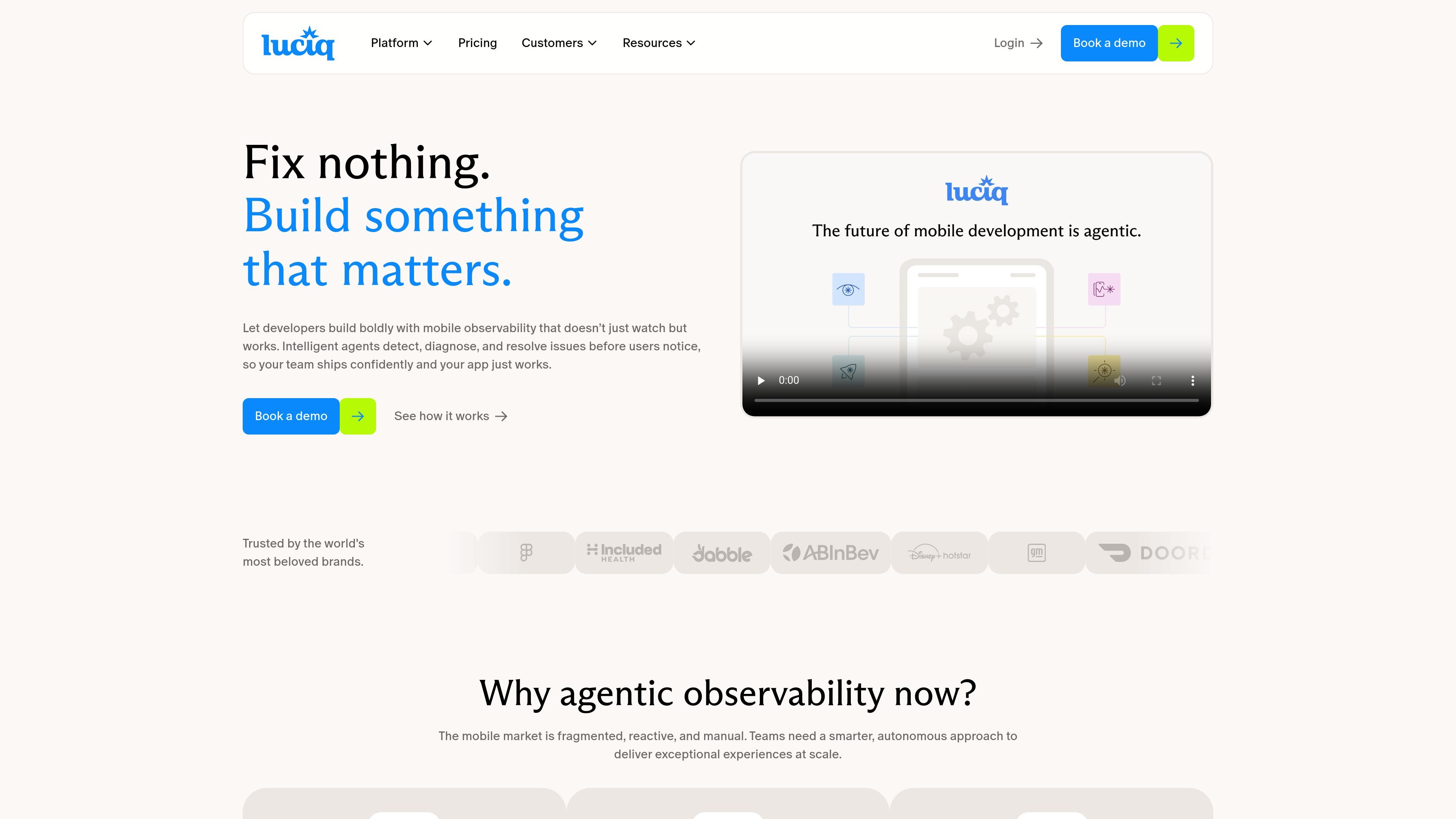
Luciq is an agentic AI platform for mobile observability and app experience management. It is presented as a mobile-first system that covers the full lifecycle, from testing and beta monitoring through production observability, triage, resolution, and prevention.
The product combines crash reporting, app performance monitoring, session replay, in-app surveys, intelligence, and autonomous remediation. Luciq’s stated purpose is to help teams detect, understand, and fix mobile issues with less manual triage, while linking app quality work to business outcomes such as stability, retention, and revenue protection.
Captures crashes, UI glitches, broken functionality, user feedback, session replay, logs, device details, and environment context so teams can understand issues without piecing together separate tools.
Groups and prioritizes noisy data using business impact scoring, frustration-free session scores, dashboards, and issue routing so teams can focus on the problems that matter most.
Analyzes stack traces, codebase context, and device details to surface root causes, suggest reproduction steps, and generate code fix suggestions.
Creates ready-to-merge pull requests from suggested fixes and supports a developer feedback loop so engineers can revise the proposed solution before it reaches production.
Helps teams prevent issues before users feel them through real-time alerts, release management, feature flag controls, and automated fixes.
Supports enterprise needs with SSO, SAML, SCIM, role-based access control, audit logs, and options for global hosting or regional data pinning.
Use Luciq to capture crash reports, session replay, performance data, and user feedback during beta or production so engineers can reproduce issues with full context instead of relying on incomplete reports.
Use the prioritization and business-impact tooling to sort noisy issue streams, route items to the right team, and decide what needs attention first.
Use the Resolve agent to analyze crashes, suggest fixes, and generate pull requests when a team wants to shorten the path from diagnosis to code change.
Use release management, real-time alerts, and feature flag controls to catch regressions early and stop problems from reaching more users.
Use dashboards, session scores, in-app surveys, and app ratings context to align engineering and product teams around app health and user experience trends.
Luciq is positioned as an agentic mobile observability platform that combines crash reporting, app performance monitoring, session replay, in-app surveys, intelligence, and autonomous resolution. The source describes it as covering the mobile lifecycle from testing to production monitoring.
The pricing page says Luciq charges on daily active users and member seats, with full platform access included in one transparent plan. It also says Enterprise plans include standard technical support, with Premier support available for teams that need 24/7 coverage and dedicated Slack channels.
The source shows support for global data hosting and optional regional data pinning, plus SSO, SAML, SCIM, role-based access control, and audit logs on Enterprise plans. The company also states that customer data is not used to train its AI models.
Luciq’s Resolve agent can surface crash context, suggest fixes, and generate a ready-to-merge pull request. The product copy says developers stay in control and can review or modify the suggested solution before it is applied.
The source does not provide a full integrations list. One page mentions a Luciq MCP Server for use inside an IDE, and another mentions integrations used to manage releases and automatically label them.