
Unified delivery data layer
Connect Jira and Git accounts to build a unified view of delivery data from commit to release. Haystack says it ingests raw data from Jira, Git, and releases to create a single data layer.

Haystack is a delivery operations platform that turns Jira and Git data into insights, reports, and automated updates without changing your workflow.
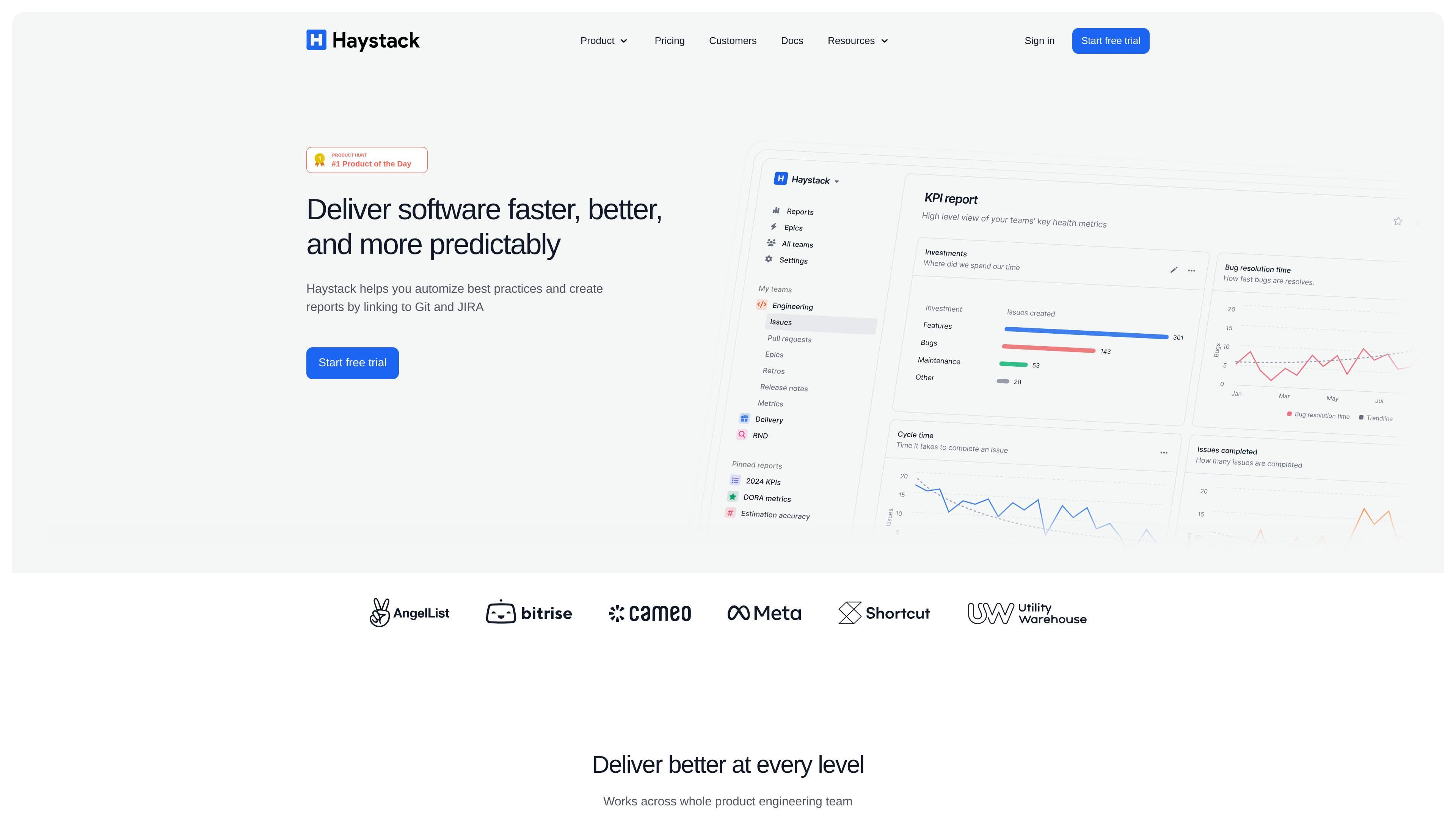
Haystack is a delivery operations platform for product and engineering leaders. It sits on top of Jira and Git-based workflows to clean, connect, and enhance delivery data, then turns that data into reports, summaries, and operational insights.
The product pages describe a set of connected workflows: a unified delivery stack that creates a single source of truth from commit to release, delivery pulse for automated status updates and release notes, and delivery insights for weekly sprint summaries and delivery analysis. The overall goal is to make delivery progress, risks, and investments easier to understand without changing the underlying process.
Connect Jira and Git accounts to build a unified view of delivery data from commit to release. Haystack says it ingests raw data from Jira, Git, and releases to create a single data layer.
Map teams, milestones, releases, and other delivery objects automatically without changing existing processes. The platform is positioned as a layer on top of your current delivery stack.
Backfill historical data and surface insights such as injections, scope creep, risks, and trends. This gives teams context beyond current sprint activity.
Generate release notes, milestone updates, and weekly summaries from tickets and commits. Haystack also describes these as automated reports and stakeholder updates.
Surface operational signals such as risks, blockers, epic progress, capacity, and investment visibility. The homepage also highlights status updates that can be read quickly for standups and reviews.
Support both team reporting and executive communication with products focused on pulse updates and weekly insights. The site describes reports that help teams show progress and keep stakeholders informed.
Pull together Jira and Git activity into one delivery view so product and engineering leaders can understand progress from commit to release without manual reconciliation.
Use automated release notes, milestone updates, and status summaries to keep executives, stakeholders, and cross-functional teams informed with less manual reporting.
Review weekly sprint summaries and diagnostic insights to understand completed work, rollovers, capacity, resource allocation, and scope changes.
Track epic progress, risks, and blockers so managers can spot delivery delays earlier and respond before work slips late in the cycle.
Use historical backfill and reporting to compare current delivery patterns with past data and identify trends, injections, and scope creep.
Haystack uses data from Jira and Git repositories to generate delivery reports, release notes, and weekly summaries. Its product pages describe outputs such as automated release notes, milestone updates, weekly progress summaries, and delivery insights.
The pricing page says Haystack supports a 14-day free trial and a Growth plan for teams under 100 engineers, with custom Enterprise pricing for larger teams.
The pricing page states that Haystack supports GitHub, Bitbucket, and GitLab, and that GitHub Enterprise and GitLab Enterprise are available on the Enterprise plan.
The pricing page says Haystack does not store, read, or access source code. It uses metadata returned from standard APIs such as timestamps, titles, descriptions, and tags.
Haystack’s public product pages emphasize product and engineering leadership, managers, product teams, and engineering teams that want delivery visibility, automated updates, and weekly reporting.