
Multiple model families in one place
The platform aggregates multiple mainstream models behind one API layer, including image generation, video generation, and chat-related models.

Grsai is an AI API aggregation platform for image, video, and chat models. It offers documented endpoints, credit-based billing examples, and API key onboarding.
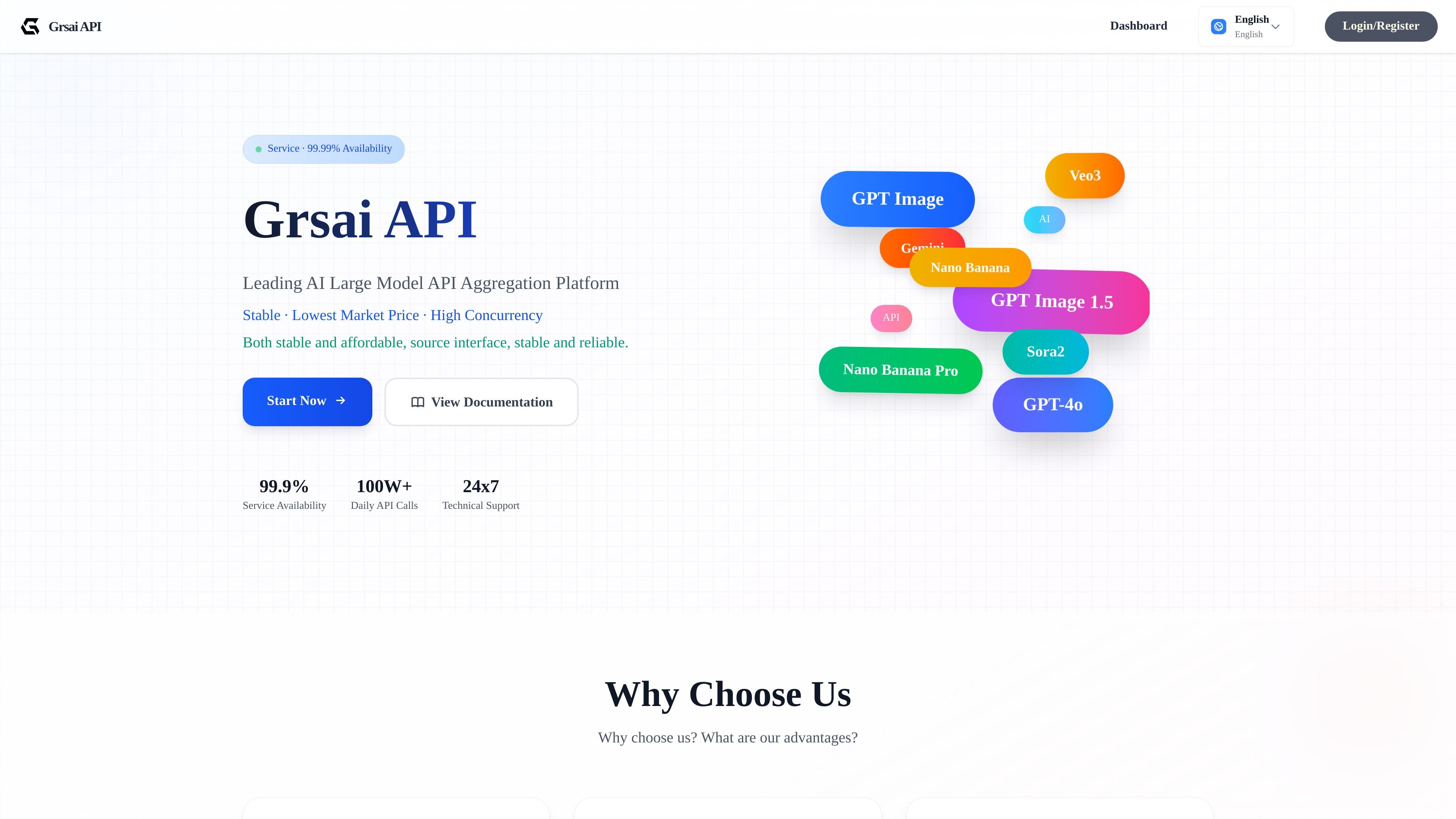
Grsai is an AI large-model API aggregation platform that exposes multiple mainstream models through a single interface. The site positions it around image generation, video generation, and chat use cases, with documented endpoints for products such as GPT Image and Chat API.
The homepage emphasizes service stability, high concurrency, and lower usage cost than official pricing. It also states a 99.99% service availability guarantee, while the dashboard documentation shows that users register an account, create an API key, and then call the model endpoints using the provided docs and sample code.
The platform aggregates multiple mainstream models behind one API layer, including image generation, video generation, and chat-related models.
The dashboard documentation shows host information, endpoint paths, and example calls for models such as GPT Image and Chat API.
The homepage states multi-node deployment, global accelerated access, automatic load balancing, real-time monitoring, and intelligent failover.
The model directory shows per-request or per-token pricing examples, with different costs by model and channel.
The homepage and FAQ indicate account registration, API key creation, and sample code as the basic onboarding flow.
The site lists direct official integration and says it does not act as a third-party reseller.
Developers can call image-generation endpoints such as GPT Image through the documented host and path structure, then fetch results through the separate result endpoint.
Teams working on chat products can use the Chat API documentation and route requests through the same platform instead of wiring up individual providers.
Video-oriented products can use the platform’s aggregation approach to access supported video models such as Veo from a single API surface.
Builders comparing cost and quality can review the model directory, where each model shows pricing examples and notes on resolution support or channel behavior.
Operational teams that care about stability can use the platform’s documented redundancy claims, load balancing, and monitoring-oriented infrastructure.
Grsai API is an API service platform that aggregates multiple AI models and exposes them through a stable interface. The source pages mention models such as GPT Image, Gemini, Flux, Veo, and chat models.
The documented starting flow is to register an account, create an API key in the console, and then call the API endpoints using the provided documentation and sample code.
The platform uses credit-based billing. The model directory shows per-request or per-token examples, and pricing varies by model and channel.
The homepage states a 99.99% service availability guarantee and describes multi-node deployment, load balancing, real-time monitoring, and failover as part of the stability setup.
The homepage and model directory list mainstream image, video, and text models, including GPT-4o, Gemini, Claude, Flux, Veo, and several GPT Image and Nano Banana variants.
Traffic-Daten dienen nur als Referenz.
| Mär | 276964 |
|---|---|
| Apr | 114226 |
| Mai | 198565 |