
Runtime policy enforcement
Checks each agent action against policy before it reaches an external system, so allowed, paused, and blocked outcomes happen in the execution path rather than after the fact.

Execlave is an AI agent governance and enforcement platform that sits between agents and the systems they can access. It helps teams add policy checks, approvals, tracing, and audit logs to AI agents in production.
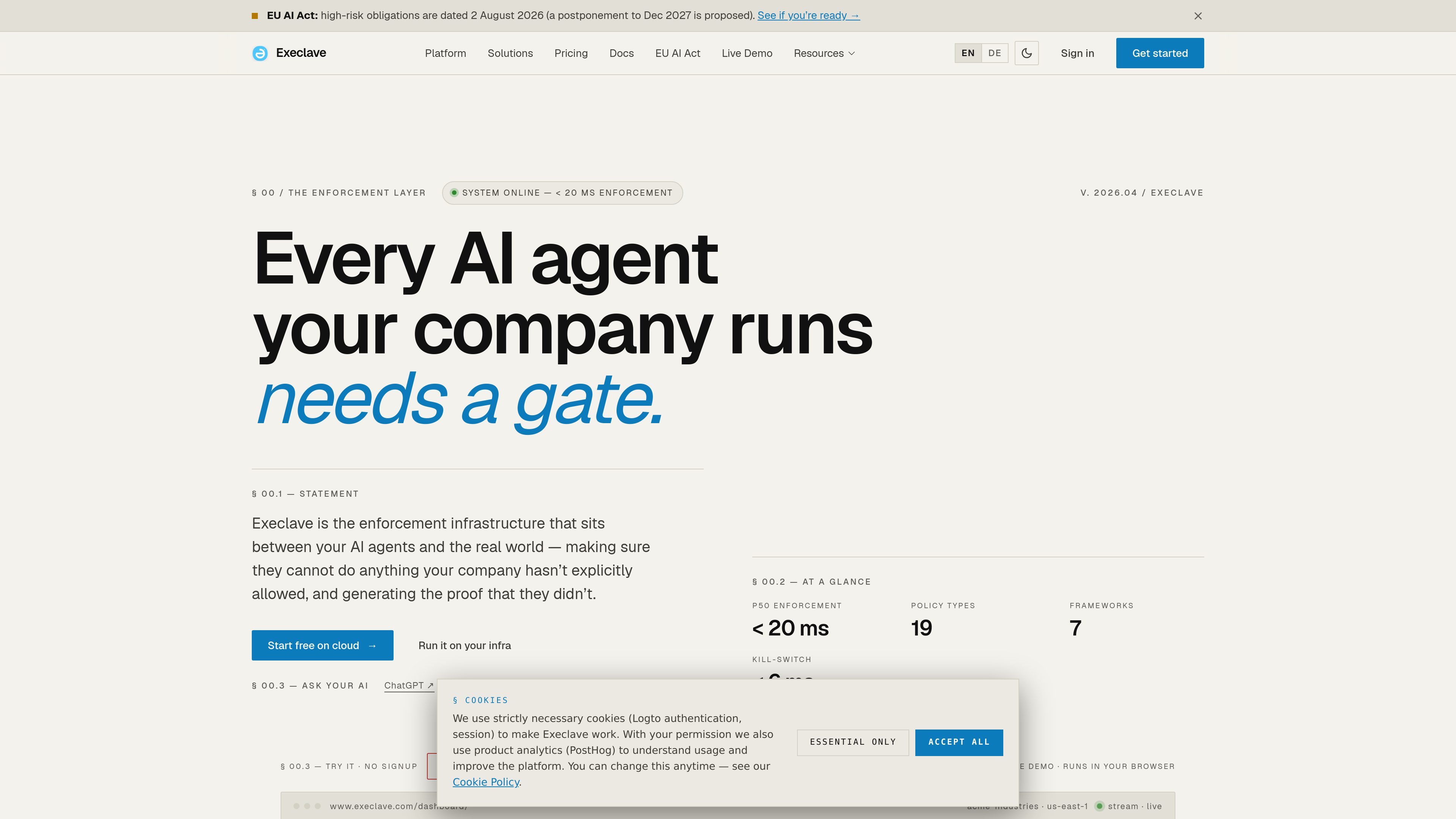
Execlave is a platform for governing AI agents before they can take action in the real world. It checks agent behavior against policy at runtime, routes some actions to human approval, blocks disallowed operations, and records signed audit logs for later review.
The product is aimed at teams running customer support, internal operations, data analysis, or multi-agent workflows where agents can access tools, data, or infrastructure. Its documentation shows a Python and TypeScript SDK, policy enforcement before execution, and deployment options for cloud or self-hosted use.
Checks each agent action against policy before it reaches an external system, so allowed, paused, and blocked outcomes happen in the execution path rather than after the fact.
Captures structured traces with input, output, model name, token counts, latency, and cost, then stores cryptographically signed audit records for compliance review.
Supports paused actions that require human review, which is useful for higher-impact tasks such as refunds, deletions, or production changes.
Provides a server-side stop mechanism that can pause an individual agent or an entire organization quickly, with the site stating sub-6 ms response in measured conditions.
Offers TypeScript and Python SDKs, plus a public API and webhook support on paid plans, so teams can instrument agent workflows in application code.
Includes auto-generated reporting for seven named compliance frameworks and governance controls such as policy bundles, autonomy tiers, cost limits, and agent lifecycle tracking.
Use Execlave to control refunds, account changes, and customer-record access. The site shows policies for capping refunds, scrubbing PII from traces, blocking billing data for lower-tier agents, and sending sensitive actions to Slack approval.
Apply time-based and environment-specific rules to agents that run scripts or change infrastructure. The use-case page highlights approval for production deployments, restrictions on production database writes outside business hours, and auditing of SSH and API-key access attempts.
Govern query-level access for agents that read databases or generate reports. Execlave is described as blocking individual-record access, limiting raw exports, enforcing daily compute budgets, and classifying or blocking PHI and PII.
Monitor and control chains of agent-to-agent actions. The platform traces the full execution graph, can limit orchestration depth, and can kill one agent in the chain without disrupting the others.
Adopt the platform when teams want a gate between model output and external tools, rather than a passive log. The setup guide emphasizes synchronous policy checks before an LLM call and trace capture during the same workflow.
Yes. The docs describe a synchronous policy check that must run before the LLM call or external action, and the homepage frames Execlave as an enforcement layer rather than a log.
The documentation says TypeScript/JavaScript and Python are first-class, and the pricing page also lists a public API and webhooks on all plans.
Yes. The pricing page says the product is available in cloud and self-hosted modes, with self-hosted starting on the Starter plan.
The site highlights customer support agents, internal operations and DevOps agents, data analyst agents, and multi-agent orchestration workflows.
Yes. The use-case pages and setup examples show paused actions and approval routing for higher-impact tasks such as refunds and production changes.
Traffic-Daten dienen nur als Referenz.
| Mai | 0 |
|---|---|
| Jun | 37 |
| Jul | 74 |
Traffic-Analysen sind noch nicht verfügbar.
Traffic-Analysen sind noch nicht verfügbar.