
Real-time world generation
Generates realistic, physically grounded environments that evolve continuously instead of producing a one-off offline clip.

Decart AI Lab builds real-time world models and optimization infrastructure for Physical AI, including Oasis 3 for interactive simulation and DOS for low-latency AI workloads.
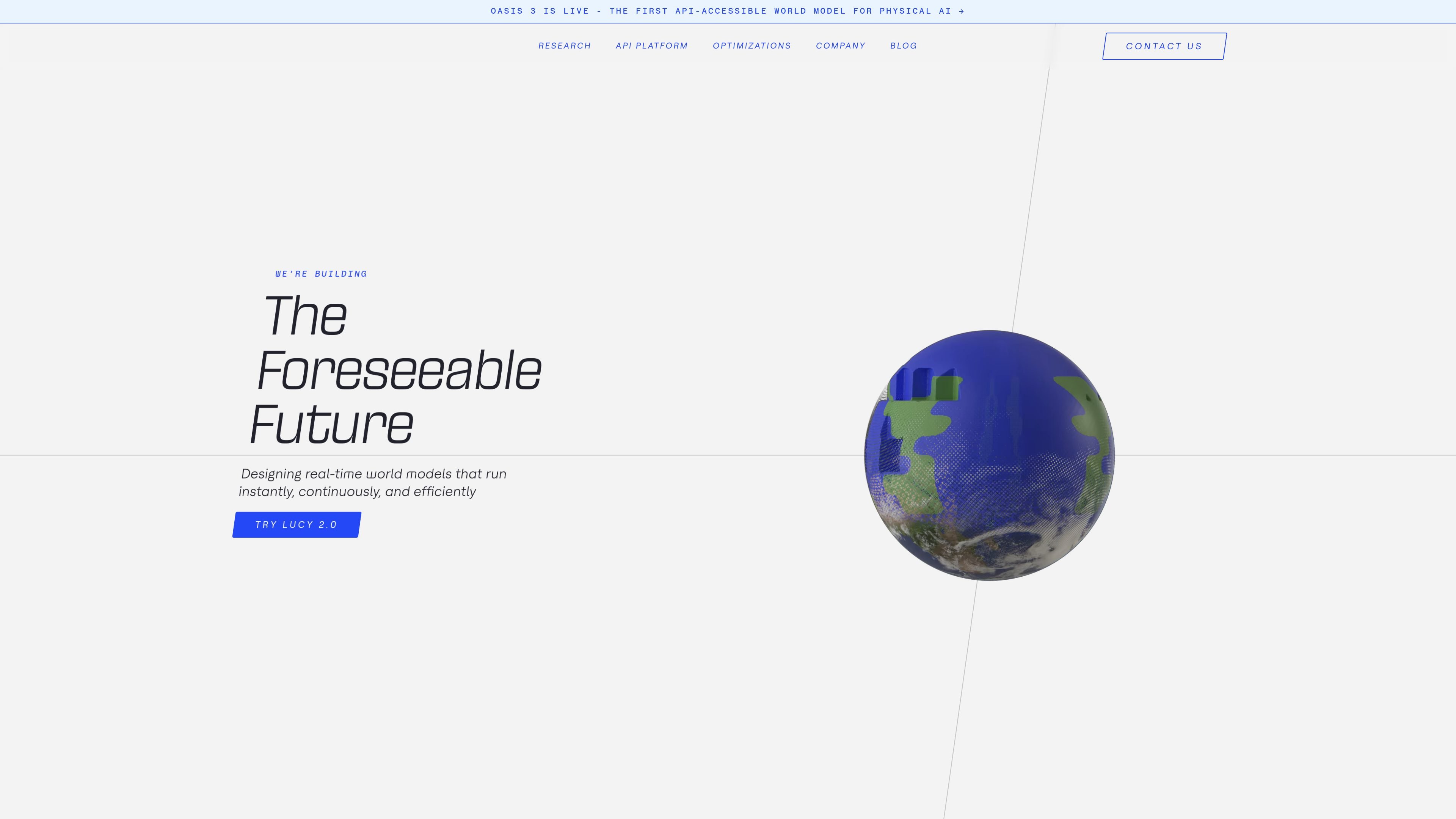
Decart AI Lab builds real-time world models and optimization infrastructure for generative AI systems. Its site centers on three product lines: Oasis for physical AI world generation, Lucy for real-time world editing, and DOS, the Decart Optimization Stack for low-latency inference and training.
Oasis 3 is the clearest productized world model on the site. It generates realistic, controllable simulation environments in real time, responds to physical control signals, and is positioned for robotics and autonomous vehicle workflows that need repeated, closed-loop training in many scenarios.
Generates realistic, physically grounded environments that evolve continuously instead of producing a one-off offline clip.
Supports closed-loop simulation by reacting to steering, movement, and API commands as a policy acts inside the environment.
Produces synchronized multi-camera views from one coherent world state, helping maintain consistency across angles.
Exposes the world model through an API, so teams can connect it to existing simulation and training pipelines.
Runs with low latency that Decart cites at under 200 ms end-to-end, making interactive training loops practical.
Covers optimization across GPUs, TPUs, Trainium, AMD, and other accelerators through the Decart Optimization Stack.
Train autonomous driving policies inside prompt-driven environments that can vary geography, weather, lighting, traffic, and driving scenarios without needing to record new footage each time.
Test robots in closed-loop simulation where actions immediately affect the next world state, supporting repeated practice and online reinforcement learning.
Build and evaluate scenarios for drones, off-road vehicles, maritime systems, or humanoid manipulation when real-world edge cases are hard to capture safely.
Use the Decart Optimization Stack to tune latency, throughput, and cost across GPU, TPU, Trainium, and AMD-based workloads.
Integrate the model into existing simulation workflows through API access and SDK-based setup.
Oasis 3 is an interactive world model for Physical AI. It generates realistic, controllable, multi-view simulation environments in real time and responds to physical control signals for closed-loop training.
Decart describes Oasis 3 as available via API, with SDK access shown in the quick-start example on the product page. The page also presents it as infrastructure for developers, researchers, and robotics teams.
The page says Oasis 3 is designed for autonomous vehicles first, with the same system extending to drones, off-road vehicles, maritime applications, and humanoid manipulation.
The product page states under 200 ms end-to-end latency and 22 FPS at 512×768×3, while also noting that Decart continues optimizing the stack.
Decart’s optimization stack is a vertically integrated platform for LLM, agentic, video, and world model workloads. It spans hardware-aware model design, kernel tooling, proprietary compilers, and inference optimization, and integrates into existing infrastructure.