
Real-time response detection
Scores each AI response so teams can identify hallucinations, missing context, knowledge gaps, and policy issues before the output reaches a user.

Cleanlab helps teams detect and fix incorrect AI responses before users see them, with guardrails, human review, and root-cause tracing in production.
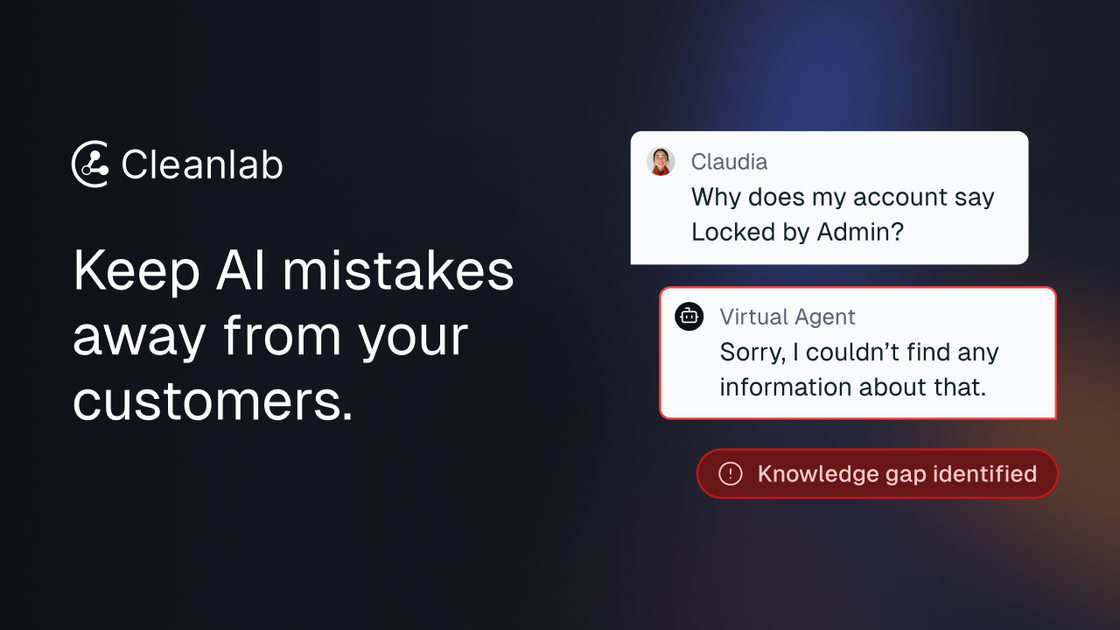
Cleanlab is a product for detecting and remediating incorrect AI responses before they reach users. The site positions it as a safety layer for AI agents, with tools for real-time detection and human review so teams can control accuracy, trust, and compliance in production.
The product is organized around two workflows: Detect, which scores responses and flags issues such as hallucinations, missing context, and knowledge gaps; and Remediate, which lets subject-matter experts provide approved answers, review failures, and trace problems back to the underlying LLM, retrieval, or data source. Cleanlab says it works with any AI system and knowledge base as an independent layer, and offers both VPC and SaaS deployment options.
Scores each AI response so teams can identify hallucinations, missing context, knowledge gaps, and policy issues before the output reaches a user.
Provides trustworthiness scores and clear explanations so systems can decide when to answer confidently or hand off to a human.
Lets subject-matter experts apply approved answers directly in production, without retraining or fine-tuning the model.
Groups recurring failures and highlights higher-impact issues using trust scores and user impact, which helps teams prioritize review.
Tracks prompts, flagged responses, and corrected responses so teams can monitor the health of AI applications over time.
Auto-generates checks for prompt adherence and can help separate LLM, retrieval, and data issues when failures occur.
Use Cleanlab to score every AI answer as it is generated, then block or route responses that look untrustworthy before users see them.
Use the remediation workflow when non-technical reviewers need to supply approved answers, correct repeated failures, and improve responses without engineering effort.
Use the prioritization and tracking tools to focus on recurring, high-impact issues and monitor how many responses are flagged or corrected.
Use the product when you need to distinguish whether a failure came from the model, retrieval, or source data, so the right team can fix it.
Use Cleanlab for customer support or employee-facing assistants where incorrect responses can affect user trust and require a smooth escalation path.
Cleanlab is designed to check AI responses in real time, flag likely hallucinations, missing context, and other issues, and route untrustworthy outputs to a human or fallback flow.
The source says Cleanlab works with any AI system and knowledge base as an independent layer, but it does not provide a detailed integration list or supported stack.
The source describes two main workflows: Detect for real-time scoring and guardrails, and Remediate for SME review, expert answers, and root-cause tracing.
Yes. The home page says Cleanlab offers deployment options in VPC for private cloud use and SaaS for managed access.