

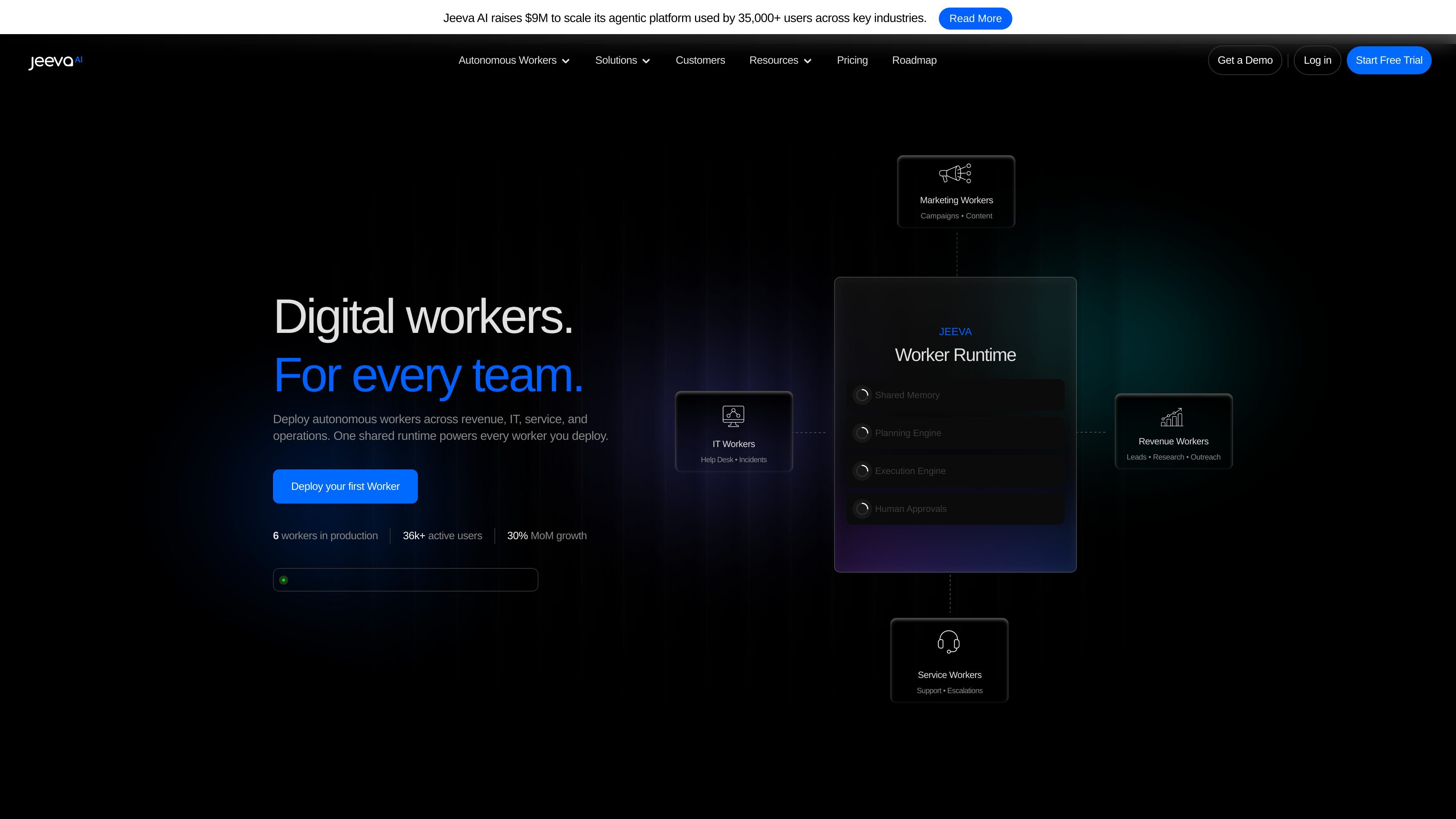
Shared worker runtime
Workers across business functions use a common runtime with shared memory, planning, execution, and support for human approvals.
Jeeva AI is a platform for building, deploying, and governing autonomous digital workers across business functions. Workers operate on a shared runtime with memory, planning, execution, and human approval capabilities. Unlike fixed workflow automation, the platform describes workers as systems that perceive, reason, act, and retain context while carrying out tasks.
Its examples span customer service, IT and operations, revenue, marketing, finance, security, and human resources. A worker can handle defined work continuously, while approval gates and escalation thresholds keep people involved where required. The website also presents a separate sales automation offering focused on prospecting and outreach.
Workers across business functions use a common runtime with shared memory, planning, execution, and support for human approvals.
Describe the work a digital worker should perform; the site says deployment can be initiated without code or node diagrams.
Workers can perform sequences of tasks, such as investigating and resolving support tickets, and escalate cases when policy thresholds are reached.
The platform presents worker activity with task counts, resolution or routing rates, and average task cost for example deployments.
The sales offering includes prospect discovery and enrichment, CRM deduplication, lead scoring, and automated multichannel outreach.
The pricing page lists SSO, compliance controls, private cloud or on-premises deployment, custom dashboards, and team support for Enterprise.
A customer service worker can find relevant knowledge and account records, draft a response, resolve tier-one or tier-two cases, and escalate according to policy.
IT workers can provision access, respond to incidents, and run onboarding playbooks; the site gives incident response as an example workflow.
A revenue worker can respond to opportunity-stage changes with enrichment, routing, account research, and follow-up tasks.
A finance worker can extract invoice line items, match invoices to approved purchase orders, and route exceptions for approval.
Sales teams can find and enrich prospects, prioritize contacts, and coordinate email and LinkedIn outreach with follow-ups.
The website describes first deployment as requiring no code: users describe the digital worker's task, and Jeeva orchestrates execution.
The platform is presented for revenue, IT, customer service, operations, marketing, finance, security, and human resources workflows.
Yes. Human approvals are part of the shared runtime, and example workers can escalate cases based on policy thresholds.
Yes. The pricing page lists a free plan for trying the platform, with core prospecting tools including email finding and verification, basic prospect search, a Chrome extension, and email templates.
The Enterprise plan lists private cloud or on-premises deployment as available.
流量數據僅供參考。

observe.ai
AI agents for customer service, frontline assistance, and contact center operations

mycelai.dev
Mycel is an AI operations agent for service firms that performs recurring client work, prepares drafts in connected tools, and pauses for approval before anything is sent or otherwise affects clients. It learns from corrections and supports workflows such as monthly close, accounts receivable, pipeline outreach, recruiting, security questionnaires, and contract review.