
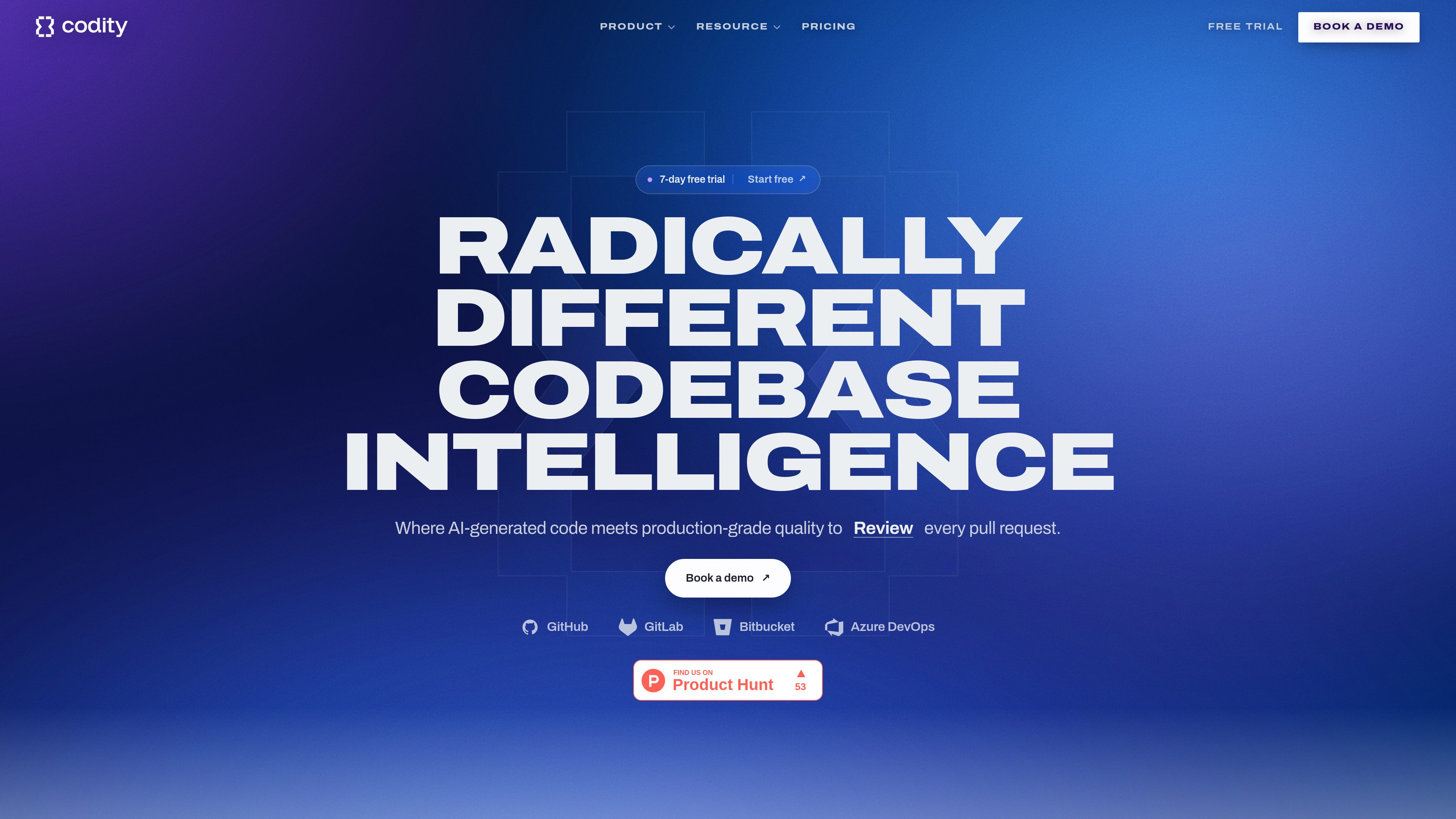
Context-aware pull request review
Reviews each PR against the wider repository context, then posts a plain-language summary, merge readiness signal, and inline findings directly on the pull request.
Codity 是一款 AI 程式碼審查平台,能讀取每個提取要求背後的完整程式碼庫脈絡。它協助工程團隊審查變更、掃描安全問題、梳理架構,並追蹤已連結 Git 服務提供者上的開發者分析資料。
Codity is an AI code review and repository intelligence platform for engineering teams that want review automation with broader codebase context. It connects to a Git provider, indexes repositories, and uses that context to review pull requests, surface security issues, map dependencies and architecture, and provide engineering analytics.
The product is positioned around reading more than the changed files in a pull request. Codity says it uses repository context, linked tickets, service dependencies, and connected repositories to produce inline feedback, severity-ranked findings, code navigation answers, and monitoring signals. It also offers CLI, plugin, dashboard, webhook, and API surfaces for local workflows and team automation.
Reviews each PR against the wider repository context, then posts a plain-language summary, merge readiness signal, and inline findings directly on the pull request.
Flags leaked secrets, vulnerable dependencies, injection risks, authentication gaps, and unsafe data handling during review, with findings explained in plain language and linked to the relevant file and line.
Builds a live architecture map so teams can search across connected repositories, trace dependencies, and ask questions about how services and components fit together.
Reports review latency, merge velocity, deployment trends, DORA-style metrics, and team or repository-level engineering insights.
Watches repositories for unusual code changes, quality regressions, and deployment-related signals so teams can notice issues before they become incidents.
Supports terminal workflows through a CLI, local assistance through a Claude Code plugin, and automation through a public API, with integrations for common developer platforms and collaboration tools.
Useful when a team wants automated review comments that go beyond syntax checks and consider the repository’s history, architecture, and linked requirements.
Fits teams that want to catch secrets, dependency risks, and unsafe patterns during the normal PR process instead of in a separate post-review gate.
Helps developers understand what depends on a service before changing it, especially when a change spans multiple repositories or branches.
Supports managers or platform teams that need visibility into review efficiency, throughput, DORA metrics, and bottlenecks across repositories.
Suits teams that want alerts and root-cause analysis tied to code changes, deployments, logs, metrics, and traces.
Codity connects to a Git provider, indexes repositories with context, and reviews pull requests automatically. It then summarizes changes, ranks findings by severity, and posts feedback inline when a PR opens.
The site says it checks for code quality issues, leaked secrets, vulnerable dependencies, injection risks, unsafe data handling, and authentication gaps.
Yes. Its code navigation feature maps services and dependencies across repositories and lets users ask questions in plain language about how the codebase fits together.
Yes. The product includes developer analytics such as review latency, throughput, merge velocity, deployment trends, and DORA-style metrics.
The pricing page lists Basic and Premium self-serve plans billed yearly, plus Codity One for teams that want the app with their own connectors and a custom annual agreement.
流量數據僅供參考。