
Unified model API
Access 500+ models through one base URL and API key, including models from Anthropic, OpenAI, Google, and other providers. The catalog provides model names, context windows, token prices, and provider information where available.

Hopscotch is a unified API for accessing 500+ AI models from providers including Anthropic, OpenAI, and Google. It helps developers and teams switch models, configure fallbacks, and control spending through shared keys, teammate limits, and workspace limits.
Hopscotch is an AI model gateway that gives developers and teams one API for 500+ models from Anthropic, OpenAI, Google, and other providers. It consolidates model access, billing through one balance, routing, request visibility, and spending controls in a single service.
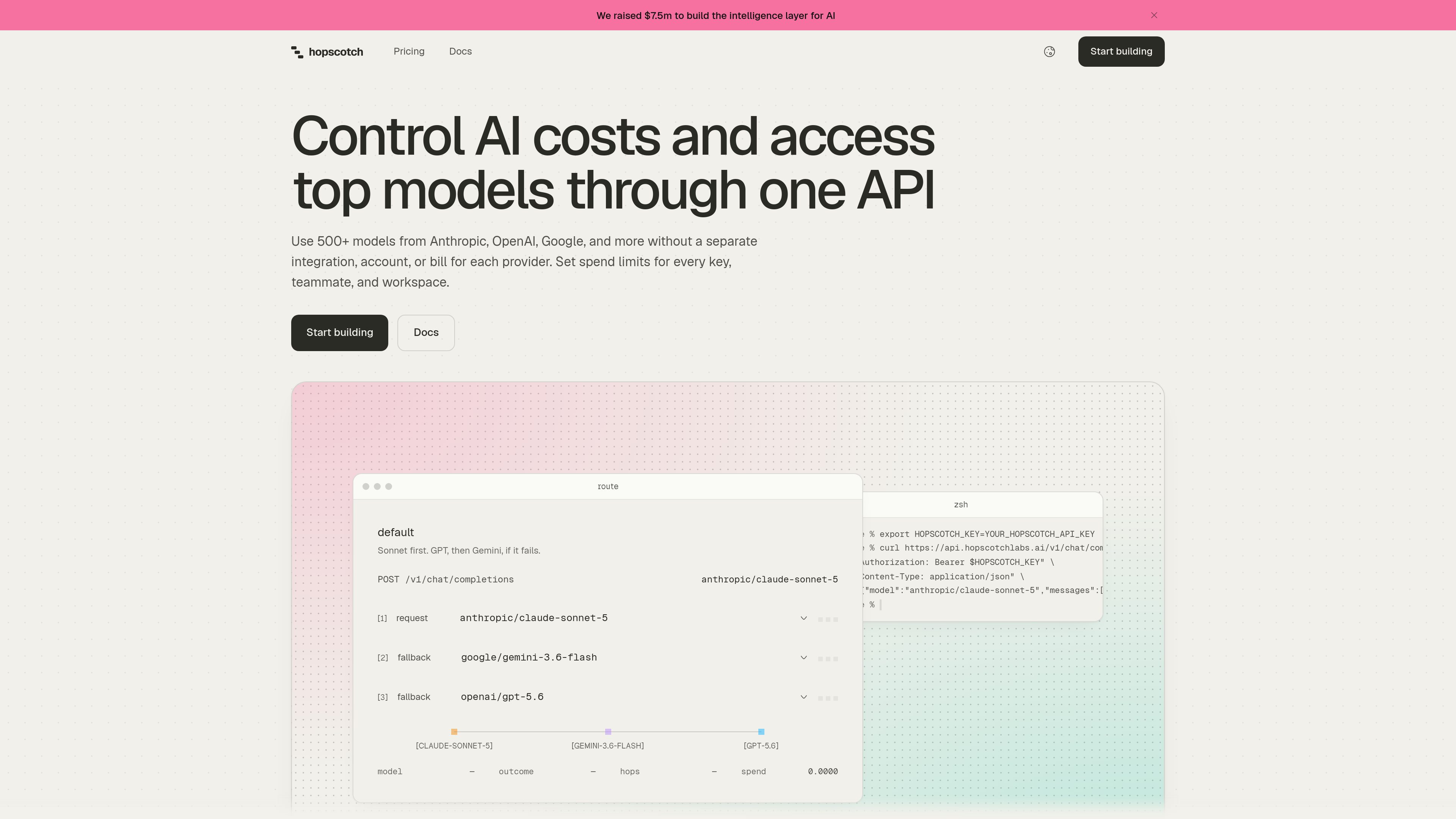
Applications can use an OpenAI-compatible setup by changing the base URL, API key, and provider-prefixed model name. Hopscotch supports chat completions, the Responses API, and a models endpoint. Users can request a named model directly, configure ordered fallback models, and review which provider handled each request.
The platform also supports operational controls for AI usage. Key-level limits can reset daily, weekly, or monthly, while teammates and workspaces can have monthly limits. Activity and Usage views provide request and cost details by model, provider, key, and teammate. Pricing is pay-as-you-go, with credit purchased in advance and provider list pricing applied to token usage.
Access 500+ models through one base URL and API key, including models from Anthropic, OpenAI, Google, and other providers. The catalog provides model names, context windows, token prices, and provider information where available.
Existing OpenAI SDK integrations can be pointed to Hopscotch by changing the base URL and key, then selecting a provider-prefixed model name. Chat completions, the Responses API, and a models endpoint are supported.
The model named in a request is the model Hopscotch runs. Users can switch models by changing one request parameter, while the Activity log identifies the provider that served the request.
Routing profiles let users specify backup models in a chosen order. Hopscotch retries failed requests and can move through the configured route; chat requests can also receive a final attempt through a backup provider.
Set daily, weekly, or monthly credit limits for individual keys, plus monthly limits for teammates and the workspace. Requests that would exceed a limit are refused before they reach the provider, and account spend rate can also be capped.
Activity logs record request status, provider, attempts, token counts, duration, and cost, with CSV export available. Usage reports break spending down by model, provider, key, and teammate; the playground compares up to three models on one prompt.
A team using the OpenAI SDK can route requests through Hopscotch by changing the base URL and API key, then evaluate models from multiple providers without installing a separate SDK for each one.
Developers can submit the same prompt to up to three models in the playground and compare their responses and billed costs before changing the model used in production code.
Teams can define an ordered set of backup models for a routing profile. When a provider request fails, Hopscotch retries and proceeds through the configured route, subject to the service's supported routing behavior.
Engineering or workspace administrators can issue separate keys, set reset-based limits, assign monthly teammate and workspace limits, and refuse requests that would cross those thresholds.
Teams can use Activity logs and Usage breakdowns to investigate request outcomes, identify the provider that served a model, review token and latency details, and export activity for further analysis.
Change the SDK base URL to https://api.hopscotchlabs.ai/v1, use a Hopscotch API key, and select a model name that includes its provider, such as anthropic/claude-sonnet-5. The rest of the OpenAI SDK request pattern can remain the same.
Yes. Change the model name in the request to another model in the catalog. The same key, balance, and limits remain in use.
No. Hopscotch runs the model named in the request. A different model is used only when you configure backup models in a routing profile and the request proceeds to a fallback.
Hopscotch retries the request. If a routing profile is configured, it then proceeds through the backup models in the order selected. For chat requests, the service describes a final attempt through a backup provider; if all attempts fail, the request returns an error.
The site states that some features providers run on their own servers, such as web search, audio, and hosted tools, are not supported through Hopscotch's provider accounts. The documentation lists the specific unsupported features.

wokey.ai
Wokey AI provides a single API key for models from providers including Anthropic, OpenAI, Moonshot AI and xAI, with compatible endpoints and locally verifiable response proofs.

edenai.co
A unified API for developers to access, compare, and route AI models across providers.

zro.moonmath.ai
Zro 是面向编码代理的私有推理端点,在欧盟基础设施上提供开放权重模型服务。支持兼容 OpenAI 和 Anthropic 的请求,并可通过启动器为多种编码工具完成设置。