
Browser-based calling
Agents make and receive calls through a WebRTC dialer in the web app, without desk phones or additional desktop software.

Open-source voice infrastructure for browser calling, call routing, recording, AI analysis, and voice bots.
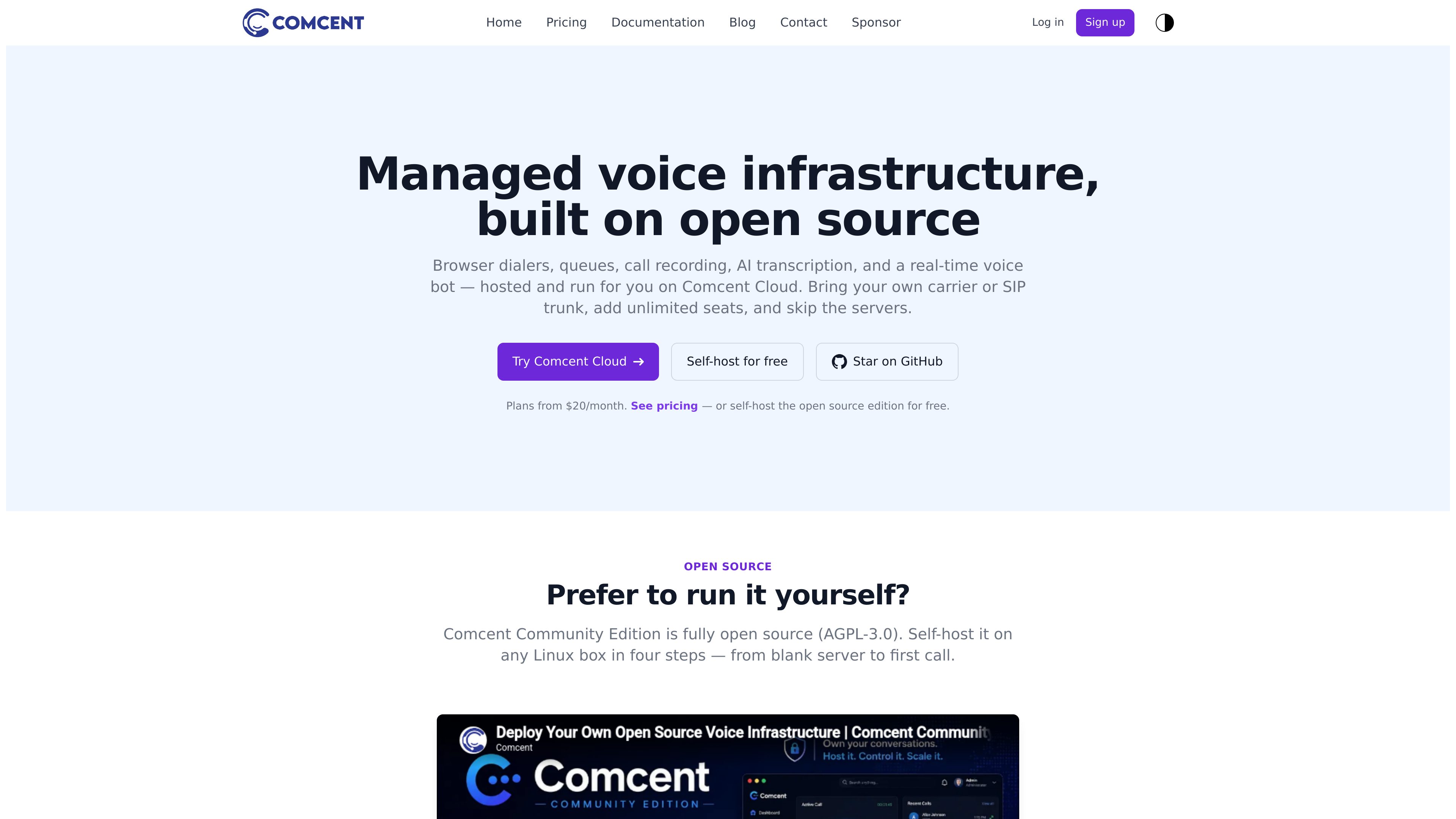
Comcent is open-source voice infrastructure for teams that need phone numbers, browser-based calling, queues, call routing, recording, and AI-assisted call analysis. It works with a SIP trunk or carrier that you provide, while Comcent handles signaling, media, routing, recording, and analysis. Teams can use Comcent Cloud as a managed service or run the Community Edition on their own Linux server.
Agents can make and receive calls through a WebRTC browser dialer, without desk phones or separate desktop software. Numbers can be connected to visual call flows that include menus, business hours, queues, and voice bots. The platform also provides call recording, speaker-labeled transcripts, summaries, sentiment, labels, semantic search, and graphical call analytics.
For self-hosted deployments, the Community Edition is AGPL-3.0 licensed and can be installed with Docker Compose. Self-hosted users provide their own storage and AI keys, while Comcent Cloud is hosted by Comcent.
Agents make and receive calls through a WebRTC dialer in the web app, without desk phones or additional desktop software.
Route inbound calls with configurable flowcharts containing menus, business hours, queues, and voice bots.
Record calls and add speaker-labeled transcripts, summaries, sentiment, labels, and semantic search through AI Insights.
Create real-time AI voice bots for automated tasks, frequently asked questions, and customer interactions.
Add browser calling to your own website with SIP.js and receive completed-call data through webhooks as vCon documents.
Enterprise adds per-organization metered usage and invoicing, GDPR workflows, tamper-evident audit logs, SLA tracking, outbound campaigns, and scheduled executive summaries.
Use the WebRTC browser dialer to make and receive calls, and route incoming calls through queues.
Connect existing phone numbers and a SIP trunk to visual flows that direct callers through menus, business hours, queues, or voice bots.
Use recordings, diarized transcripts, summaries, sentiment, labels, and semantic search to review calls and locate specific interactions.
Run the Community Edition on a Linux server with Docker Compose, your own storage, and your own Deepgram and OpenAI API keys.
Use organization-level metering, invoicing, audit trails, compliance workflows, SLA reporting, and outbound campaigns for larger deployments.
You bring your own carrier or SIP trunk. The documentation names Twilio, Telnyx, and Bandwidth as examples, and Comcent handles signaling, media, routing, recording, and analysis on top of that connection.
Yes. The Community Edition is free and AGPL-3.0 licensed. The documented installation uses a Linux server with a public IP, DNS, open SIP and web ports, and Docker Compose. You configure your domain, storage, and SIP trunk during setup.
AI Insights can provide transcription, speaker identification, call summaries, sentiment, labels, and searchable transcripts. Self-hosted installations use the operator's own storage and AI keys.
Comcent Cloud is hosted and managed by Comcent. Self-hosting runs the Community Edition on your own Linux server and lets you choose when to update it. Both models use your own SIP trunk. Starter AI Insights is pay-as-you-go; Team includes 3,000 AI minutes per month and Scale includes 10,000, with additional usage charged separately.
Enterprise runs on your own servers and adds commercial licensing and support, plus billing and metered usage, GDPR workflows, audit logs, SLA tracking, outbound campaigns, and scheduled executive summaries.

glama.ai
Glama is a registry and infrastructure platform for discovering, evaluating, and connecting to Model Context Protocol (MCP) servers, connectors, clients, and tools. It supports browsing open-source and remote MCP entries, with hosted access and gateway features described on the site.

www.pipecat.ai
Pipecat is an open-source Python framework and ecosystem for building real-time voice and multimodal AI agents. It helps developers compose pipelines that coordinate speech, language, vision, video, text, tools, and telephony transports.

phonic.ai
Speech-to-speech voice agent infrastructure for teams building phone and audio workflows.

theagentrouter.ai
Agent Router is an open-source Go project for managing unified access to generative AI services through Envoy Gateway. It is intended for teams that want a gateway-based control point for AI service traffic and related agent or MCP workloads.

www.getzep.com
Graphiti is an open-source GitHub project for building real-time knowledge graphs for AI agents. It provides a codebase that developers can inspect, extend, and contribute to through the repository’s development workflow.