
Input attribution algorithms
Apply Integrated Gradients, DeepLIFT, GradientShap, Occlusion, LRP, or LIME to examine how input features contribute to a selected model output.

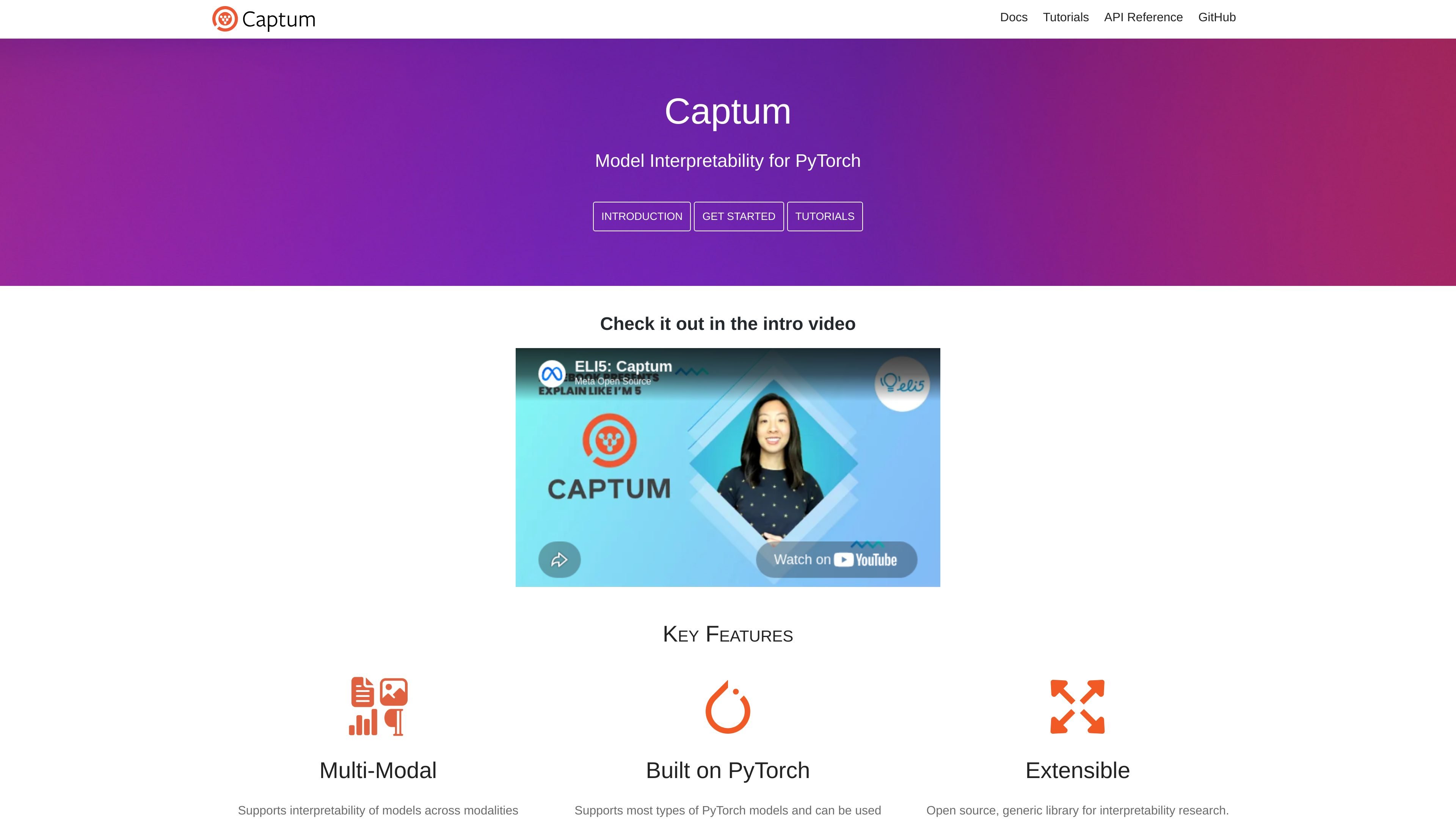
An open source PyTorch library for developers and researchers interpreting model outputs.
Captum is an open source, extensible library for model interpretability built on PyTorch. It helps developers and researchers examine which input features contribute to a model’s output and investigate how internal layers and neurons affect predictions.
The library supports most types of PyTorch models with minimal modification to the original network. Its algorithms and tutorials cover vision, text, tabular data, and multimodal models, providing a practical foundation for troubleshooting predictions and researching interpretability methods.
Apply Integrated Gradients, DeepLIFT, GradientShap, Occlusion, LRP, or LIME to examine how input features contribute to a selected model output.
Use conductance and internal attribution methods to investigate layer and neuron importance, including the input features associated with a particular neuron.
Interpret text generation with LLM attribution functionality. For multimodal LLMs, combine ImageMaskInput, image segmentation, and FeatureAblation to examine image regions contributing to generated text.
Explore concepts with Testing with Concept Activation Vectors (TCAV). Tutorials also demonstrate FGSM and PGD attacks and robustness metrics alongside attribution algorithms.
Implement new interpretability algorithms and benchmark them against methods available in the library. Tutorials demonstrate distributed attribution using torch.distributed and DataParallel.
Inspect influential words in sentiment predictions or image regions in vision models to investigate unexpected outputs.
Evaluate feature importance and internal attribution in a house price regression network to understand how the network uses its inputs.
Examine sparse and dense feature contributions in Deep Learning Recommender Models, including feature interactions involved in clicked and non-clicked ad predictions.
Study BERT embeddings, attention layers, and token interactions to understand a particular answer prediction.
Install with `conda install captum -c pytorch`, the website’s recommended method, or use `pip install captum`.
The tutorials assume familiarity with PyTorch and its basic features. The introductory Captum tutorial trains a neural network on Titanic survival data, then examines input, layer, and neuron importance.
The homepage example passes input and baseline tensors to an IntegratedGradients instance, selects a target output, and returns attribution scores. With return_convergence_delta=True, it also returns a convergence delta.
流量数据仅供参考。
| 5月 | 14880 |
|---|---|
| 6月 | 14494 |
| 7月 | 11580 |
暂无流量分析数据。

clipsai.com
Clips AI 是面向开发者的开源 Python 库,可基于视频转录文本识别片段并制作短视频,还能跟随当前说话者动态裁切,适配 9:16 等画面比例,适用于播客、访谈和演讲等以口述内容为主的视频。

harnessmanager.devmesh.xyz
Harness Manager 是一款免费开源的原生 Mac 工作区,用于管理 AI 编程工具、MCP 服务器、技能、更新和模型比较。

payloadcms.com
面向开发者和内容团队的开源 Next.js CMS 与应用框架,基于 TypeScript 构建。

weaveos.com
Weave Router 是面向编程代理的智能模型路由器,可评估编码任务并在开源与闭源模型之间分配请求,帮助开发者沿用现有代理工作流,同时兼顾速度、质量与模型成本。

apipark.com
开源企业级 API 开发者门户与 AI 网关,管理 API 和生产环境 LLM

cortexdocs.dev
开源 API 工具工作流:将 API 规范和 Markdown 转化为交互式文档、类型化 SDK 与 MCP 服务器,统一服务开发者、应用和 AI 代理。