
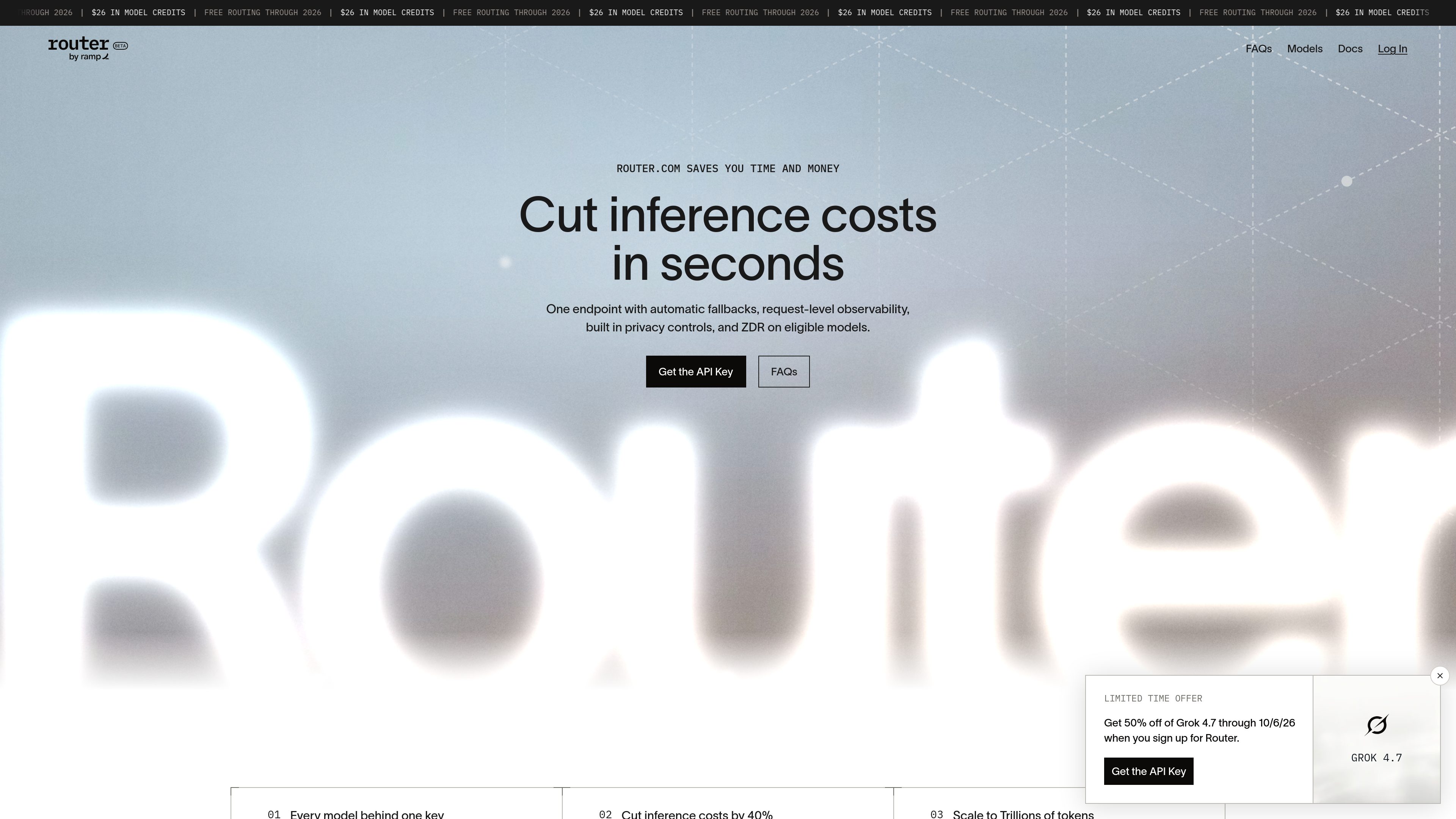
Single endpoint for multiple providers
Use one Router endpoint to access supported models from providers including OpenAI, Anthropic, and select open-source providers, reducing the need for separate provider integrations.

Router by Ramp is an LLM gateway that gives applications one API endpoint for accessing models from multiple providers. It routes eligible requests based on cost, quality, and availability while providing usage and spend visibility.
Router by Ramp is an LLM gateway that provides one API endpoint for accessing multiple AI models and providers. Applications send requests to Router rather than integrating separately with each provider, helping teams change models without changing their core integration.
Router evaluates eligible requests using cost, quality, and availability considerations. It can route requests to a lower-cost model tier when the expected quality impact is acceptable, and it can fall back to another available model when a provider has an outage or rate limit. The service also records request-level information such as usage, model, provider, and cost.
The product supports OpenAI- and Anthropic-compatible APIs, includes documentation for model selection and routing strategies, and offers a model directory with published pricing, context windows, and capability information. It is positioned for individual developers and U.S.-based teams that need to operate across multiple models.
Use one Router endpoint to access supported models from providers including OpenAI, Anthropic, and select open-source providers, reducing the need for separate provider integrations.
Router can move eligible requests to a more cost-efficient model tier when it determines that the change should not affect quality, helping teams manage inference spend.
Requests can be routed to another available model when a provider is unavailable or applies rate limits, providing an alternative path for eligible workloads.
Router tracks the usage, selected model, provider, and cost associated with requests. Its dashboard exposes keys, usage, and spend for the account.
The API is compatible with OpenAI and Anthropic interfaces. Existing compatible SDK integrations can generally be switched by updating the base URL to Router’s endpoint.
The model directory lists published pricing, context windows, release information, and capabilities. Documentation covers fallbacks, spend controls, coding-agent routing, model comparison, and caching repeated work.
A developer can connect an application to Router once and evaluate or use models from several supported providers through the same endpoint, rather than maintaining a separate provider connection for each model.
Teams with recurring or high-volume model traffic can use cost-aware routing to send suitable requests to lower-cost tiers while retaining access to more capable models for workloads that need them.
Teams can configure or use eligible fallbacks so requests have another model option when a provider experiences an outage or rate limit.
Engineering and finance stakeholders can inspect request usage, model selection, provider, and cost, while using the model directory to compare published pricing and context limits.
Developers already using OpenAI or Anthropic SDKs, or another compatible framework, can test Router by changing the API base URL instead of rewriting the application’s model-calling layer.
It is an LLM router and gateway that provides one endpoint for accessing multiple AI models. Router can choose among eligible models based on quality, cost, and availability.
Usually not if the application uses an OpenAI- or Anthropic-compatible SDK or framework. Router’s documented migration approach is to update the base URL to its endpoint.
Router supports current models from OpenAI, Anthropic, and other providers, including select open-source models such as Kimi. The model directory provides the current documented catalog and model details.
For eligible requests, Router can route to another available model when a provider is down or rate-limits the request. Fallback behavior and configuration are covered in the Router documentation.
Router states that routing is free through 2026. Users pay list price for the tokens they use, and the first $26 in credits are offered at no charge subject to the offer terms. The pricing page currently does not provide additional plan details.
流量数据仅供参考。

docs.litellm.ai
通过兼容 OpenAI 的 Python SDK 或代理调用和管理 100 多种 LLM。
aimlapi.com
AIMLAPI provides one API and billing key for accessing a catalog of AI models for chat, reasoning, image, video, audio, voice, search, embeddings, code, and related tasks. It is intended for developers and teams that want to compare and use models from multiple providers through a common platform.

zenmux.ai
面向企业的 LLM 平台,提供统一多模型 API 与智能路由

www.newapi.ai
New API is an open-source, self-hosted AI gateway for developers and teams. It provides a unified OpenAI-compatible endpoint for connecting multiple AI providers, selecting models, configuring channels, and monitoring usage on their own infrastructure.

cometapi.com
CometAPI is a unified, OpenAI-compatible API layer for accessing more than 500 text, image, video, and audio models through one key. It helps developers and teams compare models, centralize billing, and switch providers without maintaining separate vendor integrations.

vercel.com
Vercel AI Gateway gives developers one API surface for hundreds of text, image, video, and audio models across multiple providers. It centralizes model access, routing, fallback, billing, and observability while supporting AI SDK, OpenAI, and Anthropic workflows.