
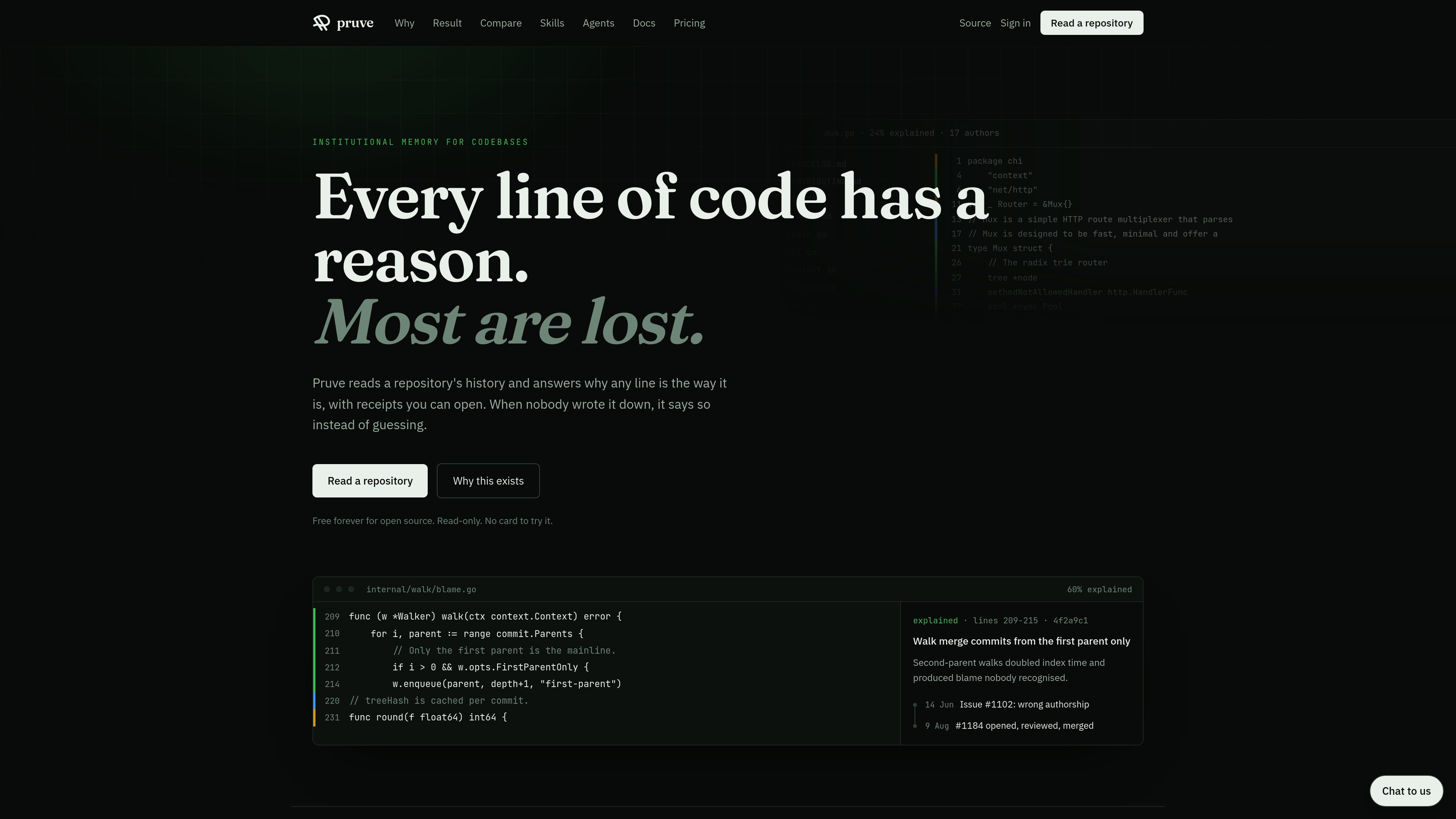
Line-level explanations with receipts
Pruve answers questions about specific lines by tracing them back to the changes and discussions that wrote them. The result is a clickable chain of evidence rather than a speculative summary.

Pruve 会读取代码仓库的历史记录,解释特定代码行为何如此编写,并提供可打开查看的依据。它为开发者、产品经理和 AI 智能体提供来自 GitHub 或 GitLab 仓库的只读上下文。
Pruve is a read-only product for exploring why code exists the way it does. It reads a repository’s history and ties individual lines back to the change that introduced them, so you can open the supporting discussion, commit, review thread, or agent session instead of relying on guesswork.
The product is built around evidence. When a line can be explained, Pruve shows the receipts behind it; when it cannot, it says so plainly. That makes it useful for understanding unusual constants, merge decisions, undocumented behavior, and other code that is hard to interpret from the source alone.
Pruve answers questions about specific lines by tracing them back to the changes and discussions that wrote them. The result is a clickable chain of evidence rather than a speculative summary.
It classifies changes as explained, described, or undocumented, then surfaces that coverage in dashboards, file trees, and the code gutter so readers can see which parts of a codebase have recorded reasoning.
Indexing can pull from commit messages, pull request bodies, review comments, linked issues, and agent sessions, which lets the product preserve the discussion around a change, not just the diff.
Pruve reads repository history and file contents without writing back to the code host. The only optional write action mentioned is a PR check run for the documentation gate.
The product exposes read-only MCP tools so agents can inspect reasoning before editing code. This is meant to let automated workflows ask “why” before making a change.
Teams can optionally fail pull requests that have no recorded reasoning anywhere, turning missing context into an explicit review signal.
A developer can click a line, see the change that introduced it, and read the discussion that explains why it was added instead of reverse-engineering the intent from the implementation.
When a merge commit drops discussion context, Pruve can surface the issue, benchmark, review comment, or agent session that explains why a choice was made.
Teams can scan a codebase to see which files or folders have recorded reasoning and which areas are still undocumented, making gaps visible before they become maintenance problems.
An AI agent can use MCP tools to inspect receipts before editing code, helping it avoid changes based on invented rationale.
Teams that want explicit evidence for pull requests can use the documentation gate to flag changes that lack recorded reasoning.
No. The product is read-only. The documentation says it does not push code, comments, or branches. The only write-related action mentioned is an optional PR check run for the documentation gate.
It indexes repository history and related discussion, including commits, pull requests, review threads, issues, and agent sessions when they are available.
It says so rather than guessing. The product is designed to report what it searched and stop if there is no evidence.
Coverage is counted as explained, described, or undocumented changes. Those counts are used in the product’s dashboards and line gutters.
Yes. The pricing page says open source is free forever, with free and unmetered read-only access for receipts.
流量数据仅供参考。

refraction.dev
面向开发者的 AI 代码生成工具,支持重构、文档、测试、查错与代码转换

onorca.dev
Orca 是用于借助编码代理交付产品的智能体开发环境,支持在隔离工作树中并行运行多个 CLI 代理,并提供桌面端和移动端协同工作流。

blopai.com
编写、运行、聚类并修复浏览器测试的 QA 代理

rlama.dev
本地 AI 平台,用于构建 RAG 系统和智能代理

kastra.ai
Kastra 是面向 AI 系统的授权基础设施,可在提示词、工具调用、Shell 命令、API 请求和浏览器操作执行前进行检查,帮助团队执行策略、保留签名审计记录,并治理本地及企业级 AI 工作流。

aakar-ai.dev
在一个仪表板中管理 AI 供应商、项目配置、日志和分析,支持 BYOK 工作流。