
Broad model catalog and model customization
Access foundational, open, reasoning, multimodal, and industry-specific models from providers listed by Microsoft, then train, fine-tune, distill, or upgrade models with minimal coding.

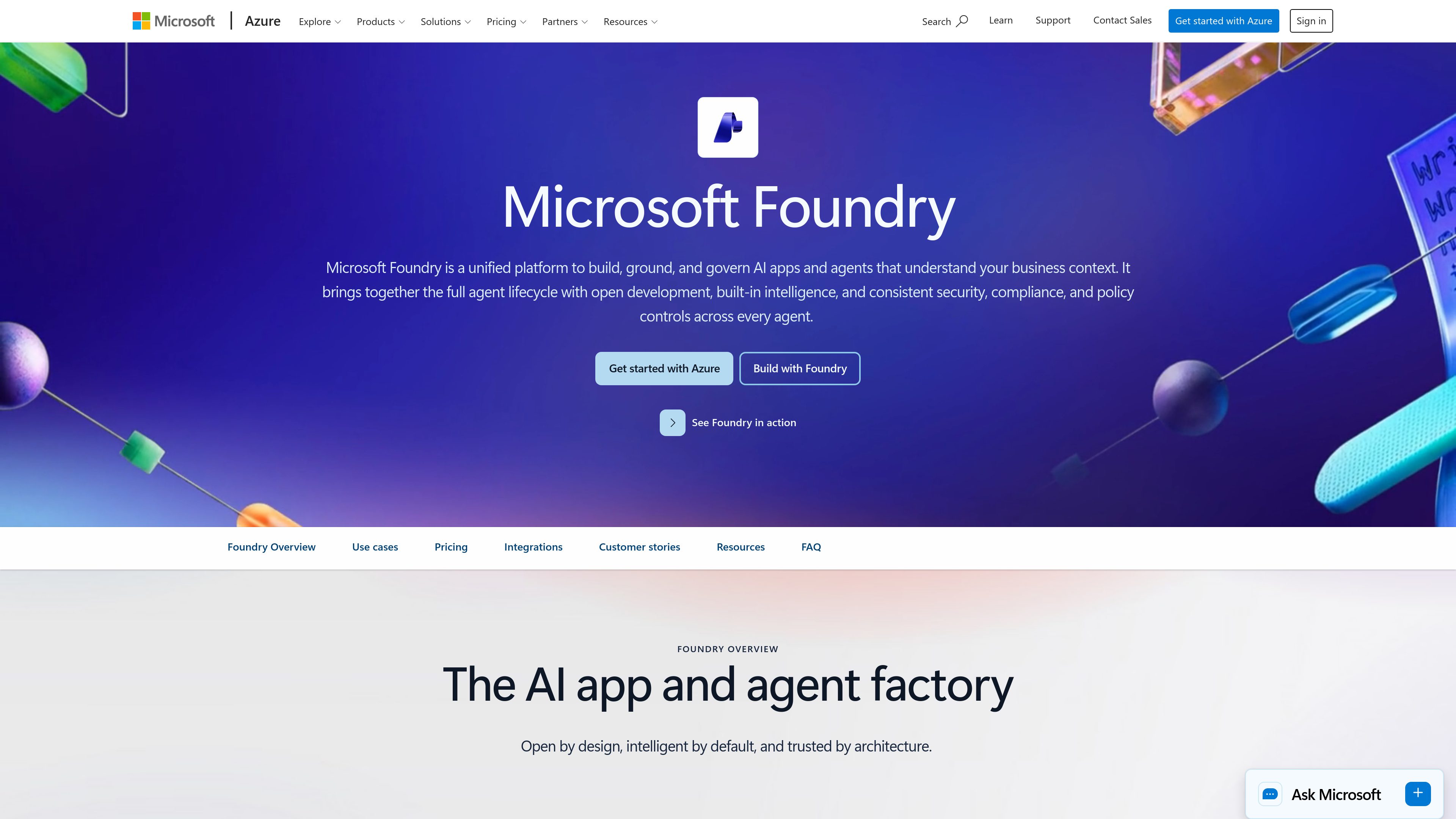
Microsoft Foundry is an enterprise AI platform for building, grounding, deploying, and governing AI applications and agents. It helps development and data teams connect models, organizational knowledge, business tools, and lifecycle controls in Azure.
Microsoft Foundry is an enterprise AI platform for building, grounding, deploying, and governing AI applications and agents. It combines model access and customization, agent development, organizational knowledge, business tools, observability, and trust controls in a unified Azure environment.
The platform is designed for development and data teams creating AI-driven, cloud-native applications. Teams can choose from a broad model catalog, build agents with Foundry Agent Service or the open-source Microsoft Agent Framework, connect agents to organizational and business-system context, and manage production behavior through monitoring and governance capabilities.
Foundry pricing is consumption-based across the services and features used. Each service has its own billing model and price, so the total cost depends on the selected capabilities and usage.
Access foundational, open, reasoning, multimodal, and industry-specific models from providers listed by Microsoft, then train, fine-tune, distill, or upgrade models with minimal coding.
Use intelligent model routing to select a model for a particular task and optimize performance or cost without rewriting the application.
Build action-oriented, context-aware agents with Foundry Agent Service and use the open-source Microsoft Agent Framework to create, orchestrate, and extend agent applications. Foundry also supports serverless containers and event-driven functions for hosting and scaling.
Ground agents in organizational intelligence with permission-aware grounding and Microsoft Graph integration. Connect workflows to business systems through more than 1,400 prebuilt connections, including SAP, Salesforce, and Dynamics 365, or add custom tools through Model Context Protocol.
Trace agent interactions in production with OpenTelemetry-based tooling and evaluate applications using built-in measures for coherence, relevance, groundedness, and safety.
Manage agents, tools, and knowledge sources through a control plane integrated with Microsoft Entra, Purview, and Defender. Runtime controls can help simulate, detect, and mitigate prompt attacks, hallucinations, and sensitive-data leakage.
Create agents that perform specific, action-oriented tasks across connected business systems while retaining human control over the workflow.
Combine permission-aware organizational context, Microsoft Graph, and business data so applications can reason using relevant organizational signals rather than relying only on a general model.
Use model choice, routing, agent frameworks, prebuilt tools, and Azure services to add AI capabilities to new or existing cloud-native applications.
Trace interactions, evaluate response quality and safety, and apply runtime trust controls as agent applications move from development into ongoing use.
Combine customizable tools such as OCR, translation, speech, and object detection with agents or applications to automate information-processing workflows.
It is used to build, ground, deploy, monitor, and govern AI applications and agents. Common workflows include business-process automation, data and document processing, application modernization, and adding AI capabilities to cloud-native applications.
Yes. Microsoft describes Foundry Models as a catalog spanning foundational, open, reasoning, multimodal, and industry-specific models, including models from providers such as OpenAI, Anthropic, Meta, Google, xAI, and Hugging Face.
Agents can use permission-aware grounding, Microsoft Graph integration, Microsoft IQ, Foundry IQ, and Fabric IQ. They can also connect to business systems through prebuilt connections, use customizable tools, or access custom APIs through Model Context Protocol.
Its control-plane capabilities include OpenTelemetry-based tracing, evaluators for coherence, relevance, groundedness, and safety, and runtime controls intended to help detect and mitigate prompt attacks, hallucinations, and sensitive-data leakage.
Pricing is consumption-based and depends on the individual Foundry services and features used. Each service has its own billing model and price; Microsoft provides pricing estimates, a pricing calculator, and sales support for quotes.

www.ibm.com
IBM watsonx.ai is an enterprise AI development studio for building predictive, prescriptive, and generative AI solutions. It supports AI builders, data scientists, and developers across model development, customization, retrieval-augmented generation, deployment, and lifecycle management.

cloud.google.com
Gemini Enterprise Agent Platform, formerly Vertex AI, is Google Cloud’s platform for developers and technical teams to build, deploy, govern, and optimize AI agents, generative AI applications, and machine learning models.

together.ai
Together AI 是一个支持推理、微调、GPU 集群、沙盒和托管存储的 AI 云平台。

aws.amazon.com
Amazon Bedrock is a fully managed AWS platform for building generative AI applications and agents with access to foundation models, customization tools, safety controls, and production-oriented workflows. It supports teams that want to experiment through the console or build applications through AWS APIs and SDKs.
www.bentoml.com
Bento is an inference platform for packaging, deploying, optimizing, and operating AI and machine-learning models at scale. It supports open and custom models across cloud, on-premises, Kubernetes, and bring-your-own-cloud environments.

prodia.com
Prodia is a multi-silicon inference platform focused on video generation. It develops AI model implementations across different hardware to balance cost, output quality, and performance.