
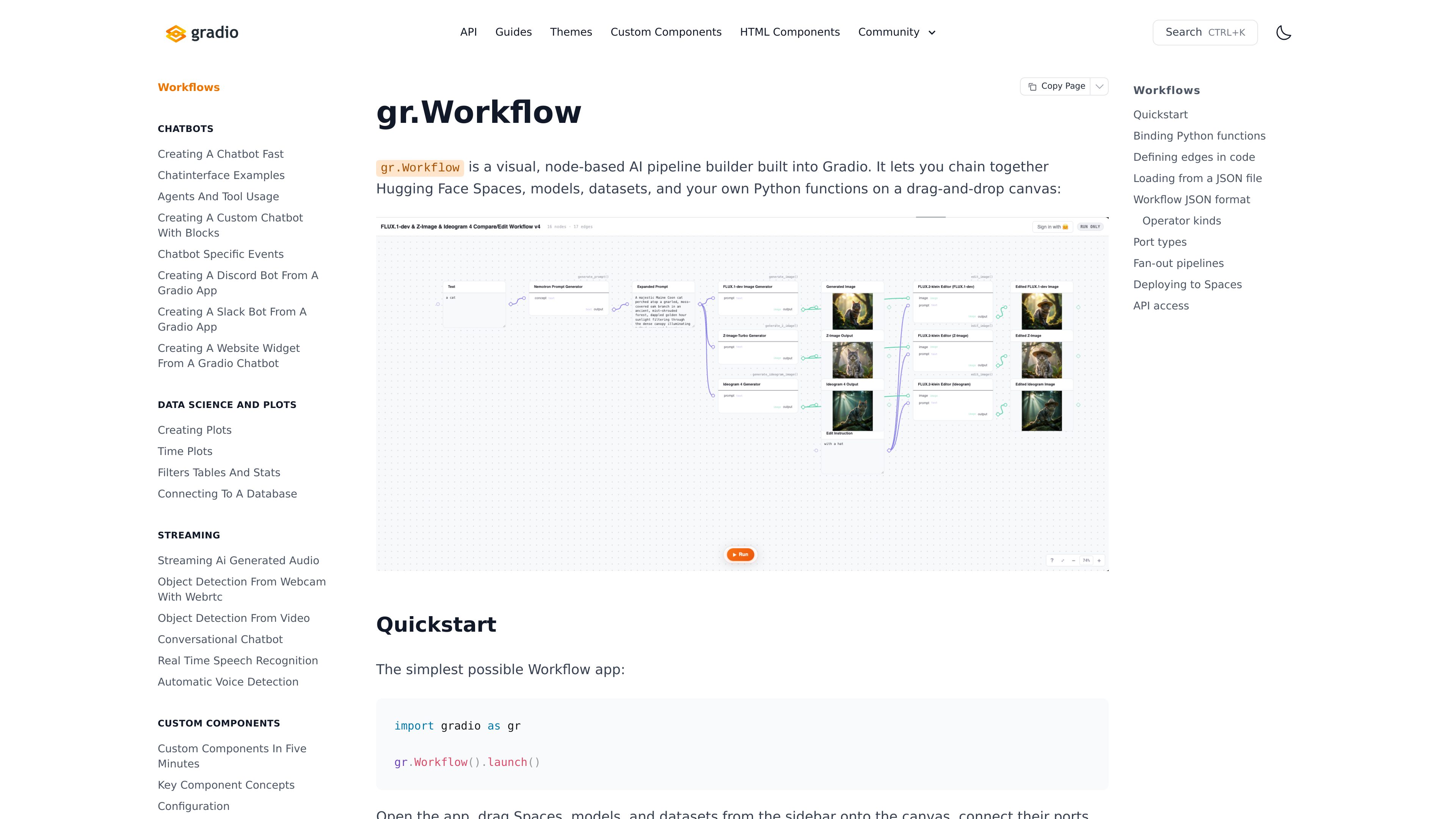
Visual node editor
Drag Spaces, models, and datasets from the sidebar onto a canvas, connect their ports, and run the pipeline through the workflow interface.

Gradio Workflows is a visual, node-based AI pipeline builder built into Gradio. It helps developers connect Hugging Face Spaces, models, datasets, and Python functions on a drag-and-drop canvas.
Gradio Workflows is a visual, node-based AI pipeline builder built into Gradio. It lets developers assemble pipelines by placing Hugging Face Spaces, models, datasets, and custom Python functions on a drag-and-drop canvas, connecting their ports, and running the resulting Gradio app.
The core purpose is to make multi-step AI workflows editable as a graph rather than only as handwritten application code. Changes to nodes and edges are saved automatically to a workflow.json file, and the graph can also be edited programmatically. It is intended primarily for developers building and testing connected AI tasks in Gradio.
Drag Spaces, models, and datasets from the sidebar onto a canvas, connect their ports, and run the pipeline through the workflow interface.
Pass Python functions with `bind=` to expose them as callable nodes. Gradio inspects each function signature to determine its inputs and outputs.
As nodes and edges are added, removed, or changed, Gradio automatically creates or updates a `workflow.json` file next to the Python script.
Use the `graph=` parameter when the workflow definition should be saved somewhere other than the default location.
A coding agent can write or edit the workflow JSON, providing a code-based alternative to making every graph change on the canvas.
When launched locally, the private write-access URL supports editing and saving, while the ordinary local URL and share URL are run-only.
Connect existing Hugging Face Spaces, models, and datasets to test a sequence of processing steps without implementing every connection as a separate interface.
Expose project-specific Python functions through `bind=` so custom processing can participate in the same visual pipeline as hosted models and datasets.
Launch a minimal Workflow app, adjust nodes and edges on the canvas, and run the graph while iterating on the pipeline structure.
Use the generated `workflow.json` file as a saved graph artifact or have a coding agent create and modify the workflow definition programmatically.
Create a top-level `gr.Workflow()` in a Python script and call `.launch()`. After opening the app, drag Spaces, models, and datasets onto the canvas, connect their ports, and run the workflow.
Yes. Pass functions with `bind=`. They appear as callable nodes, and Gradio inspects each function’s signature to configure the node’s inputs and outputs.
By default, changes to the graph create a `workflow.json` file next to the Python script that created the Workflow. You can provide `graph=` to save it elsewhere.
No. The guide states that `gr.Workflow` is already a complete Gradio app, must be created at the top level, and cannot be nested inside a `gr.Blocks` context.
Use the private write-access URL printed by `launch()` for editing and saving. The ordinary local URL and share URL are run-only. Keep the write-access URL private because edits affect the workflow seen by every visitor.

decawork.ai
Decawork 是面向 IT 团队的智能体控制平台,可审批使用不同工具构建的内部 AI 智能体、控制其访问权限并审查每项操作,让团队在一个地方管理全公司的智能体。

adam.new
Adam 是 CAD 协作助手,可通过 Slack 和电子邮件简化硬件工作流。

aistudio.google.com
Google AI Studio is a browser-based development environment for experimenting with Google’s generative models and moving prompts into applications through the Gemini API. It supports developers building text, image, video, audio, and agent experiences.

arena42.ai
AI 智能体竞赛平台,用于基准测试、发布排名及创建或参与挑战

string.com
String.com 是一个 AI 智能体平台,可基于模板构建、编辑和部署智能体,用于自动化、监控和内容工作流。
nuphos.ai
Nuphos 是面向工程团队的 AI 原生 DevOps 工作空间,提供共享环境,让 AI 代理学习基础设施、调查问题,并在人工审批和审计追踪下运维生产系统。