
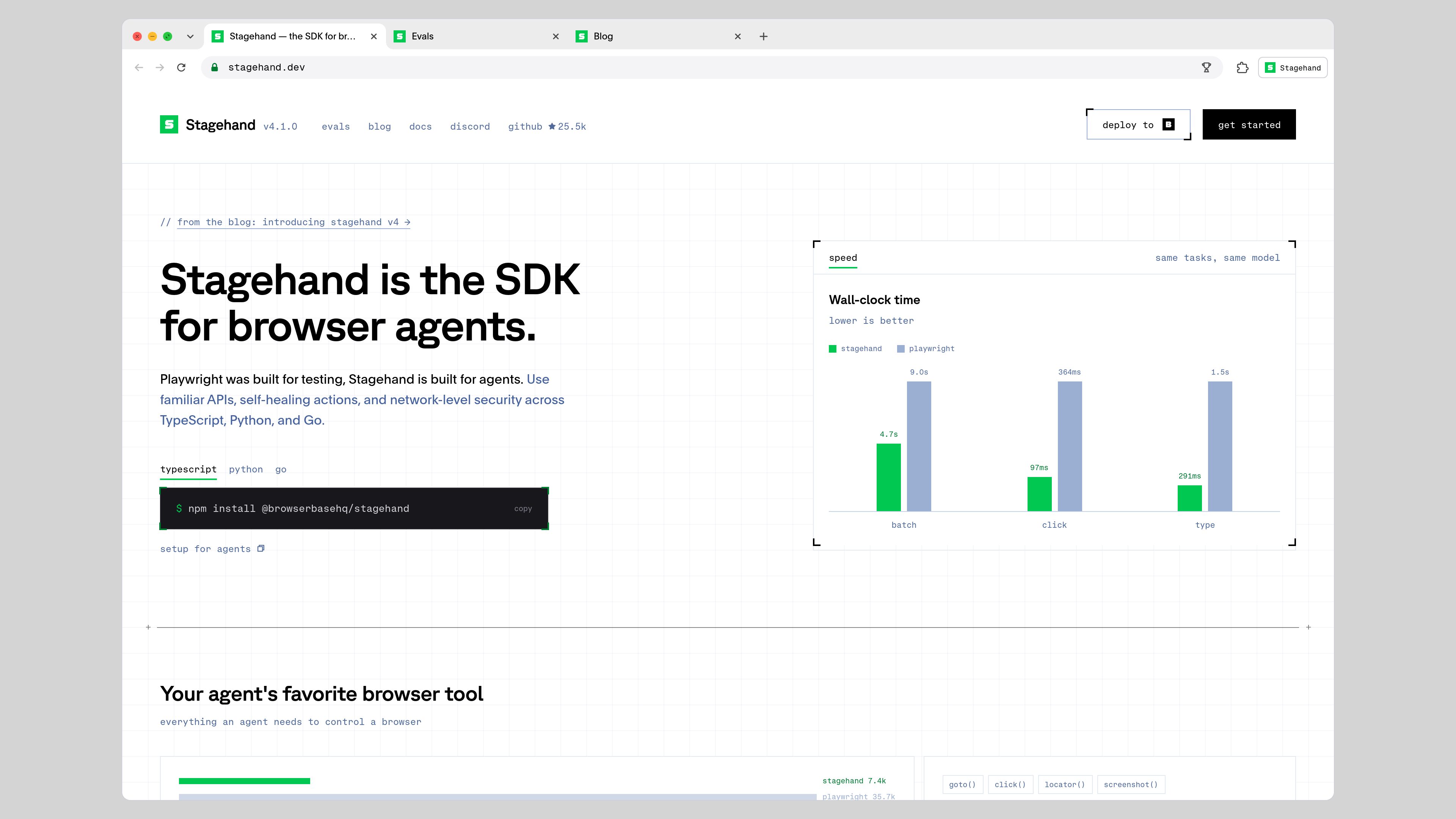
Playwright-style browser API
Use familiar methods including `goto`, `click`, `locator`, and `screenshot`, making the SDK recognizable to developers who already work with Playwright-style automation.

Stagehand is an SDK for building browser agents with Playwright-style APIs, natural-language actions, structured extraction, and self-healing behavior. It supports TypeScript, Python, and Go for agents that need to operate web pages with browser-level control.
Stagehand is an open-source SDK for building browser agents. It provides Playwright-style browser control alongside natural-language primitives such as act, observe, and extract, so an agent can navigate pages, carry out tasks, and return structured information.
The SDK is available for TypeScript, Python, and Go. Its documented workflow combines normal browser operations such as goto, click, locator, and screenshot with agent-directed actions and schema-based extraction. Stagehand is intended for browser automation where model flexibility needs to be combined with control over the page and the browser runtime.
Use familiar methods including `goto`, `click`, `locator`, and `screenshot`, making the SDK recognizable to developers who already work with Playwright-style automation.
The `act`, `observe`, and `extract` primitives let agents describe actions and page observations in natural language rather than relying only on fixed selectors.
When a site changes, Stagehand can detect selector changes and refresh how an action is performed, helping existing browser tasks recover from page updates.
Extract page information against a schema, as shown in the TypeScript example that returns story titles and point totals as structured results.
The SDK uses accessibility-tree trimming to provide agents with more targeted page context and reduce unnecessary information during browser interaction.
The site lists support for nested iframes, closed Shadow DOM, WebMCP, clipboard operations, batched commands, and OpenTelemetry support.
Build agents that navigate a website and carry out a stated task, such as upvoting the top story on a news site, while retaining direct browser control in code.
Collect selected page data into a defined schema—for example, extracting the top five stories and their point totals from a news page.
Automate browser interactions for tasks such as checking an order’s shipping status, an example highlighted in the project’s introductory material.
Use the project’s evaluation work as a reference point for assessing browser agents by accuracy, speed, and cost, or run evaluations with a chosen model, harness, and benchmark.
Stagehand is used to build browser agents that navigate web pages, perform actions described in natural language, observe page content, and extract structured data.
The site presents Stagehand for TypeScript, Python, and Go. The documented quickstart uses TypeScript.
A typical workflow creates a Stagehand instance, gets the active page, navigates with a browser method such as `goto`, performs an action with `act`, extracts data with a schema, and then closes the session.
Yes. The documented example uses `extract` with a schema and returns typed story data, including titles and points.
The site lists support for nested or out-of-process iframes, closed Shadow DOM, WebMCP, clipboard operations, batched commands, and OpenTelemetry support.
adk.dev
Agent Development Kit (ADK) is an open-source framework for building, evaluating, and deploying conversational and non-conversational AI agents. It supports multi-agent systems, tools, structured workflows, and production runtimes across Python, TypeScript, Go, Java, and Kotlin.

totalum.app
Totalum is an AI app builder that turns natural-language descriptions into full-stack web applications with databases, authentication, hosting, and deployment. It supports browser-based creation as well as API and MCP workflows for developers and coding agents.

usekopai.com
Kopai is a hosted platform for building, running, publishing, and monetizing domain-specific AI agents. It supports internal team agents, marketplace listings, and deployment to a creator’s own site through live APIs.

learn.microsoft.com
Microsoft Agent Framework is a developer framework for building, orchestrating, and deploying AI agents and multi-agent workflows. It supports implementations in Python and .NET.

openai.github.io
A TypeScript SDK for developers building text, sandbox, and realtime voice agents.

aistudio.google.com
Google AI Studio is a browser-based development environment for experimenting with Google’s generative models and moving prompts into applications through the Gemini API. It supports developers building text, image, video, audio, and agent experiences.