
Local, offline inference
Runs LLMs without API keys or hidden usage fees, which makes it suitable for private or network-limited workflows.

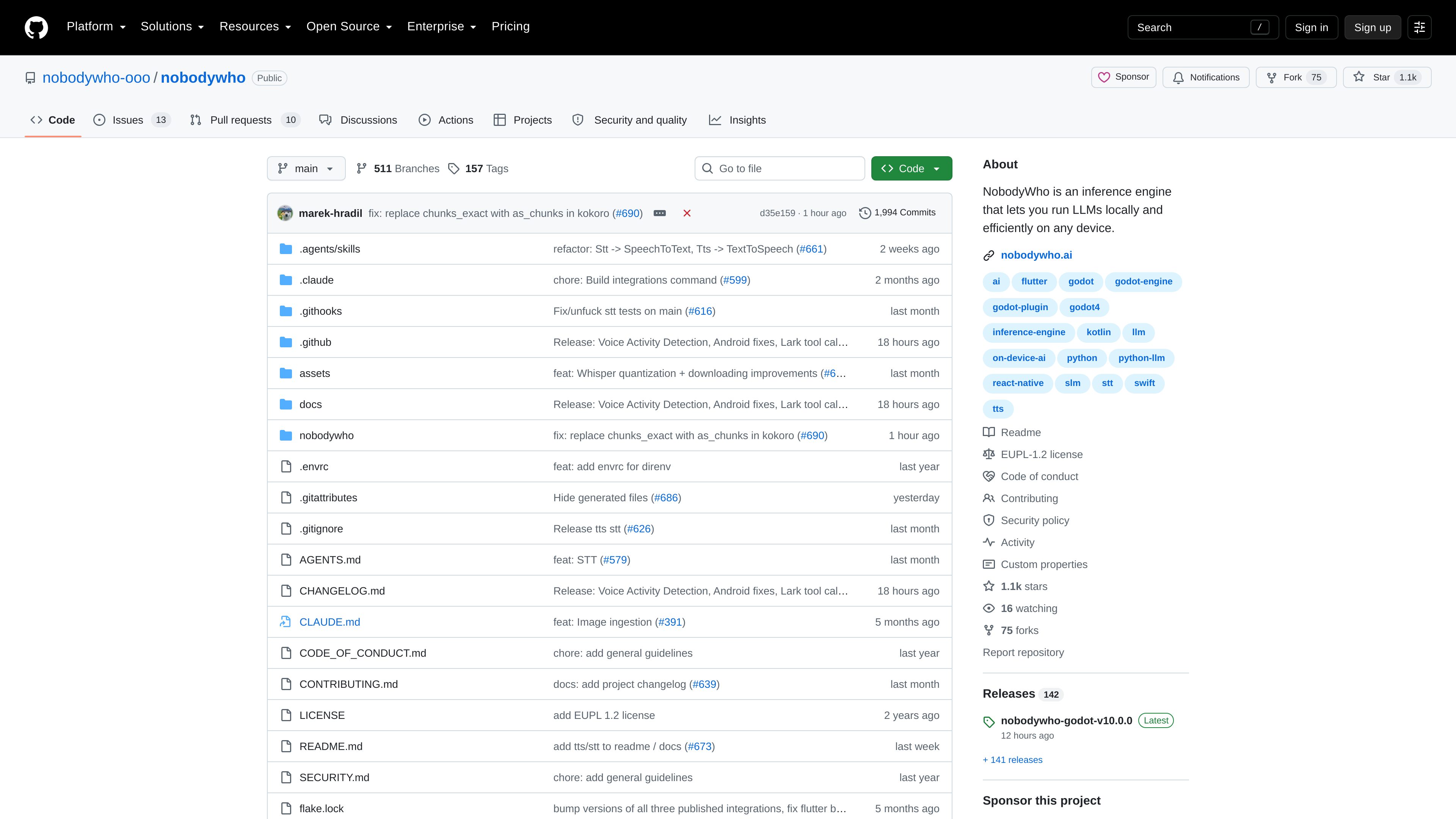
NobodyWho is an inference engine for running LLMs locally and efficiently on supported devices. It’s for developers seeking offline model inference, multimodal inputs, and local speech and text workflows without API keys.
NobodyWho is an on-device inference engine for running large language models locally. The project describes itself as a way to use LLMs efficiently on any device, with an emphasis on offline operation and local execution rather than hosted API calls.
The repository README highlights support for chat models, structured tool calling, multimodal input, text-to-speech, speech-to-text, and model downloading from Hugging Face or any direct URL. It also points to GPU-accelerated inference through Vulkan or Metal, conversation-aware context shifting, and compatibility with GGUF models powered by llama.cpp.
Runs LLMs without API keys or hidden usage fees, which makes it suitable for private or network-limited workflows.
Works with chat LLMs such as Gemma, Qwen, and Mistral, with the broader claim of compatibility with many GGUF-format models.
Generates structured grammars from function signatures, reducing the need to write schemas manually.
Accepts image and audio information as part of LLM interactions.
Includes text-to-speech backends such as Kokoro, Pocket TTS, and Supertonic, plus speech-to-text via Whisper.
Can load models directly from Hugging Face or from any URL, which simplifies distribution and testing.
Build local chat experiences that do not depend on external model APIs.
Add LLM capabilities to Kotlin, Swift, Python, Flutter, React Native, or Godot projects using the documented platform packages.
Combine Whisper transcription with local text-to-speech for voice-enabled workflows.
Use type-safe function calling when you want the model to trigger structured actions from application code.
Load GGUF models from Hugging Face URLs and experiment with local inference across supported runtimes.
No. The README states that it runs locally and offline, with no API keys needed.
The repository says it can run chat LLMs such as Gemma, Qwen, and Mistral, and that it is compatible with thousands of pretrained LLMs in GGUF format.
Yes. The README mentions text-to-speech and speech-to-text support, including Kokoro, Pocket TTS, Supertonic, and Whisper.
The project lists Kotlin, Swift, Python, Flutter, React Native, and Godot.
The README says models can be loaded from Hugging Face or any URL.
Traffic data is for reference only.
| Jun | 0 |
|---|---|
| Jul | 0 |
| Aug | 0 |
Traffic analytics are not available yet.
Traffic analytics are not available yet.

thinkingmachines.ai
Inkling is Thinking Machines Lab’s open-weights multimodal foundation model. It accepts text, image, and audio inputs, generates text, and supports fine-tuning on Tinker for downstream applications.

tiptap.dev
AI Toolkit helps developers build document-aware AI agents that edit rich-text content in place while keeping changes reviewable. It supports server-side workflows, real-time collaboration, and backend processing without requiring a Tiptap Editor session.

talkcody.com
TalkCody is a free, open-source AI coding agent for macOS, Windows, and Linux, with multiple model providers, local storage, and offline workflows.

research.meta.ai
Muse Spark 1.3 is a multimodal reasoning model from Meta Superintelligence Labs for agentic tasks, coding, and long-horizon workflows. It’s available with max reasoning on Muse Code and the Meta Model API.

minimax.io
MiniMax is a global AI foundation model platform offering multimodal models, AI-native products, and API or subscription access for people, teams, enterprises, and developers.

pi.dev
Pi Coding Agent is a terminal-based coding agent for developers seeking an extensible CLI workflow, with interactive and programmatic use, project instructions, session branching, and broad model provider support.