
Classify and route text
Assign text to supplied labels and return the selected label, probability, confidence, and scores so an application can choose a queue or destination.

milliseconds.ai is an API for making structured decisions from text and images, including classification, extraction, scoring, yes/no checks, and verification. It supports workflows such as support triage, invoice intake, sales routing, and returns review.
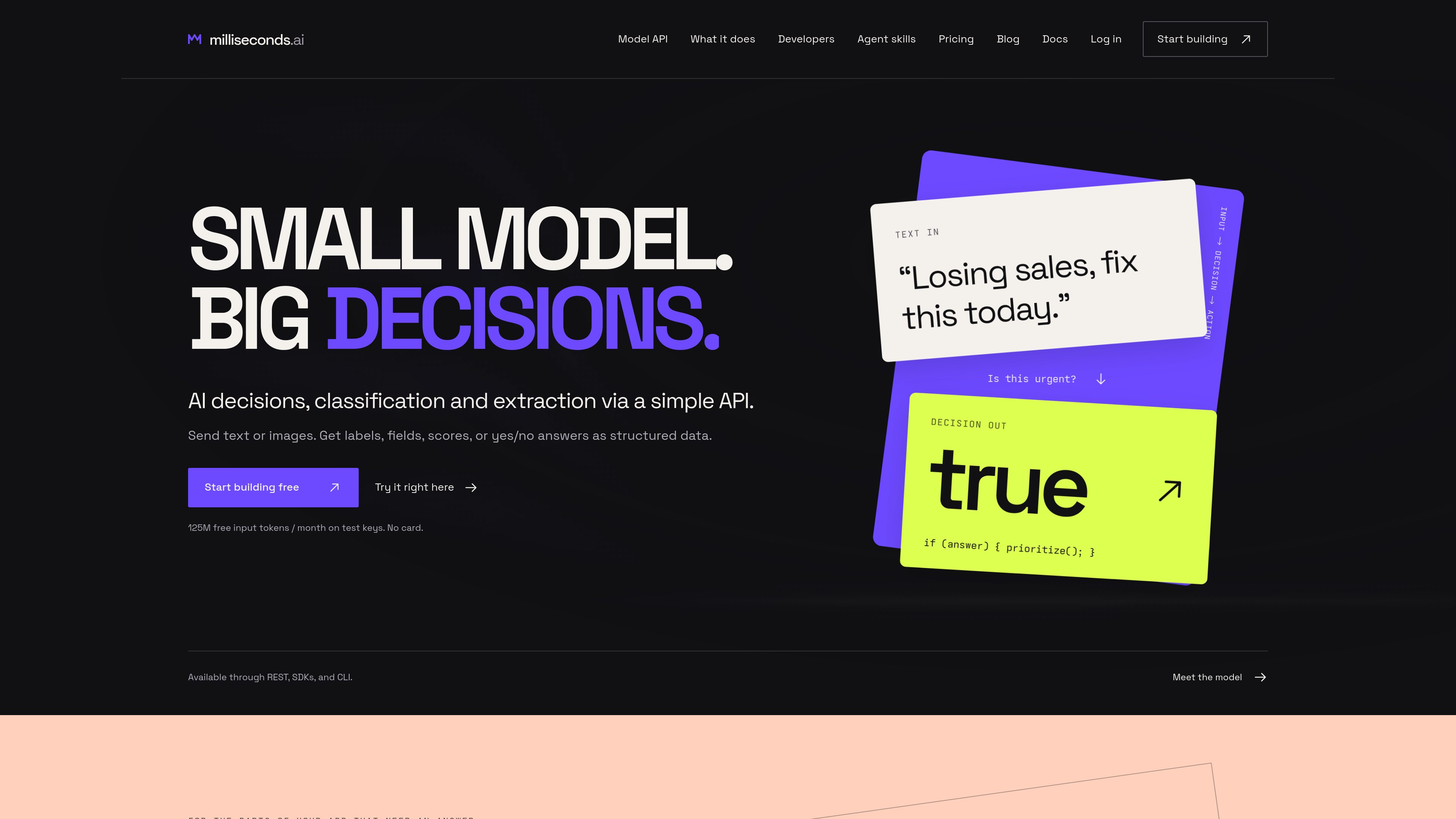
milliseconds.ai is a decision-focused AI API for applications that need a clear result from text or images rather than a long-form response. Requests can return labels, fields, scores, Boolean answers, extracted text spans, or entity records in structured data. It is available through REST, SDKs, and a CLI.
The service is suited to repetitive operational decisions such as support routing, invoice intake, evidence checks, sales-message triage, transcript review, and returns handling. Its responses can include probabilities, confidence information, source offsets, and values found in the input, allowing applications to automate a next step while retaining data for review.
Assign text to supplied labels and return the selected label, probability, confidence, and scores so an application can choose a queue or destination.
Score a message using an ordered set of levels, such as calm through furious, with the reported score, selected level, confidence, and per-level scores.
Locate an answer to a supplied question and return the matching text span, probability, and character offsets showing where the answer came from.
Map text to a supplied object schema, such as invoice number, vendor, total, and currency, for validation before writing a record.
Find typed entities such as people, organizations, dates, or custom references, and compare a proposed value with evidence in source text.
Send supported inputs through REST, SDKs, or the CLI. Images can be provided as bytes, data URLs, or base64, with JPEG, PNG, and WebP supported up to 5 MB.
Classify incoming messages into support queues, score customer frustration, and use yes/no decisions to flag urgent requests for higher priority.
Extract vendor, invoice number, totals, and other defined fields, then compare the result with purchase-order or accounting data before creating a record.
Separate demo requests, support messages, vendor pitches, and other inbox traffic while extracting stated budget, timing, and business need for follow-up.
Compare an entered or extracted value with the original text, expose the value found in the source, and prevent a mismatched number from being synced.
Find personal details for review or redaction in transcripts, and combine customer requests with order and policy facts to suggest a return action.
Depending on the capability, it can return labels, scores, yes/no answers, extracted text spans, schema-based fields, typed entities, or verification results. Responses may also include probabilities, confidence values, scores, offsets, or source values.
Yes. Supported image formats are JPEG, PNG, and WebP, with a maximum size of 5 MB. Images must be sent as bytes, a data URL, or base64; remote image URLs are not supported.
Production usage costs $0.04 per million input tokens, and output tokens are free. Test keys receive 125 million free input tokens per month. Production keys use purchased credits, while test usage and production usage remain separate.
The image capabilities for extraction, entities, and verification use a focused generative pass and are not intended for full-page transcription. The pricing page directs users with whole documents to the separate CloudRaker Paperwork product.
The service is available through REST, SDKs, and a CLI. The site also provides agent skills for coding agents, including capability-selection guidance, SDK patterns, review thresholds, and evaluation workflows.
Traffic data is for reference only.

ai.google.dev
Gemini API is a developer API for integrating Google’s generative AI models into applications. It supports text and image generation, multimodal analysis, conversational agents, structured outputs, tool use, and related media workflows through SDKs or REST.

koreshield.ai
Koreshield is a runtime security and evidence layer for AI support workflows. It checks customer input, retrieved context, and proposed tool actions before they become trusted model behavior or operational actions.