
58-rule SEO and GEO audits
Analyze local Markdown, HTML, and live-site content across crawl, on-page, content, links, structured data, AI-access, performance, security, and canonical checks.

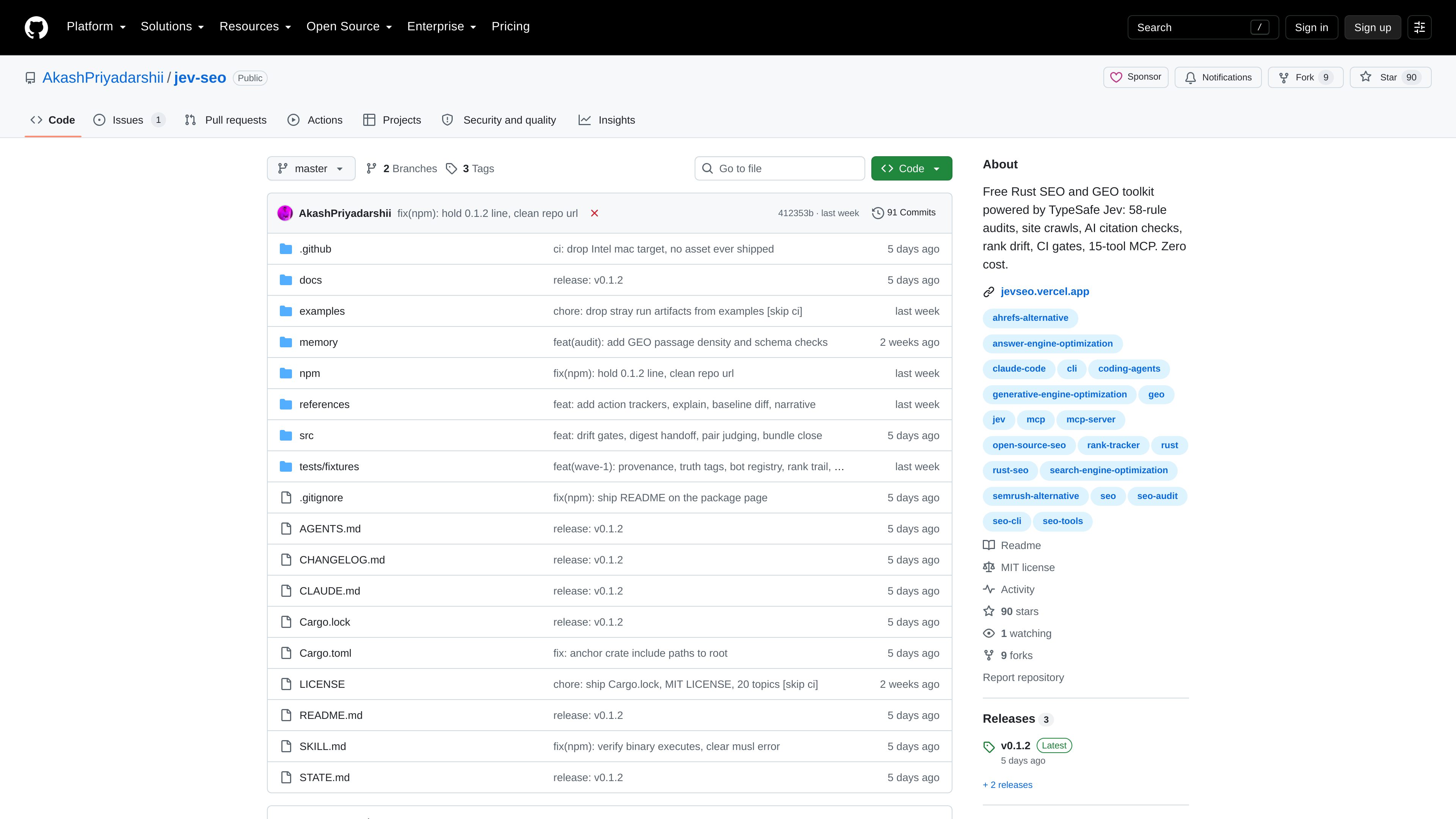
jev-seo is an open-source Rust command-line toolkit for auditing websites and local content for SEO and generative engine optimization. It also tracks rank changes, gates CI checks, and exposes its capabilities through a 15-tool MCP server for coding agents.
jev-seo is a free, open-source SEO and GEO command-line tool written in Rust. It runs as a single binary and is designed for developers, indie hackers, technical writers, and coding agents that need SEO evidence without relying on a dashboard subscription.
The toolkit audits local Markdown and HTML trees as well as live websites under 58 stable rules. Its checks cover areas including crawling, on-page content, links, structured data, AI access, performance, security, and canonicalization. Crawls honor robots.txt, and the same rule registry is used for crawling and auditing.
Beyond conventional SEO checks, jev-seo can score pages for AI answer-engine citation readiness using typed TypeSafe AI Jev primitives. It also stores rank history in a local SQLite file, supports rank-drift analysis, and can block CI when configured rules do not meet a required threshold. A 15-tool stdio MCP server exposes the same functionality to compatible coding agents.
The free path uses DuckDuckGo and local files. Jev semantic calls are controlled by a per-run budget, with the source documenting a default of $0.25; optional paid backends remain disabled unless a user supplies an explicit flag and key. The project is distributed under the MIT license.
Analyze local Markdown, HTML, and live-site content across crawl, on-page, content, links, structured data, AI-access, performance, security, and canonical checks.
Crawl live hosts while respecting robots.txt, using the same rule registry as the audit workflow.
Use TypeSafe AI Jev typed primitives to evaluate intent, GEO composite scores, and page quality; weak semantic results can be marked `[verify]` or dropped through confidence gates.
Store ranking history in a local SQLite database and compare changes over time to identify rank drift.
Set minimum-pass or blocking-rule conditions for automated checks, with HTML reports, terminal output, CSV action tracking, and optional manifest data for requests and token usage.
Run the toolkit as a stdio JSON-RPC 2.0 MCP server so supported coding-agent workflows can access the same SEO and GEO checks.
Run an audit against a documentation or website directory in CI and require a minimum pass score before a change is accepted.
Crawl a live host to inspect page-level SEO and technical conditions while retaining robots.txt controls.
Connect the MCP server to a compatible coding agent so the agent can run SEO checks while editing site files, rather than relying only on a separate dashboard.
Keep rank history in local SQLite and review drift between measurement periods when investigating changes in visibility.
Evaluate whether pages provide signals useful for answer-engine citation and use confidence-aware outputs to identify results that require verification.
jev-seo is a Rust CLI and MCP server for SEO and GEO auditing. It checks local content and live sites, evaluates AI citation readiness, tracks rank history, and supports CI enforcement.
The source identifies developers, indie hackers, technical writers, and autonomous coding agents, including Claude Code, Gemini CLI, Cursor, and Antigravity workflows.
The documented free path uses DuckDuckGo and local files. The rules, crawls, reports, and rank history are described as free. Jev semantic calls use a configurable budget, with a documented default of $0.25 per run, and optional paid backends do not run without an explicit flag and key.
Yes. jev-seo can gate CI on blocking rules or a minimum-pass threshold. The source shows an audit command using `--min-pass`, but the repository materials provided here do not define a complete CI setup for every platform.
It exposes 15 tools through a stdio JSON-RPC 2.0 MCP server. The source names Claude Code, Gemini CLI, Cursor, and Antigravity as compatible agent workflows, while the exact configuration depends on the MCP client.

howseen.ai
Howseen AI is an AI visibility and Generative Engine Optimization platform for brands, SaaS companies, ecommerce teams, and agencies. It tracks brand recommendations across ChatGPT, Gemini, Perplexity, Google AI Overviews, and Google AI Mode, and helps teams plan and publish content to improve visibility.

openseo.so
Open-source SEO research, rank tracking, audits, and AI-agent workflows for organic growth teams.

www.blazly.ai
AI-assisted Google Business Profile optimization and Maps rank tracking for local businesses.

getpassionfruit.ai
Passionfruit Labs is an AI search optimization platform for brands and agencies to track citations, sentiment, competitor visibility, and revenue across generative search engines, with content recommendations and team collaboration.

niubigeo.ai
NiubiGEO helps product teams improve discovery across communities, creator channels, publishers, developer networks, search, and AI answers. It combines campaign services, human product and AI testing, content publishing, and GEO diagnosis reports, with an open-source option for developers.

www.aiogeoprotocol.com
AIO.GEO audits whether AI crawlers and generative answer engines can access, parse, understand, and cite a public website. It helps developers, agencies, content teams, and governance teams identify structural issues, apply dry-run fixes, rescore changes, and produce verifiable receipts.