
Multi-source ingestion
Ingests files, text, URLs, feeds, and connected accounts, including PDFs, audio, video, web pages, Slack messages, email, and knowledge base sources.

Context layer for AI agents with searchable, grounded content
Graphlit is a context layer for AI agents and applications that need to work with organizational knowledge instead of isolated chat memory. It combines ingestion, extraction, search, chat, and knowledge graph workflows behind a single API.
The product is designed to bring content from files, web pages, messages, storage systems, and business tools into a searchable context layer. The site emphasizes real-time or continuous sync, provenance, and grounded answers so agents can use source-backed information rather than static prompts or ad hoc glue code.
Ingests files, text, URLs, feeds, and connected accounts, including PDFs, audio, video, web pages, Slack messages, email, and knowledge base sources.
Supports preparation, extraction, and enrichment workflows, with built-in transcription, OCR, embeddings, and completions.
Provides semantic search, keyword search, and hybrid search, plus source-grounded conversations with citations for retrieval-augmented use cases.
Extracts entities, observables, relationships, and temporal state to build organizational knowledge graphs rather than simple document indexes.
Connects to tools such as Slack, GitHub, Jira, Notion, Google Drive, S3, Gmail, Dropbox, and more, with continuous sync mentioned in the product messaging.
Offers SDKs and an MCP server for developer workflows, including TypeScript, Python, and .NET support and access from tools such as Claude, Cursor, and ChatGPT on higher plans.
Build assistants that answer from company knowledge with source citations, multi-turn memory, and retrieval over documents, messages, and connected apps.
Sync and search operational content from tools like Slack, GitHub, Jira, Notion, and email so teams can find context without manual ETL.
Extract people, companies, relationships, events, and ownership from content to support graph queries and relationship-aware applications.
Process PDFs, web pages, audio, video, and office files through ingestion, transcription, OCR, and enrichment pipelines for downstream AI use.
Connect external data sources to AI agents through MCP and SDKs so apps can retrieve context and trigger actions from familiar developer tools.
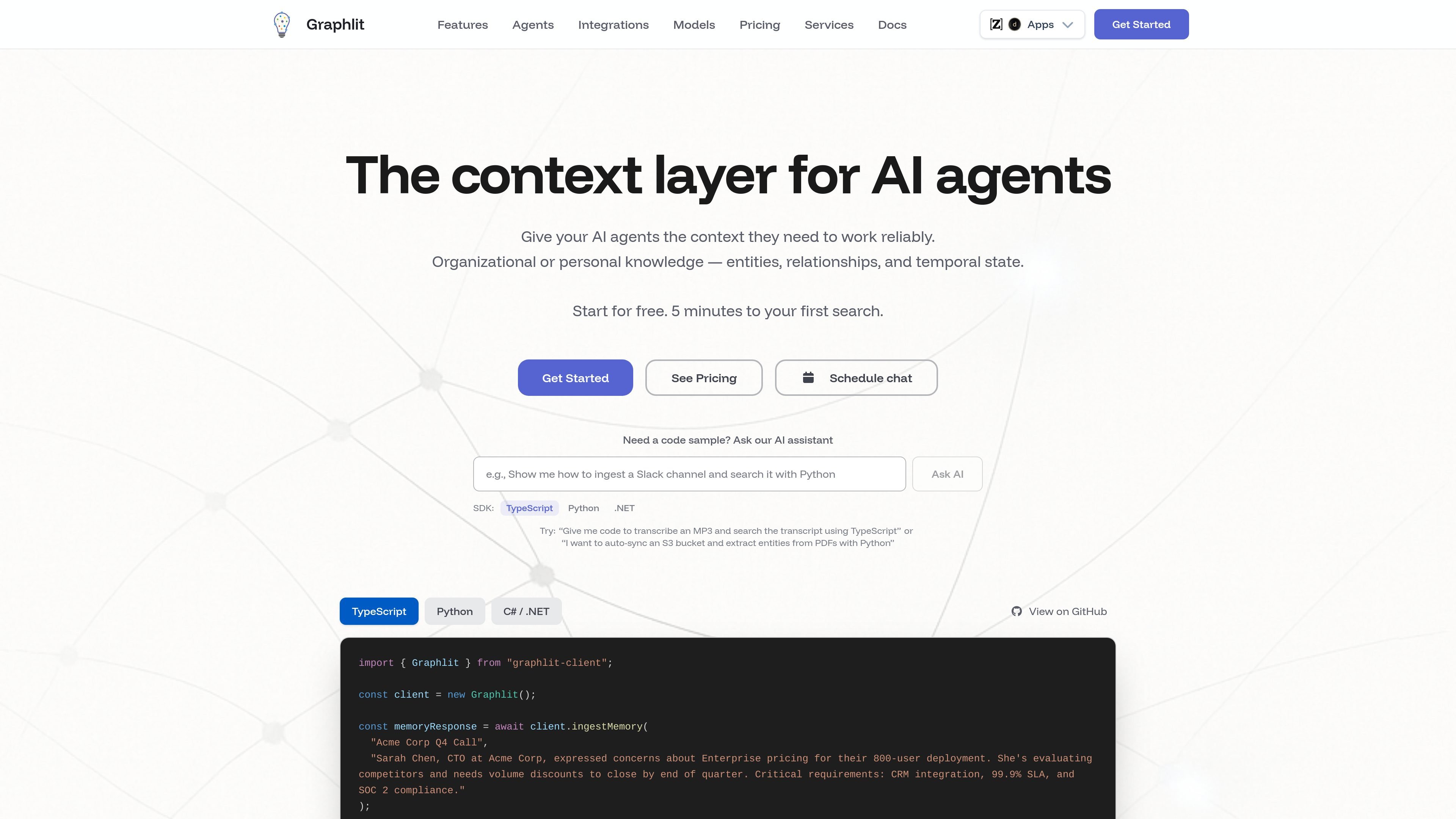
Graphlit is used to ingest content, extract structure, and make it searchable for AI applications that need grounded context. The site positions it as a context layer for AI agents, with support for search, RAG, chat, and knowledge graphs.
The pricing page shows a Free tier with limited usage and paid plans for Hobby, Starter, and Growth, plus a Custom option for larger integration and agent work. The site also says there is a free project to get started and that no credit card is required for the free tier.
Yes. The site references SDKs for TypeScript, Python, and .NET, and the home page shows example code in TypeScript.
Graphlit’s integrations page describes ingestion, preparation, and delivery across connected tools. The site highlights sources such as Slack, GitHub, Jira, Notion, Gmail, Google Drive, S3, Dropbox, and similar systems.
The pricing page says Graphlit includes ingestion and extraction, search and RAG, knowledge graphs, and agent context in one platform price. It also calls out citations, configurable workflows, and content feeds.
Traffic data is for reference only.

airweave.ai
Airweave is an open-source context retrieval layer for AI agents and RAG systems, connecting apps and databases, syncing data in real time, and enabling grounded retrieval through unified search.

unabyss.com
Connect work apps to one structured context layer, then let supported MCP agents retrieve, update and export the context their tasks need.

memmy.bot
Memmy is a local-first AI agent and memory layer for people who use multiple AI tools. It keeps authorized context on-device and can carry relevant memory between desktop apps, CLI workflows, and external agents.

pieces.app
An on-device work memory layer that helps individuals and teams recover context across their tools.
www.getnoan.com
NOAN is a fact layer and API for businesses that want websites, applications, and AI agents to use the same verified company information. It organizes approved, versioned business facts in a connected workspace accessible through REST and MCP.
skynetlab-cortex.com
Cortex is a semantic memory infrastructure for AI assistants and agents. It helps teams keep shared context, decisions, sources, and contradictions available across conversations and model changes.