
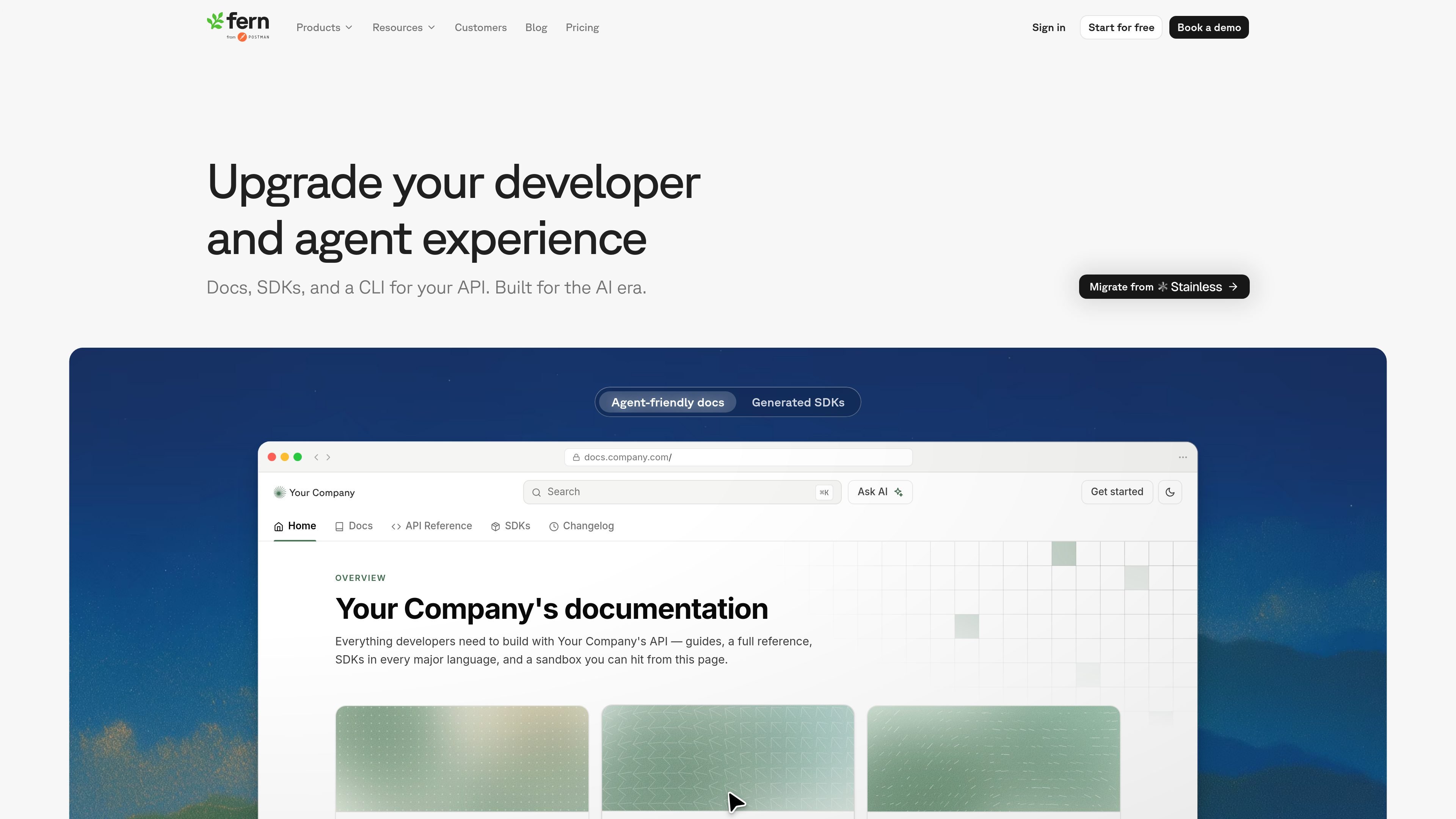
Docs from a single source of truth
Generate interactive documentation websites from an OpenAPI spec, with docs-as-code workflows, version control, pull requests, and AI-assisted authoring.

Fern turns OpenAPI specs into docs, SDKs, and branded CLIs, with AI search, llms.txt, and an MCP server.
Fern is a developer platform for turning an API specification into documentation, SDKs, and a CLI from one source of truth. The site positions it for teams that want docs, client libraries, and terminal workflows kept in sync as the API changes.
The product supports modern API protocols including REST, WebSockets, and GraphQL, and the pricing page also lists support for Webhooks, Server-sent events, Protobuf, AsyncAPI, gRPC, OpenAPI Overlays, Arazzo, and OpenRPC. Fern’s docs offering adds search, AI chat, llms.txt, and an MCP server so both developers and agents can work from the same content.
Generate interactive documentation websites from an OpenAPI spec, with docs-as-code workflows, version control, pull requests, and AI-assisted authoring.
Ship SDKs in nine languages with idiomatic APIs, strong typing, retries, pagination, idempotency helpers, multipart upload support, and tests.
Generate a branded CLI from your spec, distribute it through package managers, and keep commands aligned with SDKs and docs.
Add AI search, built-in chat grounded in your docs, llms.txt, and an MCP server so agents can read and query documentation in real time.
Use enterprise controls such as visitor authentication, RBAC, SSO, self-hosting, translated content, and Postman collection generation from the same source.
Create a documentation site that stays aligned with your API changes, supports version switching, and can be maintained with Git-based review workflows.
Ship client libraries that match your API’s behavior across languages and include built-in helpers for pagination, retries, and idempotency.
Offer a branded terminal interface for developers and agents who prefer command-line workflows, with JSON output for automation.
Support AI tools and internal assistants by exposing docs through llms.txt, AI chat, and an MCP server that can query your API and documentation.
Roll out enterprise documentation with authentication, RBAC, localization, and self-hosting when security or compliance requirements are stricter.
Fern starts from an OpenAPI spec and can generate docs, SDKs, and a CLI from the same source of truth. The docs product also supports search, llms.txt, an MCP server, and AI chat grounded in the documentation.
Yes. The pricing page includes a free Hobby plan, a Team plan with a 14-day trial, and a custom-priced Enterprise plan.
Fern supports managed cloud hosting or self-hosting for stricter security, networking, and compliance requirements.
Fern supports visitor authentication with JWT and SSO, role-based access control, translated content, and enterprise authentication options on higher-tier plans.
Fern publishes SDKs in nine languages and supports API protocols including REST, Webhooks, WebSockets, Server-sent events, Protobuf, GraphQL, and gRPC.
Traffic data is for reference only.
iconsdb.app
IconsDB is a searchable library of open-source icons, logos, flags, and emoji, with semantic search and code-ready outputs for web developers and designers. Its MCP server lets supported coding agents find icons by intent and return imports suited to a project's existing icon packages.