
Incident investigation
Alert-triggered agents investigate observability and infrastructure data in parallel, identify likely root causes against the live infrastructure graph, and open a pull request containing the proposed fix.

AI agents for Kubernetes and infrastructure operations, grounded in live environment data.
Plural is an infrastructure operations platform that uses configurable AI agents to investigate incidents, manage Kubernetes upgrades, remediate vulnerabilities, optimize cloud costs, and execute infrastructure changes. Its agents work from a live semantic graph of clusters, stacks, services, and changes, rather than relying only on static documentation.
Agents can combine observability providers, source-control and ticketing systems, arbitrary MCP servers, operational skills, runbooks, and specialized subagents. Proposed changes are produced as pull requests for review, while actions and tool calls are logged and inspectable.
Plural is designed for platform and DevOps teams that need to automate recurring infrastructure work while retaining governance and human approval. Agents run in the customer’s clusters, and the platform supports customer-selected language models including OpenAI, Anthropic, Bedrock, and Azure.
Alert-triggered agents investigate observability and infrastructure data in parallel, identify likely root causes against the live infrastructure graph, and open a pull request containing the proposed fix.
Agents inventory cluster estates, map component dependencies, plan rollout order across development, staging, and production, and generate pull requests for the upgrade.
Scheduled jobs scan the estate for known CVEs, prioritize findings by exposure, and open pull requests for affected services or stacks.
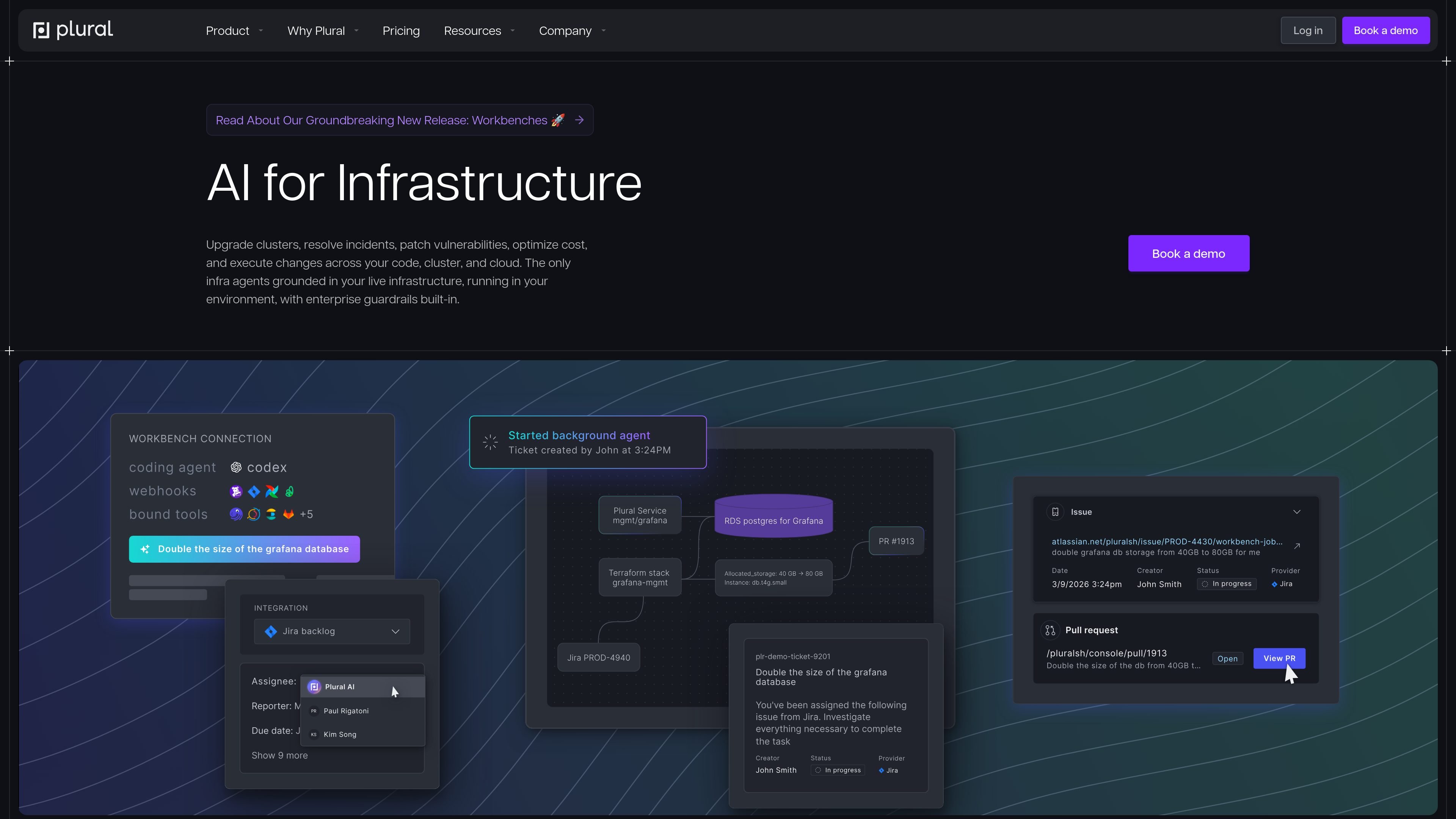
Agents can take infrastructure requests from systems such as Jira or Linear, identify relevant Terraform modules and dependencies, and create a linked pull request.
FinOps agents inventory cloud spend by cluster, query cloud billing tables with SQL, and propose right-sizing changes through Terraform pull requests and a reviewable dashboard.
Agents run in customer clusters, operate within configured permissions, and record tool calls, decisions, and artifacts. Changes remain reviewable by human operators before application.
Connect alerting and repositories so operators can inspect telemetry, implicated infrastructure, and a proposed fix together before accepting a pull request.
Platform teams managing development, staging, and production clusters can use dependency mapping and rollout planning to organize a multi-environment upgrade review.
Schedule vulnerability and drift checks, or turn a database-sizing ticket or cloud-spend finding into a Terraform proposal for the relevant team to review.
Agents run in customer clusters. Plural executes actions server-side and unifies infrastructure permissions so agents operate within prescribed boundaries.
Yes. Plural supports bring-your-own LLM configurations, including OpenAI, Anthropic, Bedrock, Azure, and other providers.
Agents produce pull requests against existing repositories. Human operators can inspect the proposed changes before they are applied.
Plural maintains a live semantic graph covering clusters, stacks, services, and changes. Subagents can query live data and expose their tool calls, decisions, and artifacts.
Sandbox offers a 14-day trial. Pro starts at $450/month for one cluster, plus $250/month per additional cluster, supports up to 10 clusters, and offers a 30-day free trial. Pro is paid monthly with no commitment. Enterprise pricing depends on cluster count and support requirements; dedicated or on-premise hosting is an Enterprise option.
Данные о трафике приведены только для справки.