
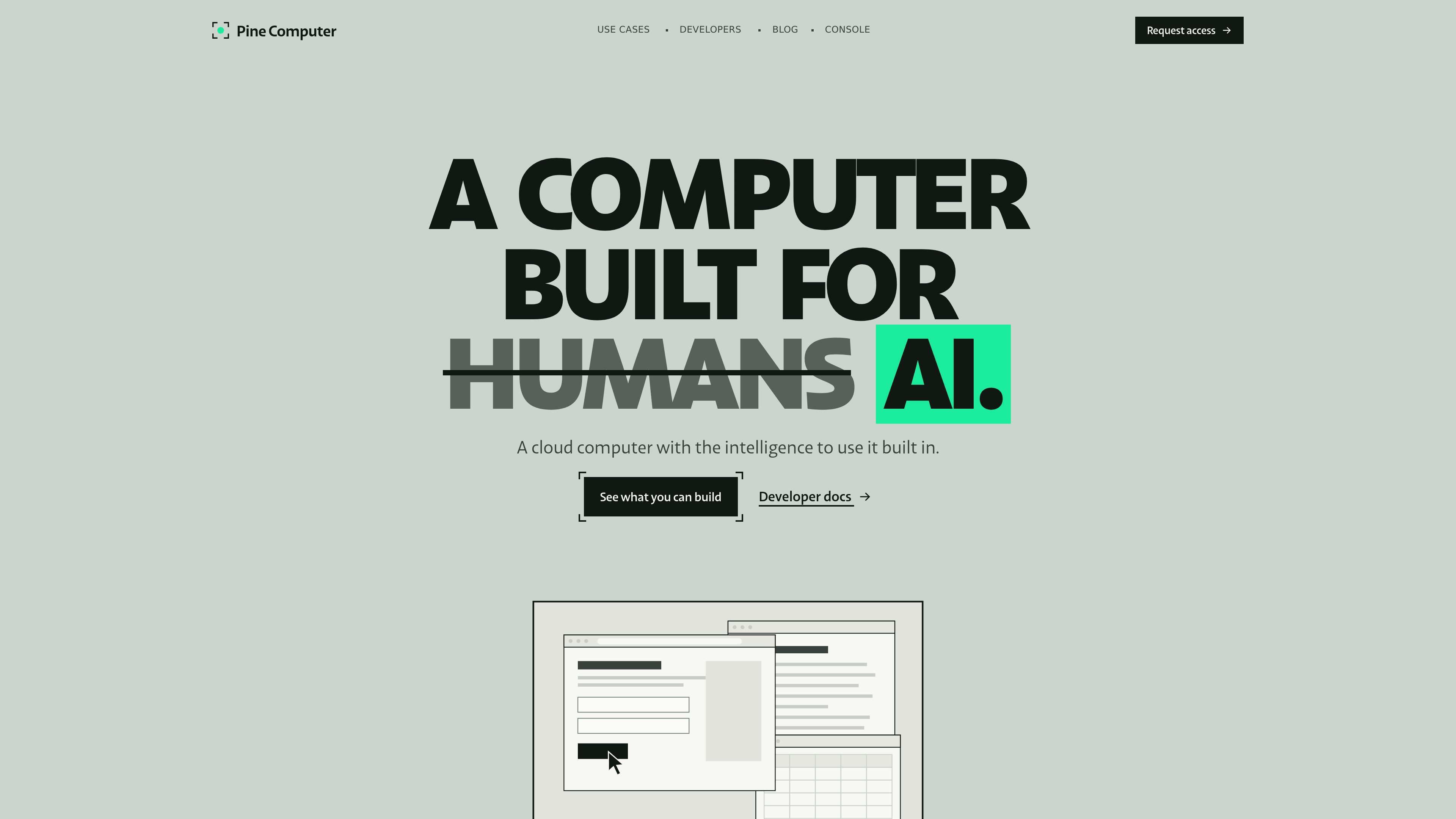
Agent-operated cloud computers
Products create computers and browser sessions in code, then give an agent a natural-language job to complete across websites and virtual screens.

A cloud computer that lets products use AI to perform real-world work across websites and apps.
Pine Computer is a cloud computer for products that need AI to carry out work across websites and desktop-style interfaces. A product creates a computer and session through code, gives an agent a job, and receives the finished work or generated files back. It is aimed at workflows that may involve several sites, changing screens, or services without APIs.
The system can run separate computers for parallel tasks, browse from a selected country, and support human handoffs when a person must sign in, enter a code, or approve an action. Ephemeral computers are available for runs that should not retain state. Example outputs include receipts, reports, filled PDFs, spreadsheets, and portal status updates.
Products create computers and browser sessions in code, then give an agent a natural-language job to complete across websites and virtual screens.
The computer can read interfaces, fill forms, navigate portals, and return results for processes that are not exposed through a conventional API.
A person can take control when a login, payment, or other sensitive action requires user input. Taking control stops the AI until the person hands the computer back.
Products can start separate computers for simultaneous jobs and choose the country from which a computer browses.
Completed work can come back as files and records, including PDF receipts, research reports, spreadsheets, and filled application forms.
Pine describes single-use containers under gVisor, customer-key encryption for saved state, short-lived tokens, and secrets delivered outside the model prompt. Ephemeral computers retain no state.
Property-management software can start a computer for each city, renew permits from its records, pause for a customer sign-in, and attach each portal receipt to the relevant permit.
An analyst can ask for a market report that compares figures from different sources, cites each claim, and returns the work as a document, PDF, and spreadsheet.
Broker software can turn rows in a renewal sheet into completed copies of an insurer’s current PDF form, check the fields against the source row, and leave the copies for review before submission.
An assistant can check multiple shops at once, build baskets, compare item and delivery totals, and stop before payment until the user approves the purchase.
Engineering teams can use cloud computers for web-app testing, bug reproduction, and release review across browser-based interfaces.
It is designed for jobs that require an AI agent to operate websites or desktop-style interfaces, including sites without APIs, research, document processing, assistants, sales workflows, and engineering or QA tasks.
Yes. A person can take control for actions such as signing in or entering sensitive information. The AI stops while the person is driving and resumes after the person hands control back.
The product can receive completed results and artifacts such as PDF receipts, reports, spreadsheets, filled forms, and messages or status updates from the workflow.
Pine says secrets reach a run as a locked file rather than in the model prompt, are scrubbed from events and logs, and are not saved. Blind sessions can hide information typed by a person from the AI.
Pine says that Pine and its AI providers do not use customer or end-user data sent to Pine Computer to train models. It says its own model is trained only on synthetic data.
Данные о трафике приведены только для справки.

www.simular.ai
Simular is an autonomous computer platform that uses AI agents to operate real computers and automate digital workflows. It serves individuals, builders, operators, and businesses that need to automate tasks across desktop applications and websites, including workflows that do not expose traditional APIs.

construct.computer
Construct Computer is an AI employee workspace for solo founders and small teams. It combines a persistent cloud computer, browser and terminal tools, memory, workflows, schedules, email, and connected apps so agents can complete work while users are away.

zapier.com
Zapier MCP connects AI clients such as Claude, ChatGPT, and Cursor to actions across Zapier’s app ecosystem. It lets an agent discover an appropriate action, request missing details, and execute it with authentication and permissions managed through Zapier.

cue.im
Personal AI agents with individual digital identities for handling real-world tasks.

www.thesecondbrain.dev
Second Brain gives connected AI tools a shared memory for projects, decisions, preferences, and updates. It runs in your own Cloudflare account and lets you save, recall, inspect, and organize context across supported clients and capture sources.

www.cognee.ai
Cognee is an open-source memory platform for AI agents and applications. It connects data across sources, builds connected memory using vector, graph, and relational storage, and makes that context available through SDK, cloud, or self-hosted deployments.