
Three trust-boundary checks
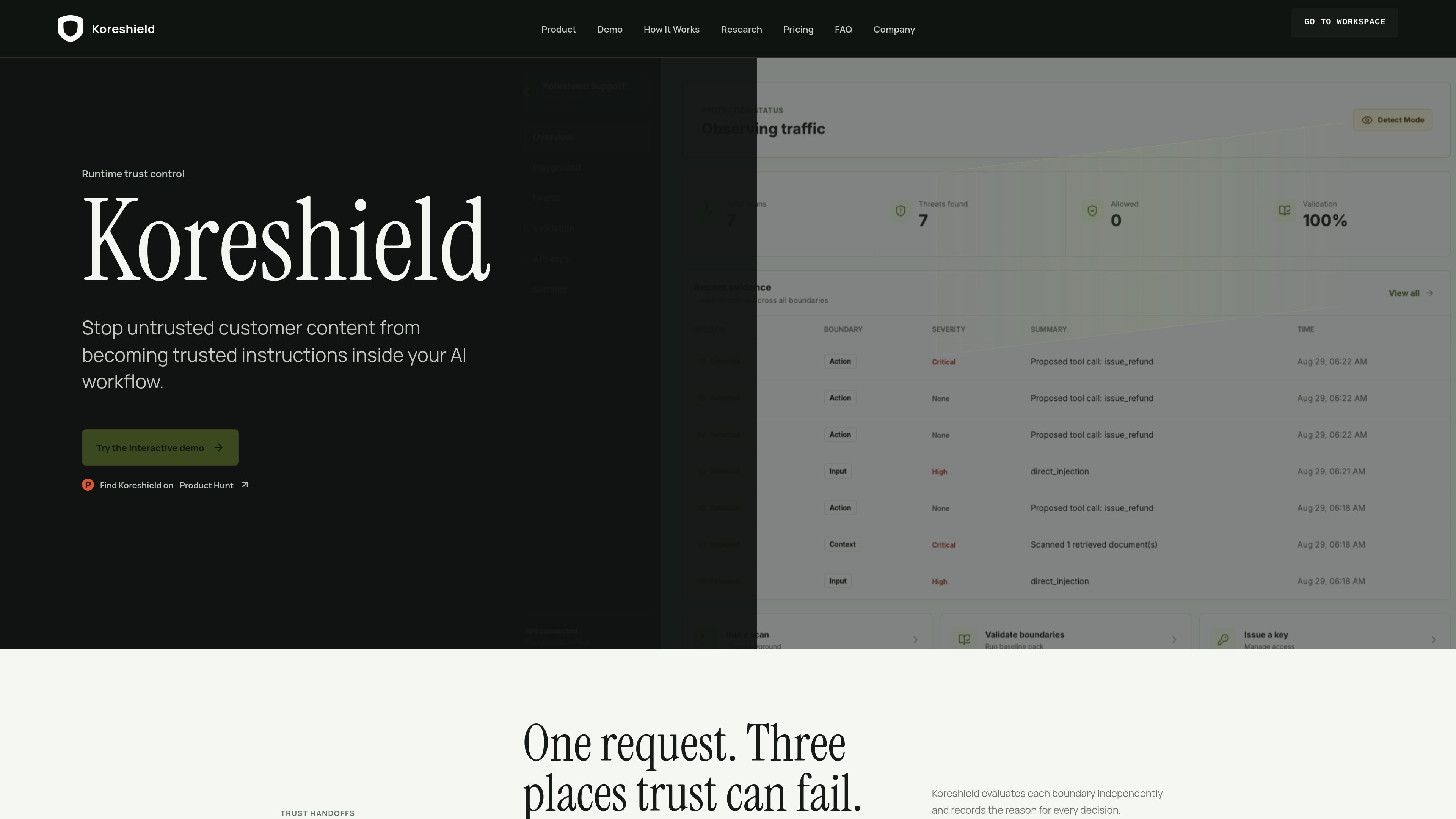
Scan customer messages before model execution, selected documents or chunks before prompt assembly, and proposed tool calls before execution.

Koreshield — уровень защиты во время выполнения и проверки доказательств для процессов поддержки с AI. Он проверяет ввод клиентов, извлечённый контекст и предлагаемые действия инструментов до того, как они станут доверенным поведением модели или операционными действиями.
Koreshield is a runtime security and evidence layer for AI customer-support applications. It inspects customer-controlled input, retrieved context, and proposed tool actions before they become trusted model context or operational behavior.
Teams can begin in detect mode beside representative traffic, review decisions and evidence, and enable enforcement only after they understand false positives, misses, latency, and fallback behavior. Koreshield complements application authorization and does not replace identity, tenant, approval, or business-rule controls.
Scan customer messages before model execution, selected documents or chunks before prompt assembly, and proposed tool calls before execution.
Use detect mode to record threats without interrupting traffic, then use enforce mode to stop requests that violate policy when fallback behavior is ready.
Return and retain operational decision details such as outcome, severity, confidence, indicators, mode, timing, and a request record for review.
Create a server-side scan key and call documented endpoints for input, retrieved-context, and proposed-action checks. Examples are provided for JavaScript, Python, and cURL.
Test representative benign and adversarial support cases and review misses, false positives, latency, blocked-response behavior, and evidence usefulness before enforcement.
Hosted Starter and Growth plans meter protected requests, while Enterprise is scoped for custom volume, deployment, identity, retention, evidence export, and support requirements.
A support application can scan a customer message before it enters the assistant conversation, helping the team identify untrusted instructions or suspicious content at the first workflow boundary.
Teams can scan ticket notes, CRM snippets, documents, or other selected retrieved chunks before prompt assembly to identify indirect prompt injection and false authority claims.
An agent workflow can submit a proposed refund, account change, data export, or handoff with its authorization context before the tool call runs.
A team preparing an AI support workflow can run Koreshield in detect mode beside live traffic, compare decisions with expected behavior, and introduce enforcement with a defined customer and operator fallback.
No. The application can add a direct scan before the provider call or use a protected proxy route where that fits its architecture.
A decision can include whether the request is allowed, detected, or blocked, together with severity, confidence, indicators, mode, timing, and an event record for review.
Create a server-side scan key, choose one trust boundary, run detect mode against representative traffic, and enforce only after the team understands false positives, misses, latency, and fallback behavior.
No. It focuses on AI workflow trust boundaries rather than acting as a general WAF, identity provider, API gateway, or replacement for application authorization.
Eligible new customers can use one seven-day evaluation without a card. It includes 10,000 protected requests, one API key, and a 20-request-per-minute limit.
Данные о трафике приведены только для справки.