
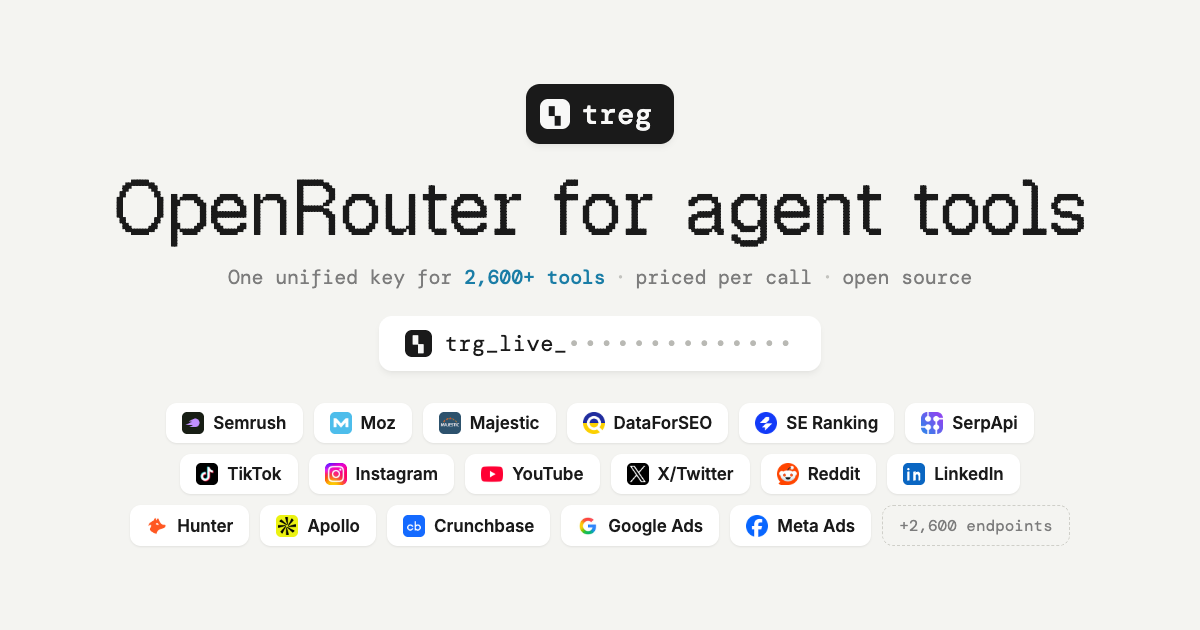
Unified API and MCP access
Call cataloged provider endpoints through one base URL and token, or connect an agent through the MCP endpoint.

treg.to is an API gateway and MCP server for calling tools and data providers through one endpoint and credential. It helps agents and developers use cataloged SEO, enrichment, advertising, social, scraping, and other data tools without managing separate provider keys for every metered call.
treg.to provides a single API gateway and MCP endpoint for calling more than 3,800 cataloged endpoints from 108 providers. It is designed for agents and developers that need access to SEO, enrichment, advertising, social, scraping, and related data services through one token rather than separate provider credentials.
A request is sent to a catalog endpoint through https://treg.to/call/. treg.to injects the relevant credential server-side and relays the provider's own response. The provider's path, parameters, and response format remain in use rather than being replaced by a treg.to-specific data model.
The catalog can be searched by task, and platform pages show available providers alongside measured price, speed, and success-rate information where available. treg.to compares providers but does not automatically select, route between, or fail over them. Developers can use the HTTP API, CLI, MCP endpoint, or the llms.txt file for agent-oriented setup.
Call cataloged provider endpoints through one base URL and token, or connect an agent through the MCP endpoint.
treg.to inserts the applicable provider credential at the gateway, so the caller does not need to hold that shared provider secret. The upstream request and response are relayed without being modeled into a separate provider API.
Search by task, such as backlinks, and inspect platform listings that compare providers by price, measured speed, and measured success rate.
A team's registered provider key takes precedence over treg.to's shared key. Calls made with the team's own key are not metered by treg.to.
Eligible calls made on treg.to's key are charged against a prepaid balance at the provider's own rate, with the rate shown before the call and no treg.to markup. New teams receive $1.00 of free credit.
Teams can register their own tools and skills, including `SKILL.md` files, and make them available to teammates' agents through the organization's shared shelf. The API also includes routes for connections, billing, activity, calls, and tool management.
An agent can search the catalog for keyword ideas, volume, rank data, backlinks, live SERP results, or AI-visibility signals, then call the selected provider endpoints through the same gateway.
A workflow can combine person or company data, work-email discovery and verification, firmographics, funding information, and buying signals. Multi-step workflows may cost more per usable lead than a raw API call because misses and filtering affect the final result.
Teams can use cataloged tools for competitor ad discovery, ad-library research, campaign management, and measurement across services such as Google Ads and Meta-related tools, subject to the provider credentials and access requirements involved.
Agents can discover creators and retrieve supported profile, post, trend, or platform data through cataloged social tools. The catalog includes tools for platforms such as Instagram, TikTok, YouTube, and X, with availability determined by the listed provider endpoint.
A team can register provider keys, connected accounts, or project skills once and let teammates' agents call them by token. This keeps credentials at the gateway and allows the organization to manage connections and access centrally.
Send an authenticated request to `https://treg.to/call/{endpoint}` with the `X-Treg-Token` header. treg.to makes the upstream request using the provider's path and parameters, injects the credential server-side, and relays the provider's response.
No. Catalog and platform pages provide comparison information such as price, speed, and measured success rate, but the caller chooses the endpoint. treg.to does not automatically route between providers or provide failover.
Calls using treg.to's key are metered against a prepaid balance at the provider's own rate, without a treg.to markup. The rate is shown before calling, and the first $1.00 of credit is free. Calls using a team's own provider key, registered tools, or connected accounts are not metered by treg.to.
Metered calls stop with a clear error until the balance is topped up. Calls using the team's own keys or own tools continue to work.
The documented access options include the HTTP API, an MCP endpoint at `https://treg.to/mcp`, a CLI installed through `install.sh`, and the `llms.txt` file for coding-agent setup. The site also documents sign-in through GitHub, Google, or an email code.
Os dados de tráfego são apenas para referência.

theagentrouter.ai
Agent Router is an open-source Go project for managing unified access to generative AI services through Envoy Gateway. It is intended for teams that want a gateway-based control point for AI service traffic and related agent or MCP workloads.

veecle.ai
Chiplab is an MCP platform that lets AI coding agents run firmware against virtual instances of target chips instead of waiting for physical hardware. It provides chip-aware execution and searchable embedded-development knowledge through a single endpoint.

www.edgee.ai
Edgee is an agent gateway for coding teams that reduces token usage, routes requests across models, and provides usage visibility. Its Compression V2 works as a drop-in CLI layer for Claude Code, Codex, OpenCode, Cursor, and other supported agents.

www.tinyfish.ai
TinyFish is web infrastructure for AI agents that searches, fetches, browses, and completes tasks on live websites. It helps developers and enterprise teams gather current web data, use authenticated portals, and automate browser-based workflows.

kody.codes
Kody is a software platform that gives connected AI agents shared memory, credentials, reusable packages, integrations, and scheduled execution. It helps developers carry work between agents such as Cursor, Claude, ChatGPT, and Codex without rebuilding the same automation each time.

anysite.io
Anysite provides live web data to AI assistants and software through MCP, REST API, and CLI interfaces. It helps GTM, marketing, research, and other teams query 900+ sources and 5,000+ endpoints for structured results.