
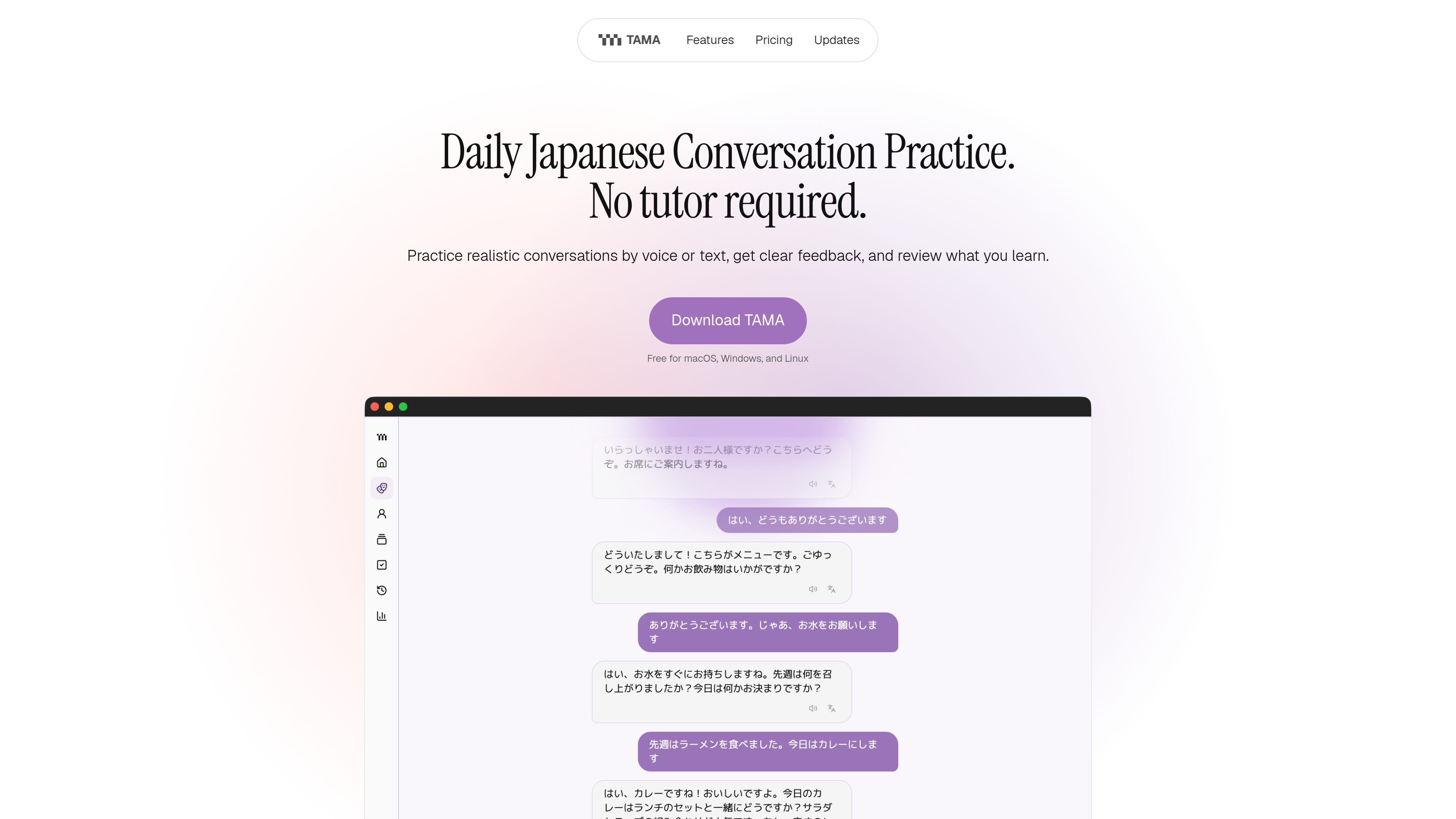
Scenario-based conversation practice
Choose practical situations and rehearse Japanese in a conversational setting, with options to make situations simpler or more challenging as your ability develops.

TAMA é um aplicativo para desktop que permite praticar japonês por meio de conversas realistas por voz ou texto. Oferece feedback sobre as sessões, salva vocabulário útil em cartões de repetição espaçada e aceita modelos locais ou chaves de API fornecidas pelo usuário.
TAMA is a desktop Japanese conversation-practice app built around realistic everyday scenarios. Learners can choose situations such as ordering food, checking into a hotel, or making small talk, then practice with an AI conversation partner by speaking or typing.
After a session, TAMA summarizes the conversation and suggests what to practice next. Learners can save useful vocabulary from the exchange to flashcards, while the practice dashboard brings together the daily plan, recent conversations, and cards that are due for review.
Choose practical situations and rehearse Japanese in a conversational setting, with options to make situations simpler or more challenging as your ability develops.
Practice by speaking or typing. This supports spoken interaction while retaining a text-based option for learners who prefer to write or who are not ready to use voice.
TAMA summarizes each conversation and provides a clear suggestion for the next practice focus, helping learners turn a completed session into a concrete follow-up activity.
Save useful words from conversations directly to flashcards. TAMA uses spaced repetition to schedule reviews so saved vocabulary can be revisited over time.
The dashboard combines the daily plan, recent conversations, and due flashcards in one place, allowing learners to resume previous work or start another activity without choosing a study plan from scratch.
The Free app supports local models and user-provided API keys. The planned managed option provides the AI service without requiring an API key or provider setup.
Learners can rehearse situations such as ordering at a restaurant, checking into a hotel, and making small talk before encountering them in real life.
People who already know a few basic Japanese words and phrases can use guided scenarios to practice combining them in longer exchanges. The app is described as especially useful from beginner through intermediate level.
After encountering unfamiliar or useful words during a session, learners can save selected vocabulary and return to it through spaced-repetition flashcards rather than maintaining a separate review workflow.
The dashboard provides a single place to see the daily plan, recent conversations, and flashcards due for review, which can help learners continue from their previous activity.
TAMA works best once you know a few basic words and phrases. Its conversations are especially useful for beginner through intermediate learners, and scenarios can be adjusted toward simpler or more challenging situations.
Public builds are available for macOS on Apple Silicon, Windows x64, and Linux x64. Installers are provided through the project’s GitHub Releases page.
Not for the Free app when using a compatible local model. The Free app can also connect to a provider through your own API key. The planned managed option is intended to include the AI service without API-key or provider setup.
In the Free app, study history, flashcards, personas, and settings stay on the device. Requests are sent only to the AI or speech provider selected by the user. The managed beta is expected to have separate data terms before access is provided.
After a conversation, TAMA provides a session summary and a practice suggestion. You can save useful vocabulary from the session, and those saved words become spaced-repetition flashcards.
Os dados de tráfego são apenas para referência.

www.openscience.sh
OpenScience é um ambiente de trabalho de IA open source para pesquisa científica. Reúne busca bibliográfica, bancos de dados científicos, código, experimentos, computação e resultados em um só espaço, com suporte a modelos incluídos, chaves de provedores externos, assinaturas e modelos locais.

usejango.com
Jango é uma ferramenta para desktop macOS que permite testar aplicações web multiusuário com participantes de IA em sessões de navegador separadas. Os desenvolvedores podem atribuir contas de teste e objetivos aos participantes, observar ou orientar suas ações e testar fluxos de trabalho como interações sociais, mensagens, colaboração, marketplaces e livros de ordens em sandbox.

zergrouter.com
ZergRouter é uma camada de roteamento de API para clientes de programação e aplicativos compatíveis com OpenAI. Permite escolher modelos disponíveis, usar credenciais de provedores ou acesso ao DeepSeek financiado pela plataforma, definir orçamentos para chaves Router e monitorar o uso roteado e as cotas do Codex conectado.

www.dograh.com
Dograh é uma plataforma de código aberto e auto-hospedável para criar e implantar agentes de voz em produção. Conecta telefonia, fala, modelos de linguagem, texto para fala, fluxos de trabalho e observabilidade na sua infraestrutura ou na nuvem gerenciada da Dograh.

relaticle.com
Relaticle é um CRM de código aberto para equipes que reúne registros compartilhados, gestão de pipelines e tarefas, chat com IA integrado e um servidor MCP com 39 ferramentas. As equipes podem usar o espaço de trabalho hospedado ou hospedar a aplicação AGPL-3.0 por conta própria e conectar agentes de IA externos por meio de MCP e da API REST.

opaline.so
Opaline oferece análises para toda a equipe das sessões de Claude Code e Codex, acompanhando custo de tokens, tempo e uso de habilidades no nível da mensagem. As equipes podem consultar a atividade de toda a organização e os rastros detalhados das sessões para entender a adoção de agentes de programação e os padrões de uso.