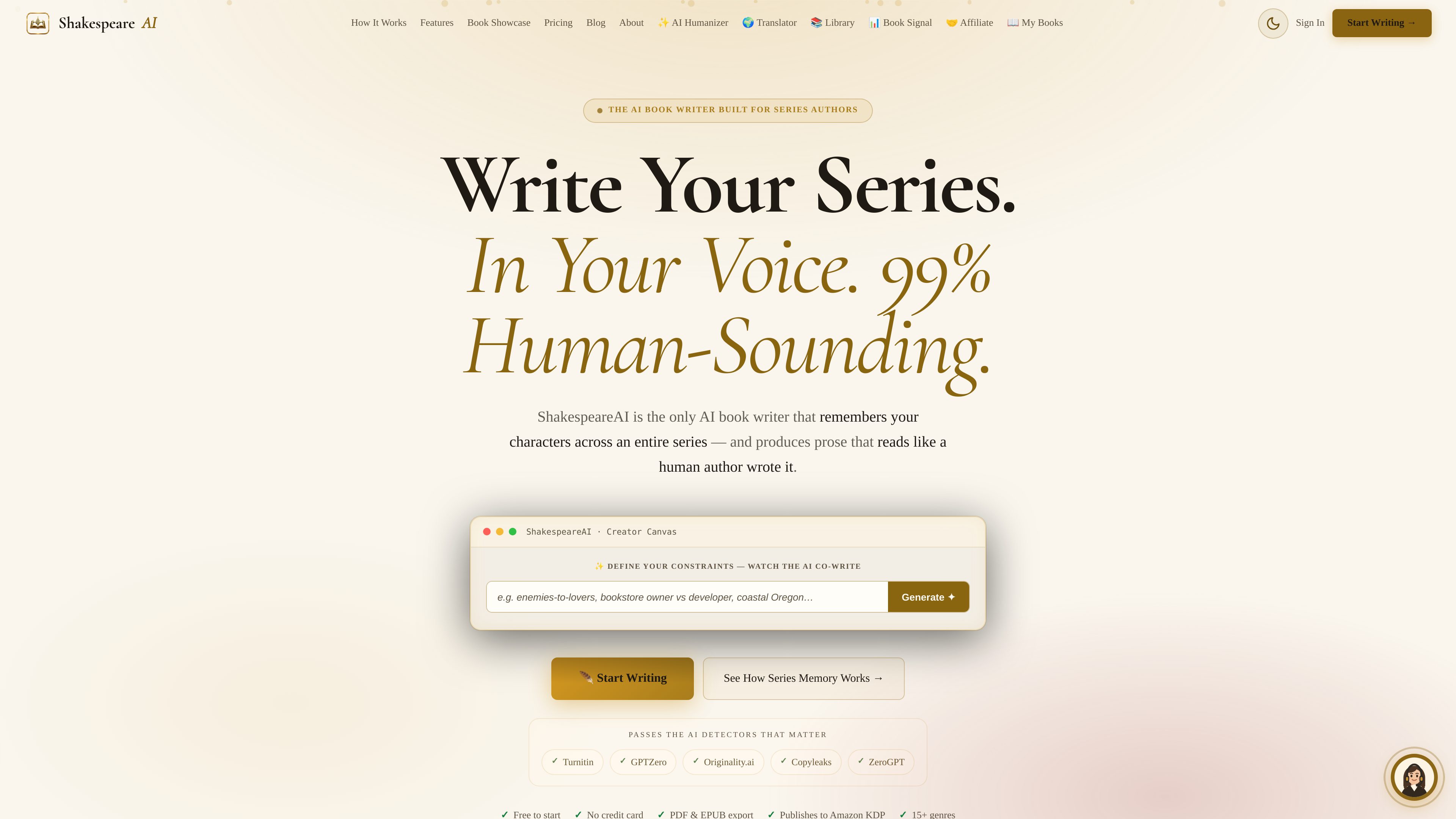
Concept-to-outline workflow
Users select a genre and describe an idea in one or two sentences. ShakespeareAI then generates a chapter-by-chapter structure with plot points, character arcs, and turning points before prose generation.

ShakespeareAI is an AI book-writing platform for creating novels, short stories, and non-fiction books from a concept, genre, and character setup. It supports structured outlining, long-form generation, series continuity, manuscript humanization, and PDF, DOCX, EPUB, or TXT export on eligible plans.
ShakespeareAI is an AI book-writing platform for generating novels, short stories, and non-fiction books from a concept, genre, and character setup. Its workflow can create a chapter-by-chapter outline before drafting prose, with the site describing support for more than 15 genres.
The product is oriented toward longer manuscripts and series work. Series Memory keeps character profiles and world-building rules available across books, and a continuity auditor flags potential conflicts. Users can export manuscripts in formats listed by plan, including PDF, DOCX, EPUB, and TXT; the homepage also states that books can be published to Amazon KDP.
A free Starter plan is available, while paid tiers increase page, book, and model allowances. Additional capabilities shown on the pricing and feature pages include AI Humanizer tools, document upload, premium models, author-focused workspaces, translation, custom templates, and—on Pro Max—Voice Engine features for learning from an existing backlist.
Users select a genre and describe an idea in one or two sentences. ShakespeareAI then generates a chapter-by-chapter structure with plot points, character arcs, and turning points before prose generation.
Persistent character profiles and world-building rules are designed to carry across books in a series. A continuity auditor is described as flagging conflicts between story details.
The platform generates novels, short stories, and non-fiction books, with genre options including romance, thriller, fantasy, science fiction, mystery, horror, children’s writing, and other categories.
The Humanizer can be used inline while writing or in bulk across a manuscript. The subscription page lists document upload on selected plans and separate humanizer-only access.
The subscription page lists PDF, DOCX, EPUB, and TXT exports on eligible paid plans. The homepage also identifies PDF and EPUB export and states that users can publish to Amazon KDP.
Higher plans add features such as premium AI models, Author Studio, Character Lab, custom templates, book translation, and—on Pro Max—Voice Engine tools that learn from an author’s uploaded books.
Series authors can maintain recurring character profiles and world-building rules across installments, using continuity checks to identify possible inconsistencies.
A writer with an initial idea can choose a genre, provide a short concept description, review an automatically generated outline, and proceed to a longer manuscript draft.
Users can apply the book-generation workflow to non-fiction projects, including structured manuscripts that can be exported for further editing and layout.
Authors can use the listed PDF, DOCX, EPUB, or TXT exports on eligible plans and follow the site’s stated workflow for publishing books to Amazon KDP.
Authors with an existing backlist can use the Pro Max Voice Engine to upload prior books and generate text intended to reflect their sentence rhythm, vocabulary, and narrative voice.
The site describes generation for full novels, short stories, and non-fiction books. It offers more than 15 genres, including romance, thriller, fantasy, science fiction, mystery, horror, children’s writing, and self-help or productivity-related content.
The documented workflow is to choose a genre, describe the concept, let the system build a chapter-by-chapter outline, and then generate the book. The outline includes plot points, character arcs, and turning points before prose is written.
Yes. The Starter plan is listed at $0 per month and allows one book per month, up to 25 pages per book, with a 50-page monthly allowance and watermarked PDF export. It also includes 10 Humanizer pages per month and does not include audiobooks.
The subscription page lists PDF, DOCX, EPUB, and TXT exports on eligible paid plans. The free Starter plan is specifically described as providing watermarked PDF export. The homepage also states that PDF and EPUB files can be exported.
Yes. Series Memory is described as retaining character profiles and world-building rules across books, with a continuity auditor that flags conflicts. The product is specifically presented for authors working on series.
Os dados de tráfego são apenas para referência.