
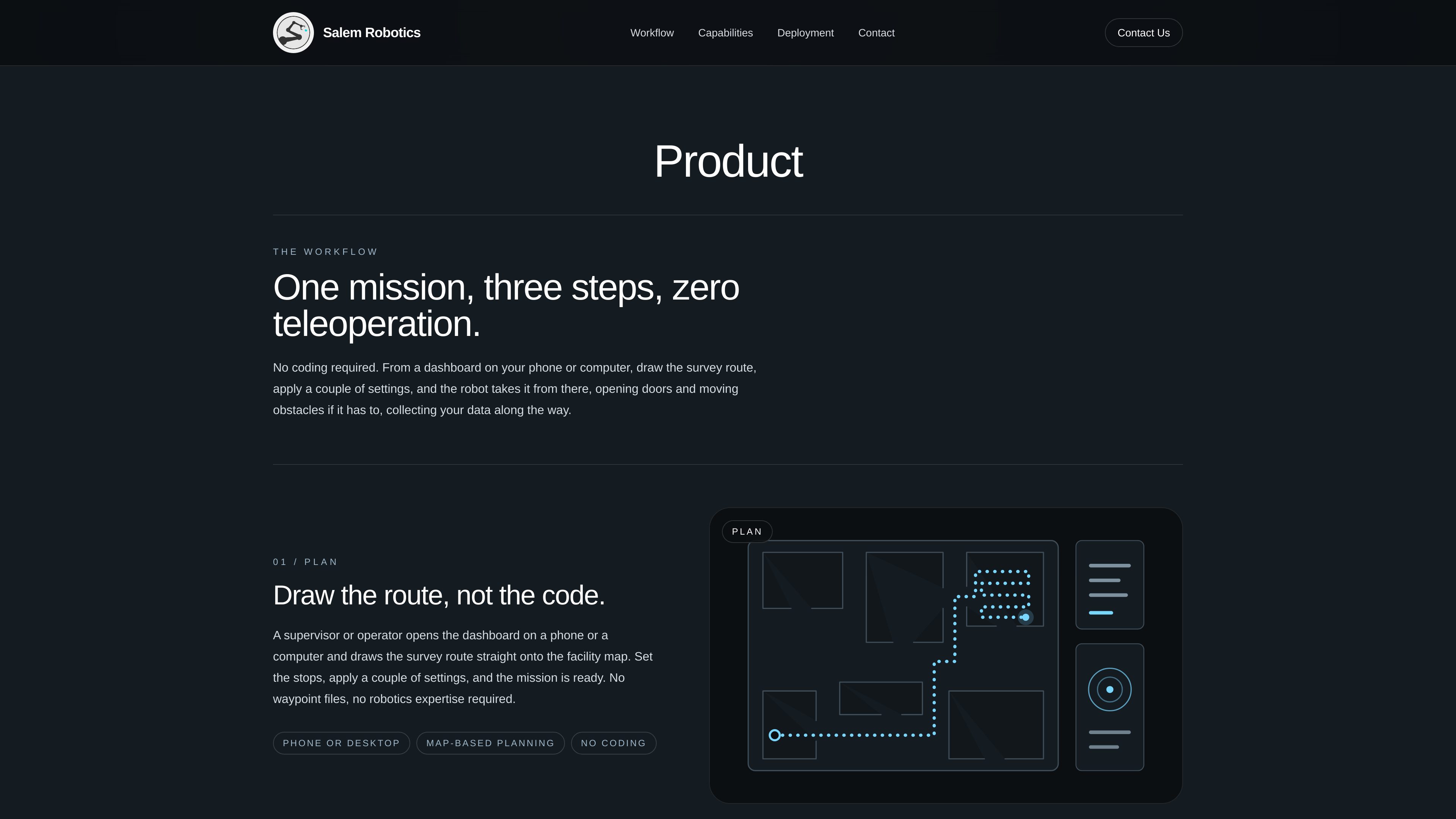
Map-based mission planning
A supervisor can draw the survey route directly on a facility map from a phone or desktop dashboard, then set stops and mission settings without coding or waypoint files.
Salem Robotics é um software de autonomia para instalações industriais perigosas. Ajuda as equipes a planejar, executar e documentar missões autônomas de inspeção e coleta de dados com robôs existentes ou um sistema fornecido pela Salem.
Salem Robotics is a software platform for autonomous inspection, survey, and monitoring operations in hazardous industrial environments. It combines mission planning, robot execution, data collection, and reporting so a supervisor can define a route, let the robot carry out the mission, and receive reviewable outputs at the end.
The workflow is built around three stages: plan, execute, and report. Operators draw a survey route on a facility map from a phone or desktop dashboard, set stops and a few mission settings, and then the robot handles the mission without teleoperation. During execution, Salem is described as handling tasks such as opening doors, working around people and equipment, and moving obstacles when needed.
The platform is aimed at inspection-heavy workflows such as nuclear inspection, radiological survey, LDAR, corrosion, NDT, and temperature measurement. It is designed to produce time-stamped, spatially linked records, heatmaps, and AI-assisted insights that map readings back to the facility and support compliance review. The site also says Salem is hardware-agnostic and can be deployed on existing robotic systems or as a complete Salem system.
A supervisor can draw the survey route directly on a facility map from a phone or desktop dashboard, then set stops and mission settings without coding or waypoint files.
The robot carries out the route without teleoperation and is described as handling doors, obstacles, and movement around people and equipment during the mission.
The platform supports autonomous inspection, survey, and monitoring missions and is described as suitable for nuclear, radiological, LDAR, corrosion, NDT, temperature, and other mission-specific data collection.
Each mission ends with a compliance-ready report that organizes readings into reviewable outputs instead of disconnected field notes.
Readings are mapped back to the facility as heatmaps and other location-aware artifacts, making it easier to review where data came from.
Salem can extend existing robotic systems already in use at industrial facilities, or be deployed as part of a complete Salem system.
Teams can automate recurring inspection routes that would otherwise require technicians to enter restricted areas and document results by hand.
The site positions Salem for nuclear inspection and radiological survey workflows where exposure limits, documentation, and route repeatability matter.
Facilities can use the platform to gather mission-specific measurements such as corrosion checks, NDT data, LDAR readings, and temperature measurements during the same autonomous run.
Organizations with robots already deployed on site can add Salem’s autonomy and data layer rather than replacing their hardware stack.
Compliance-focused teams can use the system to generate time-stamped, spatially linked mission records that are easier to review than handwritten notes or fragmented logs.
No. The site says operators can draw the route on a facility map from a phone or computer and set mission stops and settings without coding or waypoint files.
Yes. The company says the platform is hardware-agnostic and can extend robotic systems already working in industrial facilities.
The site describes compliance-ready reports, spatially linked readings, heatmaps, and AI insights that flag potential safety risks.
No. Nuclear is described as the initial focus, but the product copy also references adjacent hazardous industrial applications such as LDAR, corrosion, NDT, and temperature measurement.
No. The pricing page currently returns a 404, so pricing and commercial terms are not available from the provided site content.
Os dados de tráfego são apenas para referência.

balsa-ui.com
Balsa UI é um sistema de componentes agent-native e de código aberto para Vue e React. Ajuda as equipes a criar sistemas de design e desenvolver interfaces com fluxos de trabalho assistidos por agentes.

humaans.io
Humaans é um HRIS com IA para equipes em crescimento, centralizando dados de pessoas e automatizando fluxos de RH.

supernova.ai
Supernova AI centraliza, explora e visualiza dados para startups e equipes em crescimento.

bulbthings.com
Bulbthings é uma plataforma de gestão de ativos que permite acompanhar equipamentos, inventário, manutenção e fluxos de trabalho relacionados em um único sistema. Oferece um plano gratuito para equipes pequenas e planos pagos e serviços adicionais para necessidades maiores ou mais específicas.

prized.dev
Prized ajuda equipes de operações, suporte e finanças a criar e lançar ferramentas internas com IA, com dados da empresa pré-conectados e delimitados, um registro de auditoria de acessos e implantação protegida pelo login corporativo.

www.welaunch.sh
welaunch.sh ajuda fundadores a planejar sua primeira ação de aquisição de clientes, gerando um plano de lançamento priorizado, textos específicos para cada canal e links de publicação pré-preenchidos com um clique a partir da URL do produto.