
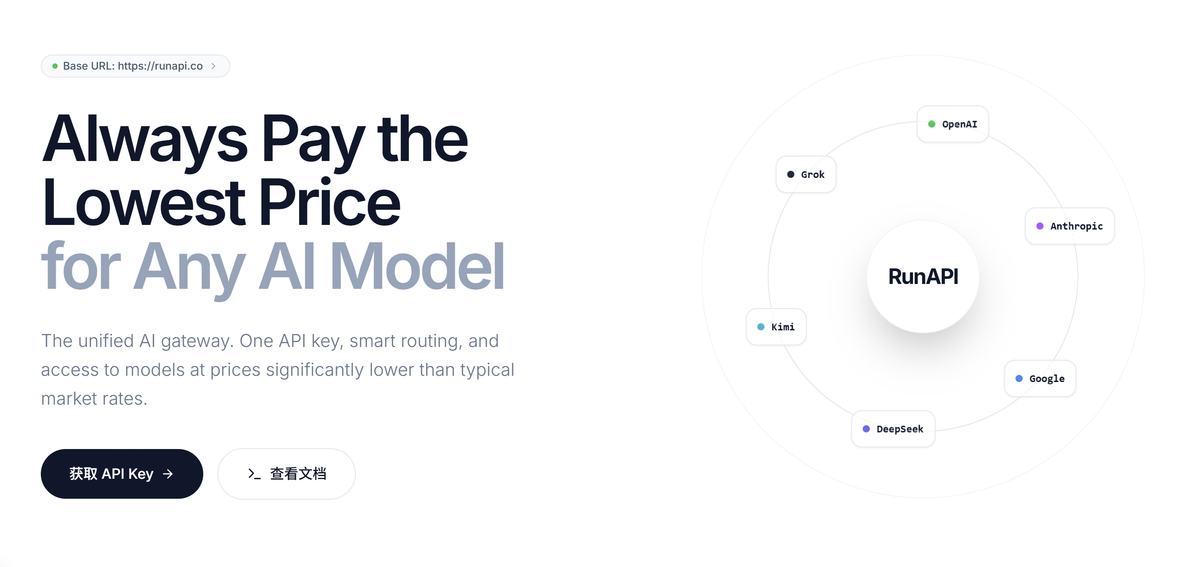
Multi-model API interface
Send requests to supported text, image and video models through one gateway interface.

One API gateway for multiple AI models, with price-and-latency routing and automatic provider failover.
RunAPI is an API aggregation service for applications that use multiple AI models. It brings text, image and video model access behind one interface and routes requests across supplier nodes based on price and latency.
The gateway combines provider routing, automatic failover and request caching. It also supports AI coding tools such as Claude Code and OpenClaw. Developers can use it to consolidate model access for an application or coding workflow rather than maintaining a separate integration path for each supplier.
Choose a supported model and configure the client for the gateway. Before using it in a production workflow, test request formats, model responses, and error handling for the selected workload. Routing and failover help manage provider differences; they do not guarantee that every request is the cheapest or that service is uninterrupted.
Send requests to supported text, image and video models through one gateway interface.
The routing layer evaluates price and latency in real time when selecting a supplier node for a request.
Automatic failover can direct requests through alternative available provider nodes when a supplier is unavailable. Check how the selected workload handles errors and provider changes.
Caching is used to reduce repeated-request costs and improve response speed.
Use the gateway with supported coding tools, including Claude Code and OpenClaw.
Connect text, image and video model requests through a common model-access service for an application.
Use RunAPI for supported AI coding tools when consolidating the model services used in a development workflow.
Use price-and-latency routing and automatic failover for workloads that can be served through alternative AI suppliers.
RunAPI supports text, image and video models through its unified API interface.
Routing considers both price and latency when selecting a supplier node; cost is one part of the decision.
Supported tools include Claude Code and OpenClaw. Configure the tool for the gateway and verify the selected model’s request and response behavior before replacing an existing connection.
No. Automatic provider failover provides an alternative path when supported nodes are available. Monitor errors and verify responses for the models and workload you use.
Os dados de tráfego são apenas para referência.