
Interaction publishing
Send user-agent conversations, session information, agent versions, metadata, and retrieved learnings to Reflexio so the system can analyze completed turns.

Reflexio é uma plataforma de aprendizagem para agentes de IA que transforma resultados de interações e correções dos usuários em orientações comportamentais recuperáveis. Os desenvolvedores podem conectar um ciclo de reflexão, avaliação e recuperação a agentes existentes por meio de APIs hospedadas, um SDK Python, REST ou uma CLI e um backend locais.
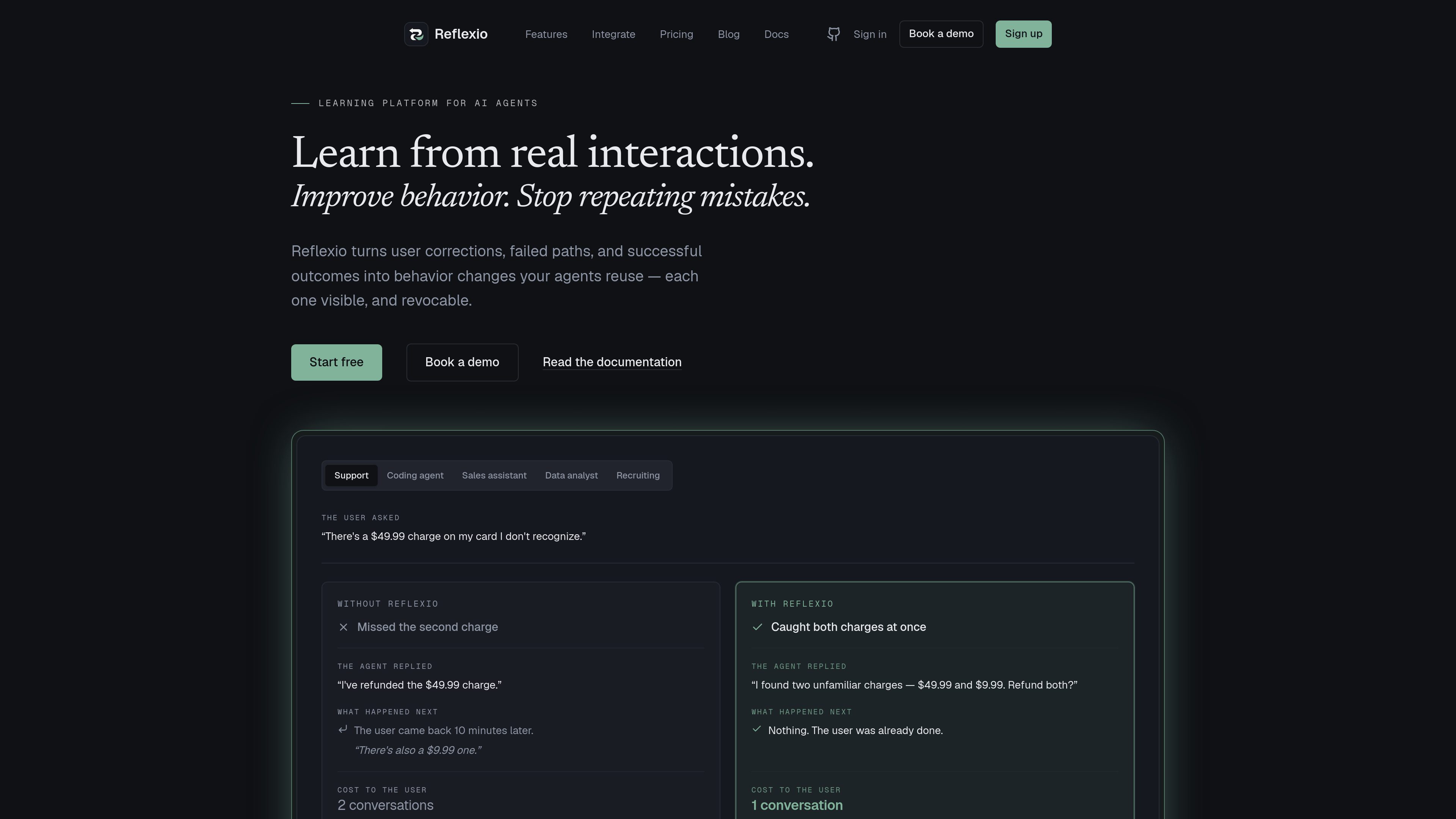
Reflexio is a behavioral learning platform for AI agents. Instead of only storing what users said, it captures interactions, corrections, and outcomes to identify how an agent should behave differently in similar situations. The resulting learnings can be retrieved before a later response and are intended to reduce repeated mistakes without retraining the underlying model.
The platform supports a loop in which an agent retrieves relevant profiles or playbooks, produces a response, and publishes the completed interaction back to Reflexio. Developers can use the hosted service, connect through Python or REST, or run the open-source local backend and CLI. Learnings can be reviewed, approved, rejected, revised, and evaluated against an un-augmented response.
Send user-agent conversations, session information, agent versions, metadata, and retrieved learnings to Reflexio so the system can analyze completed turns.
Search profiles and user or agent playbooks before an agent responds, then inject selected context into the model prompt. Retrieval can be filtered and limited for the application’s token budget.
Convert corrections, triggering conditions, and successful or failed outcomes into actionable signals about how the agent should act in future situations.
Compare a candidate response with an un-augmented control response and use the resulting evidence to revise learnings over time.
Inspect learned rules and their statuses, approve or reject them, and remove rejected learnings from retrieval. The API also includes profile, playbook, configuration, evaluation, and data-rights operations.
Connect through a Python SDK, REST API, CLI, or integration skill. The service can be managed by Reflexio, use customer model credentials or storage, or run in a customer AWS, GCP, or Azure account.
A support agent can learn to inspect the full window of recent charges before resolving one unfamiliar transaction, reducing the chance of asking the customer to return with a missed issue.
Developers can use business-specific extractors and playbooks to capture recurring coding feedback, such as how an agent should respond to a syntax or implementation error.
A sales agent can use retrieved profiles and learned playbooks to apply recurring interaction guidance when handling later conversations.
Teams can publish analyst-agent interactions and retrieve relevant learned behavior for subsequent analysis tasks, while retaining a reviewable learning record.
Teams that need local development or a customer-controlled environment can use the open-source CLI and local FastAPI backend, or discuss a BYOC deployment in their own cloud account.
The documented minimum loop retrieves profiles and playbooks before the agent responds, passes selected context to the LLM, and publishes the completed interaction afterward. The site says the SDK can wrap existing LLM calls without an agent rewrite.
No. The product describes a retrieve-and-publish learning loop rather than model retraining. Learned behavioral context is retrieved and injected at inference time.
The site documents a Python SDK, REST access, a CLI, and an integration skill for coding agents. The local open-source package includes the Python SDK, CLI, and local FastAPI server.
Yes. Learnings are presented as reviewable rules with statuses such as approved, pending, and rejected. The site states that rejecting a learning removes it from retrieval, and the API includes playbook and configuration management.
Reflexio offers a managed service, split arrangements using customer model credentials or storage, and BYOC/self-hosted deployment in AWS, GCP, or Azure. The documentation also describes a local open-source backend using SQLite by default.
Os dados de tráfego são apenas para referência.

www.maximem.ai
Maximem Synap é uma plataforma de memória agêntica e gestão de contexto para agentes de IA. Registra conversas, cria memórias estruturadas e delimitadas e recupera contexto conciso por meio de SDKs, APIs, MCP e adaptadores nativos para 23 frameworks de agentes.

build.reflex.dev
Reflex Build transforma prompts em aplicações Python para implantação no Reflex Cloud, na sua própria nuvem ou localmente, com templates prontos para produção e integrações para agentes e ferramentas de programação.

buildonto.dev
Onto ajuda proprietários de sites a tornar suas páginas mais fáceis de ler para agentes de IA, fornecendo Markdown limpo no mesmo URL. Também oferece análises de visitas de agentes e uma pontuação de legibilidade AIO. Desenvolvedores podem buscar e processar conteúdo da web pela Read API ou pelo servidor MCP.

braintrust.dev
Braintrust é uma plataforma de observabilidade de IA para rastrear o comportamento da IA em produção, executar avaliações e identificar regressões antes que cheguem aos usuários. Ela ajuda as equipes a criar e operar produtos de IA com traces, conjuntos de dados, pontuação e ferramentas de workflow.

skillsmp.com
SkillsMP é um marketplace gratuito para descobrir habilidades de agentes open source em repositórios públicos do GitHub, com pesquisa, navegação, API REST e acesso MCP para Claude Code, Codex CLI e ChatGPT.

pangea.cloud
Pangea é uma plataforma de segurança para aplicações de IA que adiciona proteções a prompts, resultados, acesso a dados e registos. Proteja fluxos de trabalho LLM através de APIs, SDKs, ferramentas de IA ou gateways de API.