
Discounted recording usage
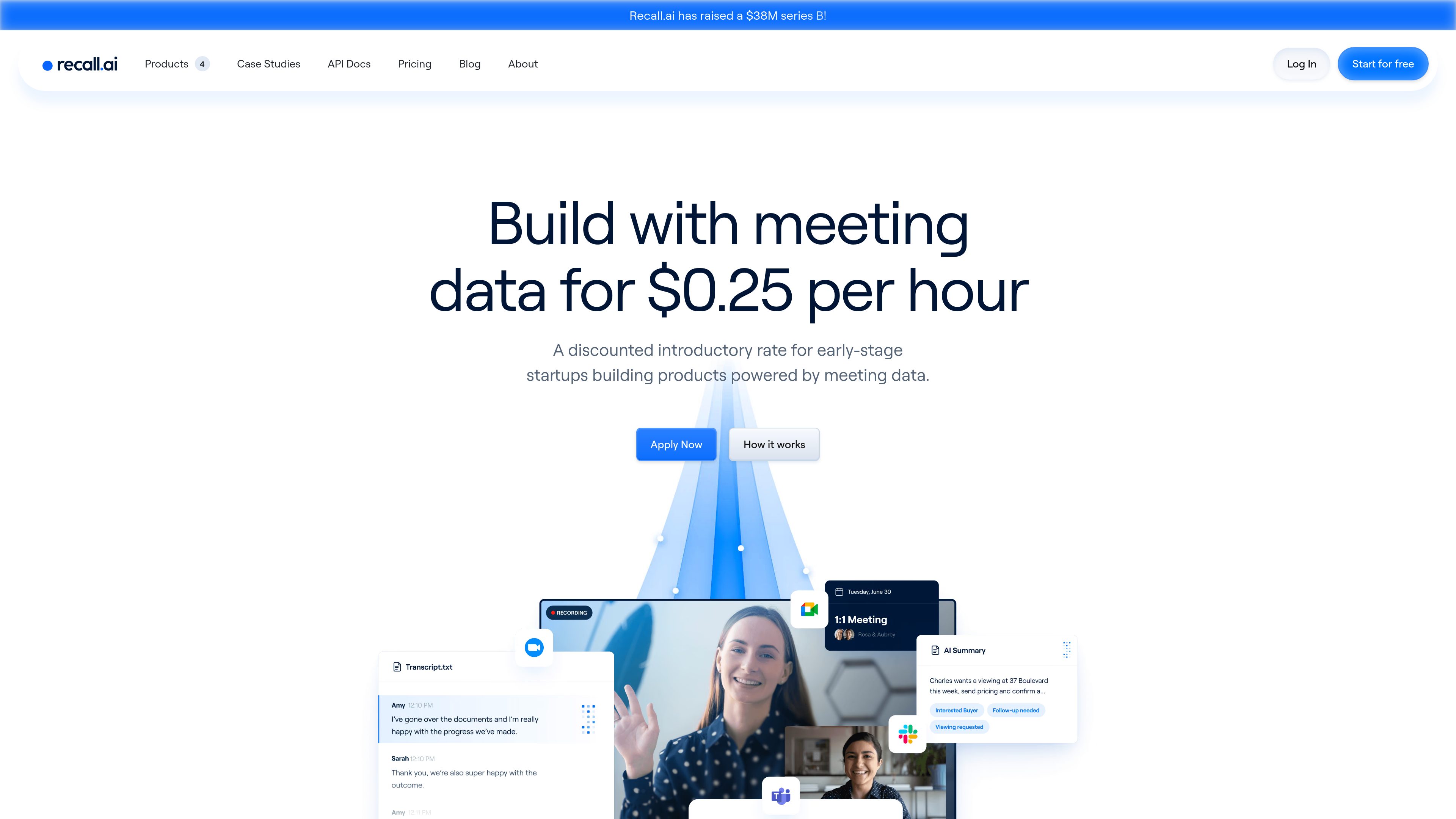
Approved startups receive an introductory rate of $0.25 per recording hour for their first 10,000 recording hours.

A startup program for early-stage companies building products powered by meeting and conversation data. Approved applicants receive discounted recording usage, access to Recall.ai products, and support while they build and launch.
The Recall.ai Startup Program is for early-stage companies building products around recorded conversations and meeting data. It combines a discounted introductory recording rate with access to Recall.ai’s recording and transcription APIs, calendar integration, and recording form factors.
Applicants explain what their company is building, then Recall.ai reviews the application. Approved startups receive a rate of $0.25 per recording hour for their first 10,000 recording hours, with global availability. The program also includes direct support from Recall.ai engineers while teams build and launch.
The included product scope supports different recording approaches. The Meeting Bot API captures meeting data through a bot that joins a call, while the Desktop Recording SDK records from a user’s Mac or Windows computer without a bot appearing in the meeting. Calendar integration can add meeting context such as titles and participant emails.
Approved startups receive an introductory rate of $0.25 per recording hour for their first 10,000 recording hours.
The program includes access to Recall.ai products for capturing meeting recordings and transcripts as part of a conversation-data product.
Teams can use the Meeting Bot API, which records through a bot joining the meeting, or the Desktop Recording SDK, which records on a user’s Mac or Windows computer without a meeting bot.
The Calendar API can work with the recording products to support calendar-based meeting workflows and enrich recordings with details such as meeting titles and participant emails.
Startups receive direct help from Recall.ai engineers while they develop and launch their product.
An early-stage team can use the program’s recording and transcription access as the infrastructure layer for a product whose core workflow depends on recorded conversations.
A product that needs to capture meetings without requiring user installation can use the Meeting Bot API, while a desktop application that should record without a visible bot can use the Desktop Recording SDK.
A team building calendar-aware meeting workflows can combine recording products with the Calendar API to associate recordings with scheduled meetings and related metadata.
A startup can use the introductory usage rate and engineering support to develop and validate its meeting-data workflow before launching its product.
It is for early-stage startups where meeting data is core to the product and the company is building around recorded conversations.
Approved applicants receive a rate of $0.25 per recording hour for their first 10,000 recording hours.
Applicants submit information about their company and what they are building. Recall.ai reviews the application, and approved teams can then start building with the program rate.
The program page lists access to recording and transcription APIs, calendar integration, and recording form factors. Recall.ai’s product suite includes the Meeting Bot API and Desktop Recording SDK; the Mobile Recording SDK is listed separately as coming soon.
Yes. The Startup Program lists its availability as global.

www.speechmatics.com
Speechmatics provides speech-to-text APIs for pre-recorded and real-time audio, with support for multilingual speech, multiple speakers, and voice-agent workflows. It is designed for teams building transcription and Voice AI applications.

speechify.ai
SpeechifyAI is a developer API for expressive text-to-speech and voice cloning. It provides streaming Simba models, catalog and cloned voices, SSML support, and a free starting tier for building speech into applications.

4allapi.com
4ALL API is an API aggregation gateway for enterprises and developers that provides one access layer for text, image, video, and audio models from multiple providers. It supports OpenAI-compatible access, usage-based billing, model routing, and failover workflows.