
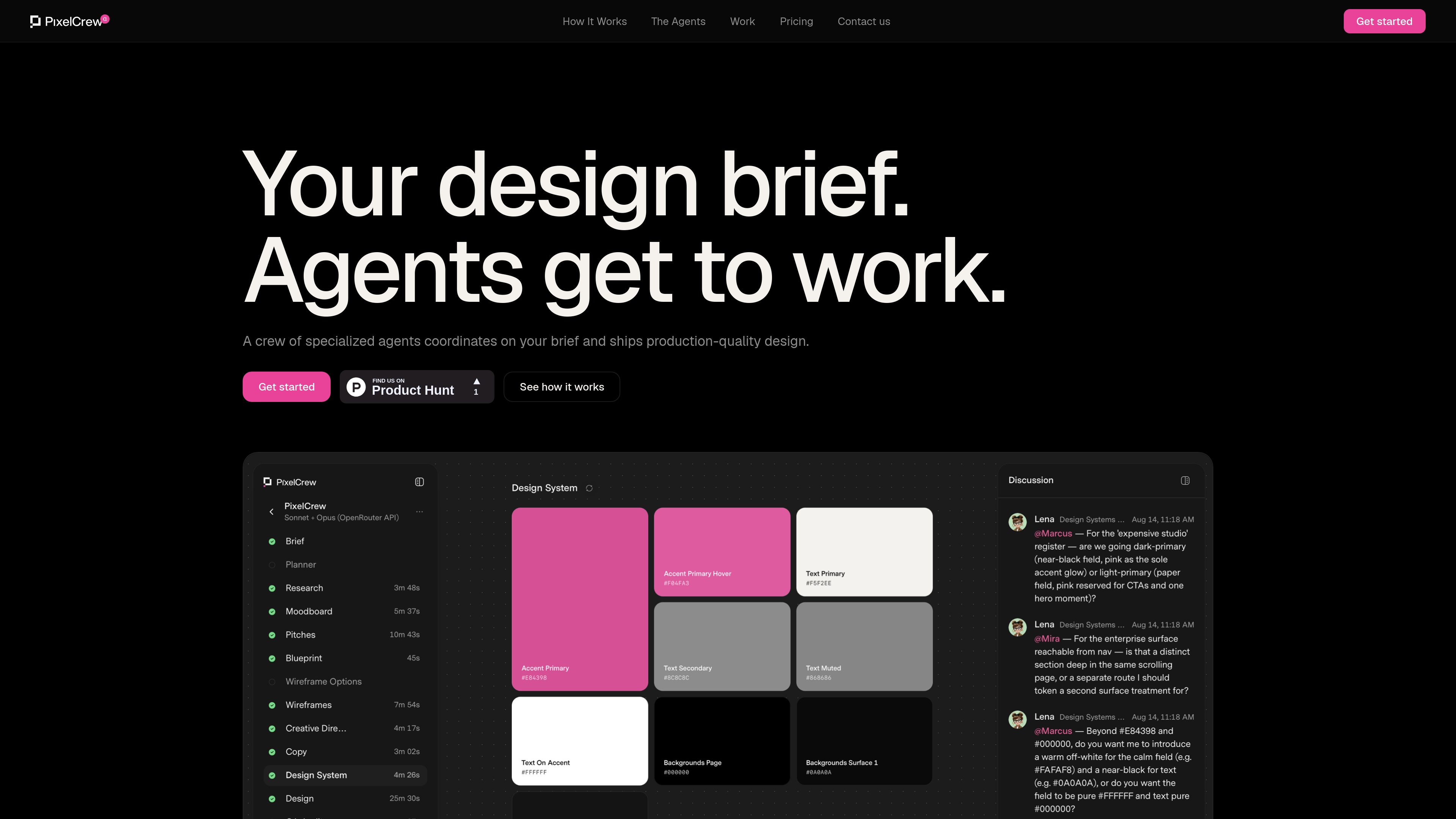
Sequential specialist agents
Elena handles research and strategy, Marcus develops creative direction, and Mira defines UX architecture before the build crew produces the final materials.

PixelCrew é um fluxo de trabalho de design com AI que coordena agentes especializados para transformar um briefing escrito em pesquisa, direção criativa, wireframes de UX, textos, recursos para o sistema de design, documentação de QA e HTML/Tailwind pronto para produção. É voltado a pessoas e equipes que precisam de sites, dashboards, landing pages ou sistemas de design sem começar por um template rígido.
PixelCrew is an AI-assisted design production workflow built around a crew of specialized agents. A user submits a free-form brief, and the agents work sequentially: research establishes audience and information architecture, art direction defines the visual approach, and UX architecture turns that direction into flows, wireframes, and screen specifications.
The workflow continues through copy, design-system assembly, QA, and final review. The stated outputs include production HTML and Tailwind, design-system files, documentation, and supporting artifacts that can be shipped directly or handed to a developer. PixelCrew reports an average delivery time of 25–45 minutes, although the site does not define how that average varies by brief complexity.
Elena handles research and strategy, Marcus develops creative direction, and Mira defines UX architecture before the build crew produces the final materials.
Users describe needs in free text rather than completing a predefined template. The site lists landing pages, product dashboards, design systems, and pitch decks as examples.
The research stage can cover audience personas, competitive analysis, jobs-to-be-done mapping, and information architecture recommendations.
The workflow produces three visual pitches, a moodboard, a creative brief, wireframes, user flows, navigation specifications, and section-by-section composition guidance.
Later stages assemble copy, tokens, type scale, colors, components, production HTML, Tailwind output, and documentation.
Screens go through a QA audit and final review, with issues flagged, revised, and rechecked before delivery.
A founder or marketing team can submit a brief for a new landing page and receive a researched structure, visual direction, wireframes, copy, and production HTML.
A product team can use the workflow to develop dashboard architecture, navigation, interaction states, and a component set before engineering implementation.
Teams starting a new interface can request tokens, type scale, colors, components, and documentation as part of a broader design deliverable.
A business with a specific atmosphere or content structure can describe that intent in a brief and receive a tailored site concept with production-oriented outputs.
A team that already knows what it wants but lacks design-production capacity can use the generated HTML, Tailwind, documentation, and design-system files as implementation material.
The site describes outputs including research briefs, personas, information-architecture specifications, moodboards, creative briefs, wireframes, UX flows, navigation specifications, copy, design tokens, components, QA reports, production HTML, Tailwind, design-system files, and documentation.
Users submit a free-text description of what they need. The agents then work in sequence, beginning with research and strategy, followed by creative direction, UX architecture, build work, copy and design-system assembly, QA, and final review.
The site names landing pages, product dashboards, design systems, and pitch decks as examples. Demonstration projects also include a coffee-shop website, an automotive landing page, a task manager web app, and a retail coffee-roastery site.
During alpha, users bring their own key. The site recommends OpenRouter and says Anthropic and Google Gemini keys also work. It states that users paste the key into PixelCrew once and set their own spend limit.
PixelCrew states that it charges nothing during alpha, with no subscription, markup, or card on file. Users are responsible for model costs billed by their key provider; the site says a typical brief costs a few dollars in model usage, without defining a fixed price.
Os dados de tráfego são apenas para referência.

tastemaker-skill.online
Tastemaker é uma habilidade de fluxo de trabalho para agentes de programação que transforma o contexto do produto e referências visuais em telas de UI, recursos, sistemas de cores com contraste verificado e decisões locais de design. Foi criada para agentes como Claude Code, Windsurf e Gemini CLI.

uxpin.com
UXPin é uma ferramenta de design de UI e prototipagem com bibliotecas React, layouts assistidos por IA e entrega de código pronto para produção.

paper.design
Paper conecta canvas, código e agentes de IA para que as equipes criem, compartilhem e entreguem em um só fluxo.

magicpath.ai
Canvas de design compartilhado para pessoas e agentes de IA

ludo.ai
Plataforma de IA para pesquisa, design e pré-produção de jogos

uxmagic.ai
UXMagic é um gerador de UI com IA que transforma textos, esboços, capturas de tela e URLs em designs prontos para Figma, com exportação para HTML ou React e importação de sistemas Figma.