
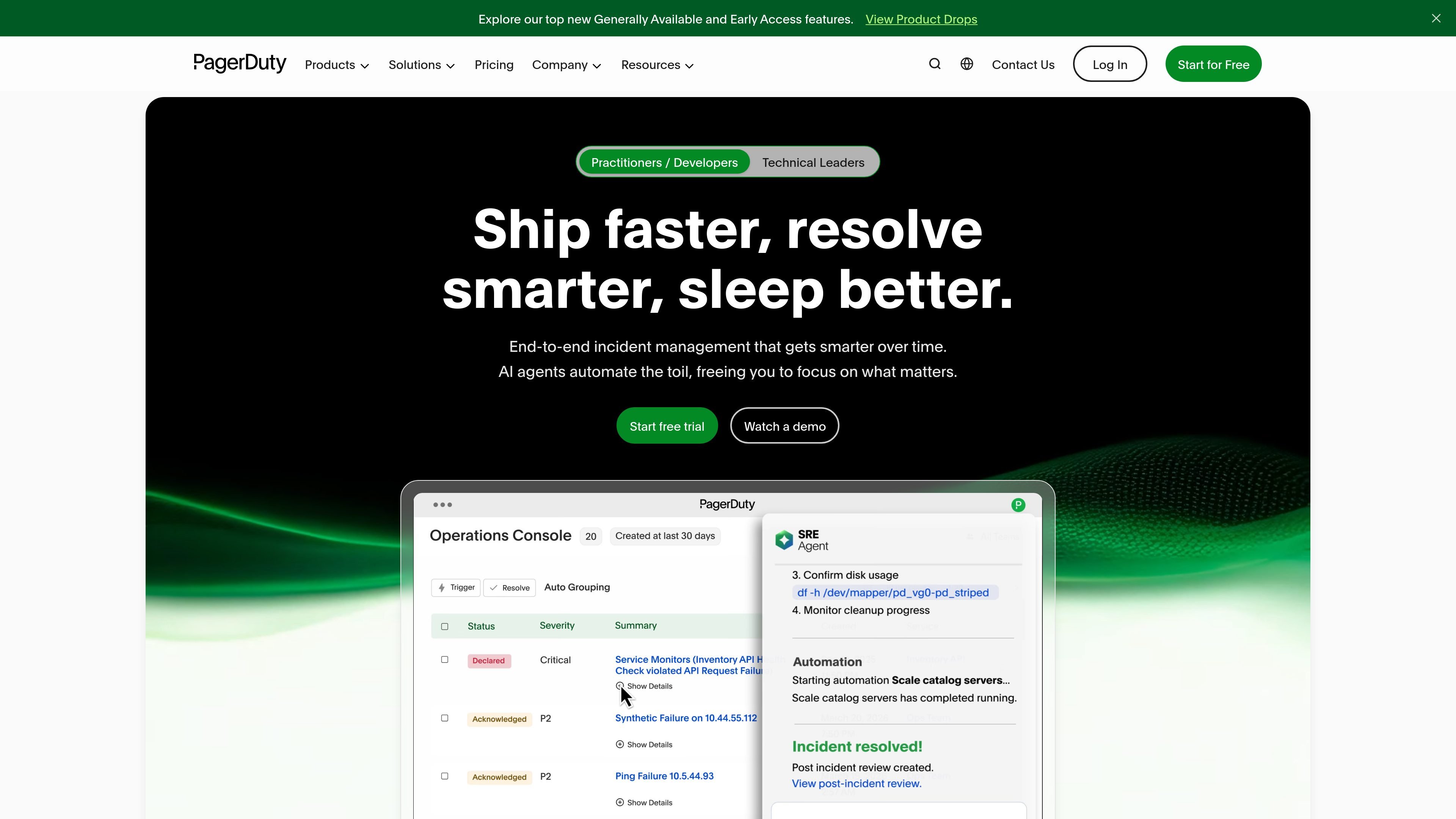
Alert routing and escalation
Deduplicate incoming events, apply service and routing rules, and notify responders through schedules and escalation policies. Severity and priority fields provide context for handling the incident.

Route service alerts to on-call responders, coordinate incidents, and track post-incident work.
PagerDuty is an operations platform for engineering, SRE, and IT teams responding to disruptions in digital services. It connects monitoring alerts to services, on-call schedules, and escalation policies, then provides incident coordination and follow-up workflows. Responders can work in Slack, Microsoft Teams, or the iOS and Android apps.
Teams can start with a limited Incident Management Free plan, add paid incident-management capabilities, or use the broader PD Reliability Platform. AI assistance and advanced automation depend on the selected plan and add-ons.
Deduplicate incoming events, apply service and routing rules, and notify responders through schedules and escalation policies. Severity and priority fields provide context for handling the incident.
Use the Service Directory to identify services and their owners. Map business services to technical dependencies to understand which capabilities an incident may affect.
Manage incidents in Slack or Microsoft Teams. The iOS and Android apps support triggering, acknowledging, and resolving incidents, checking schedules, and creating overrides.
Professional and PD Reliability Platform plans include collaborative reviews, timelines, and assigned follow-up actions. AI-generated review drafts require PagerDuty Advance on Professional and are included in the Reliability Platform plans.
Connect monitoring, security, collaboration, and deployment tools through prebuilt integrations and APIs. Custom Incident Actions can run externally hosted diagnostics or remediation tasks during response.
Connect monitoring tools to the responsible services, configure schedules and escalation paths, and notify the people covering each shift when an incident occurs.
A response team can acknowledge and resolve an incident from chat or mobile while using service ownership, dependencies, and the incident record for shared context.
On paid plans, build a post-incident timeline, collaborate on the review, and assign follow-up work. Eligible AI capabilities can prepare a draft for the team to review.
Incident Management Free supports up to five users, one on-call schedule, and one escalation policy. It includes basic chat and notifications, with 100 global SMS or phone notifications per month. Post-incident reviews and AI-generated reviews are not included.
Professional costs $21 per user per month when billed annually, or $25 per user per month on monthly billing. AIOps, PagerDuty Advance, Runbook Automation, Status Pages, and Live Call Routing are separately purchased add-ons.
Starter has a $2,800 annual platform fee including 10 seats, 5,000 Signal Intelligence Events, and 1,000 AI actions. Larger plans have different allowances. Credit packs can add seats, events, or actions; these are platform allowances rather than unlimited usage.
No. Free excludes them. Professional requires the PagerDuty Advance add-on, while the PD Reliability Platform plans include AI-generated review drafts. Advanced AI and automation should be selected according to the plan and add-ons needed.
Yes. The iOS and Android apps can trigger, acknowledge, and resolve incidents, display on-call schedules, and create schedule overrides. Mobile incident actions are available alongside Slack and Microsoft Teams collaboration.
Os dados de tráfego são apenas para referência.

metoro.io
Metoro helps Kubernetes teams monitor workloads and investigate production incidents by connecting logs, metrics, traces, profiles, and cluster state to alerts and deployment changes.

coisland.app
CoIsland is a native macOS monitoring app that brings alerts from code, deploys, data tools, tickets, mail, and on-call services into the Mac's notch. Engineers can schedule tool-specific queries, review matching items, and hand an alert's context to Claude Code, Codex, or Cortex Code while retaining approval control.