
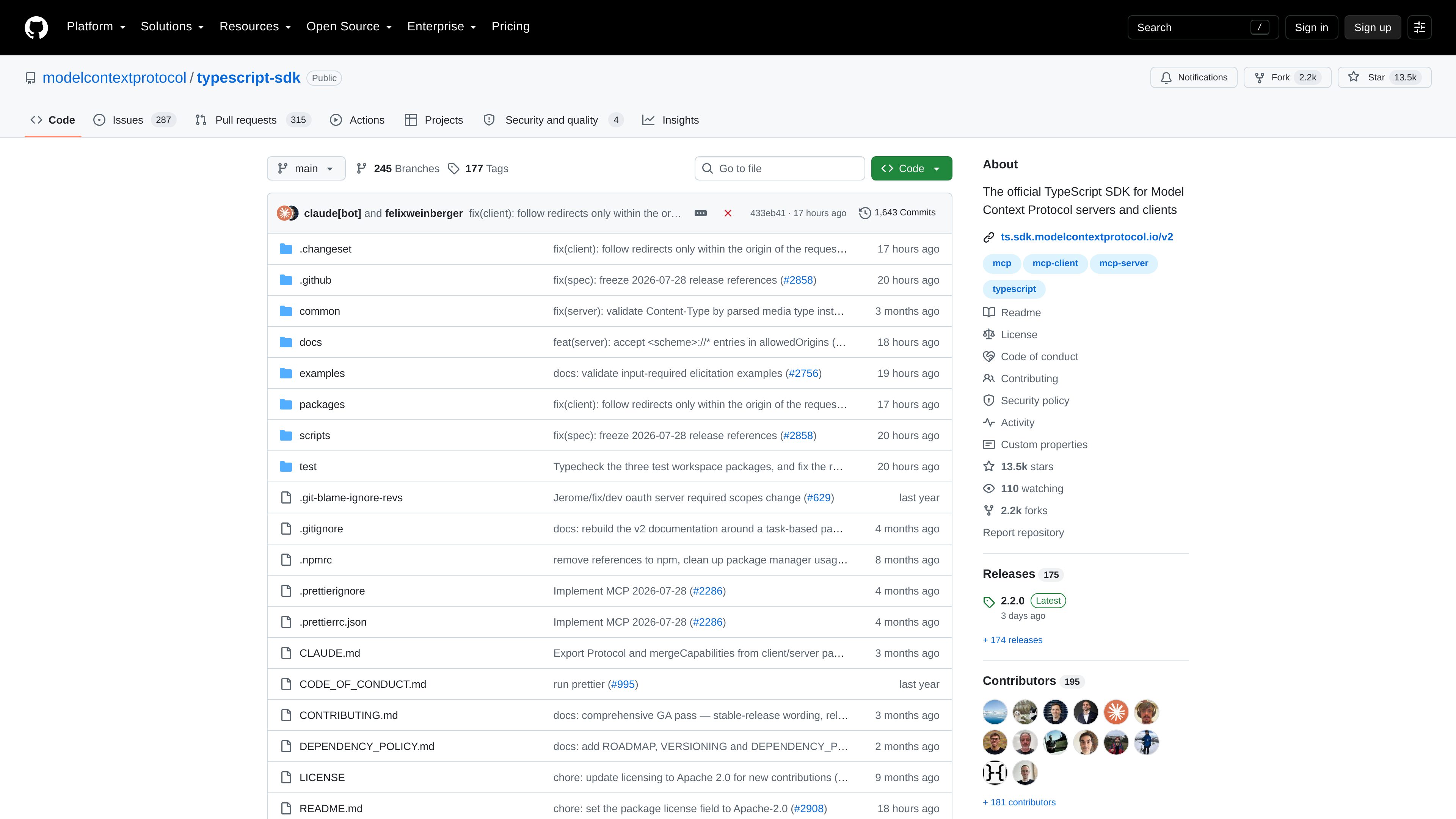
Client and server packages
The package workspace contains dedicated `client` and `server` areas for developers implementing both sides of an MCP connection.

The official TypeScript SDK for building Model Context Protocol servers and clients. It provides a repository-organized foundation for MCP development, with separate client, server, core, middleware, documentation, and example areas.
The Model Context Protocol TypeScript SDK is the official TypeScript SDK for MCP servers and clients. Hosted in a public GitHub repository, it provides the project structure and source packages used by developers implementing MCP software, with separate areas for client, server, shared core, middleware, codemod, documentation, examples, and tests.
Its core purpose is to give TypeScript teams an official starting point for building MCP clients and servers. The repository includes supporting documentation and examples, but the supplied source does not provide enough detail to state a complete list of transports, integrations, setup commands, or protocol capabilities.
The package workspace contains dedicated `client` and `server` areas for developers implementing both sides of an MCP connection.
`core` and `core-internal` packages provide distinct locations for shared SDK foundations and internal implementation code.
A dedicated `middleware` package is included for organizing middleware-related SDK code rather than mixing it into the client or server packages.
The repository includes a `codemod` package and a `server-legacy` package, indicating separate locations for code transformation work and legacy server support.
Dedicated `docs` and `examples` directories give users project guidance and reference implementations to consult while evaluating or building an MCP project.
The repository includes a `test` workspace plus contribution, security, versioning, roadmap, and dependency-policy documentation for working with the project itself.
A TypeScript developer can use the official server package as the starting point for an application that exposes MCP functionality.
An application that needs to act as an MCP client can work from the repository’s dedicated client package instead of maintaining an unrelated client implementation.
Developers evaluating MCP can use the project’s documentation and examples directories to inspect the structure and approach used by the official SDK.
Teams working with older server code can investigate the separate legacy-server and codemod areas when planning maintenance or migration work.
It is the official TypeScript SDK for Model Context Protocol servers and clients, maintained in the public `modelcontextprotocol/typescript-sdk` GitHub repository.
The repository is organized for both use cases, with separate `client` and `server` packages.
The repository contains dedicated `docs` and `examples` directories. The supplied evidence does not include their detailed contents, so consult the current files for setup and implementation guidance.
No. The supplied repository listing confirms the SDK’s main package areas but does not provide a complete transport or integration inventory. Those details should be checked in the current SDK documentation.

gitmcp.io
GitMCP creates a remote Model Context Protocol (MCP) server for public GitHub repositories and GitHub Pages sites. It helps MCP-compatible AI assistants access repository documentation and code context for more relevant coding responses.

0mcp.io
0mcp converts selected operations from an OpenAPI-described API into a hosted Model Context Protocol (MCP) server. It helps SaaS, platform, and internal teams make approved API actions available to MCP-compatible AI clients without implementing and operating the protocol layer themselves.

glama.ai
Glama is a registry and infrastructure platform for discovering, evaluating, and connecting to Model Context Protocol (MCP) servers, connectors, clients, and tools. It supports browsing open-source and remote MCP entries, with hosted access and gateway features described on the site.

ai-sdk.dev
AI SDK is a TypeScript toolkit for building AI-powered applications and agents across supported model providers and web frameworks. It provides shared APIs for model generation, tool use, streaming, structured output, and AI user interfaces.

platform.claude.com
Claude Platform gives developers programmatic access to Claude models and managed agent infrastructure for building agents and applications. It includes a REST API, official client SDKs, a web Console, and documentation for direct integrations.

dspy.ai
DSPy is an open-source framework for programming language-model applications instead of manually prompting them. Its public repository provides the project code, documentation, tests, issue tracking, and contribution workflow.