
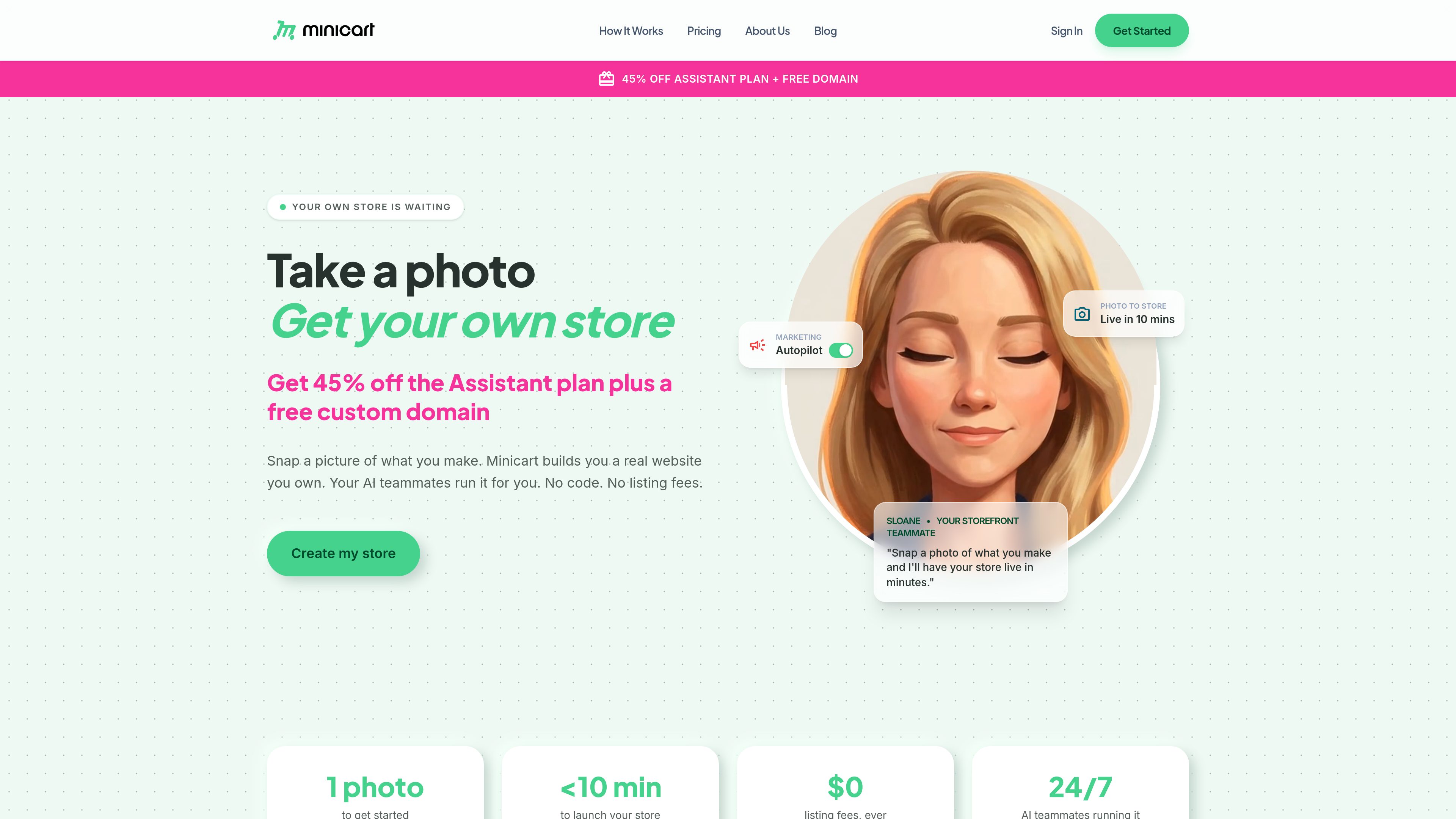
Photo-based store setup
A product photo and a few answers can be used to generate product details, additional product imagery, and an initial storefront for the seller to review.

Minicart is an AI-assisted ecommerce platform for makers, artists, and small studios. It helps users launch a branded online store, manage products and orders, create marketing drafts, handle shipping tasks, and respond to customers through chat.
Minicart is an AI-assisted ecommerce platform for makers, artists, and small studios. It combines a branded online storefront with product management, payments, sales-tax calculations, marketing assistance, order handling, shipping tools, refunds, and customer-reply drafting.
Users operate the store by chatting with AI teammates. Sloane focuses on the storefront and catalog, Milo handles marketing tasks, and Logan supports logistics and customer operations. Proposed updates can be reviewed and confirmed before they go live.
A seller can start by photographing a product, answering a few questions, and reviewing the generated listing and storefront. Minicart also supports catalog imports from Etsy, Shopify, and eBay, allowing an existing seller to build a separate branded store while continuing to operate the original marketplace or platform.
A product photo and a few answers can be used to generate product details, additional product imagery, and an initial storefront for the seller to review.
Users can describe catalog, pricing, inventory, discount, and other store changes in plain language. Minicart shows affected items for confirmation before changes are applied.
Milo can draft social posts, create discount codes or offers, and produce lifestyle imagery. Paid marketing plans add recurring Instagram and TikTok post generation, carousel images, and promotional landing pages.
Logan supports order management, tracking, shipping labels, refunds, return policies, inventory updates, delivery emails, and drafted replies to pre-sale or post-sale questions.
Stores include online hosting, customizable themes, product variants and collections, payment setup, payouts, sales-tax calculations and collection, and support for a custom domain on eligible plans.
Sellers can submit an Etsy, Shopify, or eBay store or seller link to bring products and related catalog information into a Minicart storefront. The source states that the existing store can remain active during the move.
A maker can photograph items such as candles, jewelry, ceramics, prints, knitwear, or woodwork, review the generated listings, and publish a branded store without coding or configuring a theme from scratch.
An Etsy, eBay, or Shopify seller can import an existing catalog and create a store under their own brand and domain while keeping the original selling channel running during setup.
A seller can request bulk changes such as price updates or inventory adjustments, inspect the list of affected products, and confirm only the changes they want to apply.
A small store owner can ask the marketing assistant to create a discount or promotional content for a product collection, then use the resulting social drafts and imagery to support a campaign.
A solo seller can use the logistics assistant for order tracking, shipping-label preparation, refunds, delivery emails, and suggested answers to customer or pre-sale questions.
No coding or design skills are required according to the site. Users can start with a product photo and a few answers, then review and adjust the generated storefront and listings through chat.
Minicart uses the photo and the seller’s answers to create a product listing and storefront. The site says this can include a title, description, pricing suggestion, product photos, and a store on the seller’s domain; the seller reviews the result before going live.
Yes. The site describes a one-click import flow in which the seller pastes an Etsy shop, Shopify store, or eBay store or seller link. Products and catalog details such as photos, prices, variations, and collections may be brought into Minicart, while the existing store can remain active.
The home page says users remain in control and that nothing goes out without their approval. For bulk catalog edits, Minicart displays the affected items so the seller can review, deselect, and confirm changes.
Yes. The pricing page says every AI teammate starts free, with no credit card or setup fee required. Optional paid storefront plans and AI teammate add-ons are available as a store grows, and plans can be changed or canceled.

enalito.com
AI-assisted marketing automation for ecommerce stores, combining segmentation, campaigns, personalization, and analytics.

digitalgenius.com
Handle ecommerce support conversations with AI agents that use business workflows, connected order data, and human handovers.

sessionai.com
An ecommerce marketing agent that predicts purchase intent and selects real-time nudges or offers.

particl.com
Research competitor products, prices, promotions, and estimated ecommerce sales in one platform.

nichebay.com
An AI-assisted dropshipping operations platform for product sourcing, store management, and fulfillment.

glitching.ai
An AI dropshipping platform that helps beginners research products, build Shopify pages, create ads, and plan a launch.