
Plain-language agent planning
Users can describe an agent in plain language and Lunen drafts a structured execution plan with named tools, scoped data, and a schedule.

Lunen é um plano de controle com governança para criar e executar agentes de AI nos sistemas empresariais existentes. As equipes podem aprovar ações dos agentes, controlar permissões e manter um registro de auditoria compartilhado em produção.
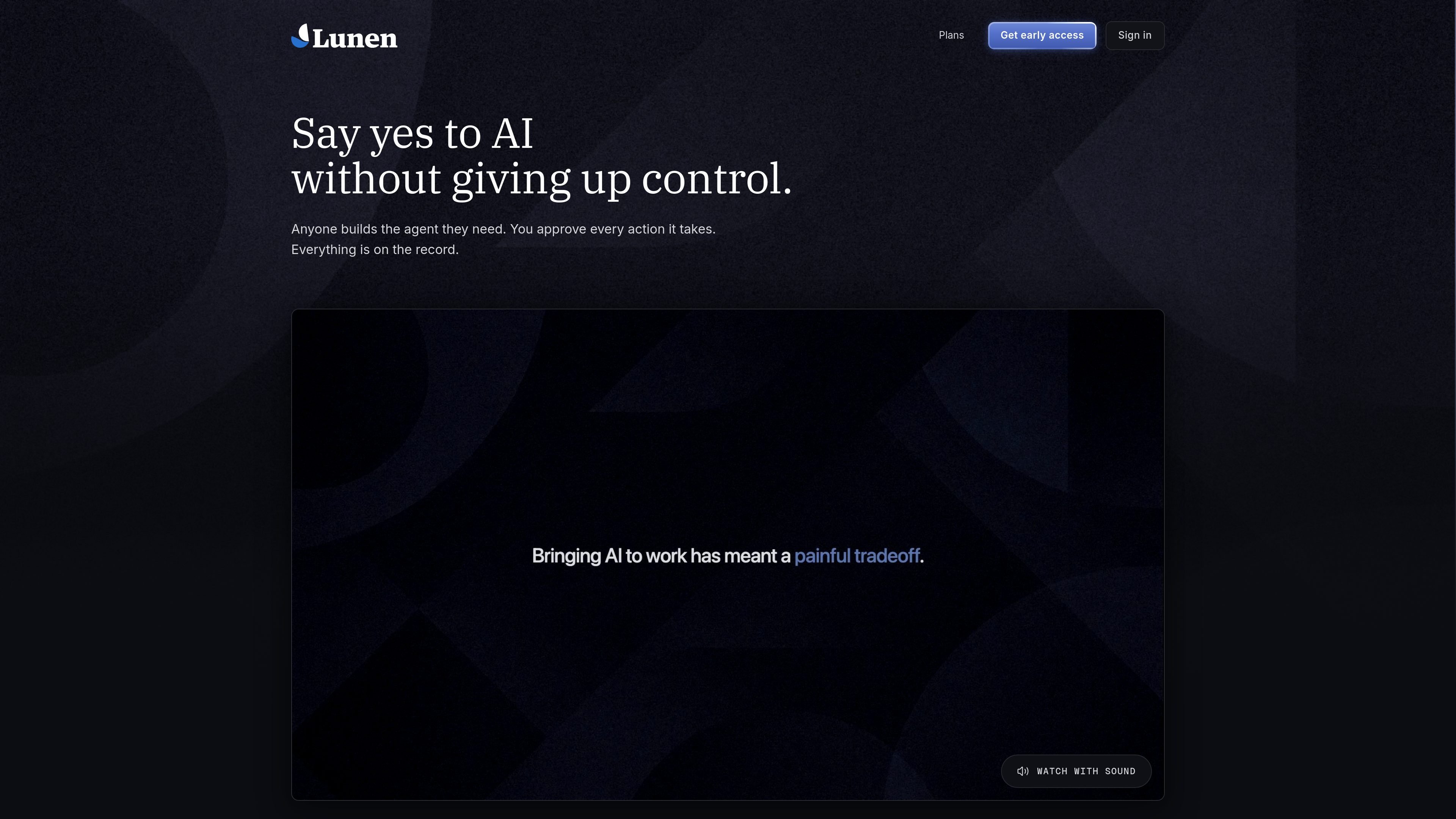
Lunen is a governed control plane for building and running AI agents across existing business systems. It is positioned for teams that want to let people create agents in plain language while retaining approval steps, tool-level permissions, and a shared audit record.
The product is framed around a specific workflow: someone describes an agent, Lunen turns that request into a structured plan, and the team decides whether each tool call can run unattended or must wait for approval. The pricing page shows an Operational Control plan for teams in production and an Enterprise plan for organizations that need dedicated deployment, private networking, and extended retention.
Users can describe an agent in plain language and Lunen drafts a structured execution plan with named tools, scoped data, and a schedule.
Teams can set each tool to run unattended or require a human approval before each call, so access rules can vary by agent and system.
User actions and agent actions roll up into a shared audit log that records who acted, what was approved, what model ran, and which data it touched.
The pricing page includes role-based access control and an allow/approve policy engine for production governance.
Lunen supports connected systems through MCP, and the homepage examples reference Atlassian, BigQuery, Google, HubSpot, Slack, and any MCP server.
Operational Control is offered as a multi-tenant cloud deployment, while Enterprise adds dedicated deployment or BYOC and private networking.
A marketing team can create a lead-scoring agent that pulls recent leads, reviews engagement history, ranks prospects, and posts a summarized list to Slack on a schedule.
A customer success or revenue operations team can ask for a digest of closed-lost deals, then have the agent gather notes and call logs before posting the result to Slack.
A legal or security team can review every tool call before it runs, using approval gates and the audit log to keep production systems reviewable.
An organization adopting MCP-connected tools can apply one policy layer across agents and ad-hoc runs so the same governance rules govern both planned and one-off actions.
A team evaluating enterprise rollout can start with Operational Control in multi-tenant cloud, then consider Enterprise when dedicated deployment, private networking, or extended retention are required.
Lunen is designed for teams that want to build and run AI agents on existing systems while keeping approvals, permissions, and audit history under control. The source describes it as a governed control plane for enterprise AI adoption.
The homepage describes a plain-language workflow: a subject-matter expert describes an agent, Lunen drafts a structured execution plan, and the team reviews it before saving and running it. The plan can include named tools, scoped data, and a schedule.
Lunen applies policies at the tool level. For each MCP tool, teams can allow it to run unattended or require a human approval before each call, and the same policy applies across agents and ad-hoc runs.
The pricing page shows Operational Control for teams and Enterprise for the org-wide control layer. Enterprise adds dedicated deployment or BYOC, private networking, extended and regulated audit retention, custom tool-call volume, and dedicated support with an SLA.
The source says Lunen is in early access and is working with a small group of design partners. It also states that the team will tell prospects honestly whether Lunen fits and shape the plan together if it does.
Os dados de tráfego são apenas para referência.

www.execlave.com
Execlave é uma plataforma de governança e aplicação de políticas para AI agents que fica entre os agentes e os sistemas que eles acessam, ajudando as equipes a adicionar verificações de políticas, aprovações, rastreamento e logs de auditoria em produção.

arcade.dev
Arcade é um runtime MCP para agentes de IA em produção, que combina autorização de agentes, ferramentas confiáveis e governança. Ajuda equipes a conectar agentes a sistemas reais, com opções flexíveis de implantação e preços que vão do gratuito ao empresarial.

kastra.ai
Kastra é uma infraestrutura de autorização para sistemas de IA que verifica prompts, chamadas de ferramentas, comandos shell, solicitações de API e ações no navegador antes da execução. Ajuda as equipes a aplicar políticas, manter trilhas de auditoria assinadas e governar fluxos de trabalho de IA locais e empresariais.

www.betterclaw.io
BetterClaw é uma ferramenta sem código para criar, implantar e gerenciar agentes de IA por meio de uma interface visual, com suporte a BYOK e controles de segurança integrados. Foi criada para equipes que querem executar fluxos de trabalho agendados entre ferramentas conectadas sem manter uma infraestrutura.

dev-swat.com
DevSwat é uma plataforma de infraestrutura de IA agêntica para criar, executar e agendar agentes de IA autônomos. Ela reúne IDE no navegador, chat, automação de fluxos de trabalho, análise de código e controles de governança em um único ambiente web.

enginelabs.ai
cto é um criador de produtos de IA e uma plataforma de equipes de agentes para criar apps, agentes e startups com modelos de IA. Inclui um plano gratuito sem cartão de crédito ou chave de API, além do Premium a partir de US$ 20.