
Python-based remote execution
Define a local Python function, attach it to a Kubetorch compute object, and call it so the work runs on Kubernetes rather than in the local process.

Kubetorch is a Python interface for building, iterating on, and deploying machine-learning workloads on Kubernetes. It lets developers invoke remote cluster compute from local Python environments, notebooks, CI pipelines, or production code.
Kubetorch is an open-source Python interface for running machine-learning workloads on Kubernetes. It allows developers to define Python functions locally, assign them to Kubetorch compute, and invoke them on a Kubernetes cluster from an IDE, notebook, CI pipeline, or production application.
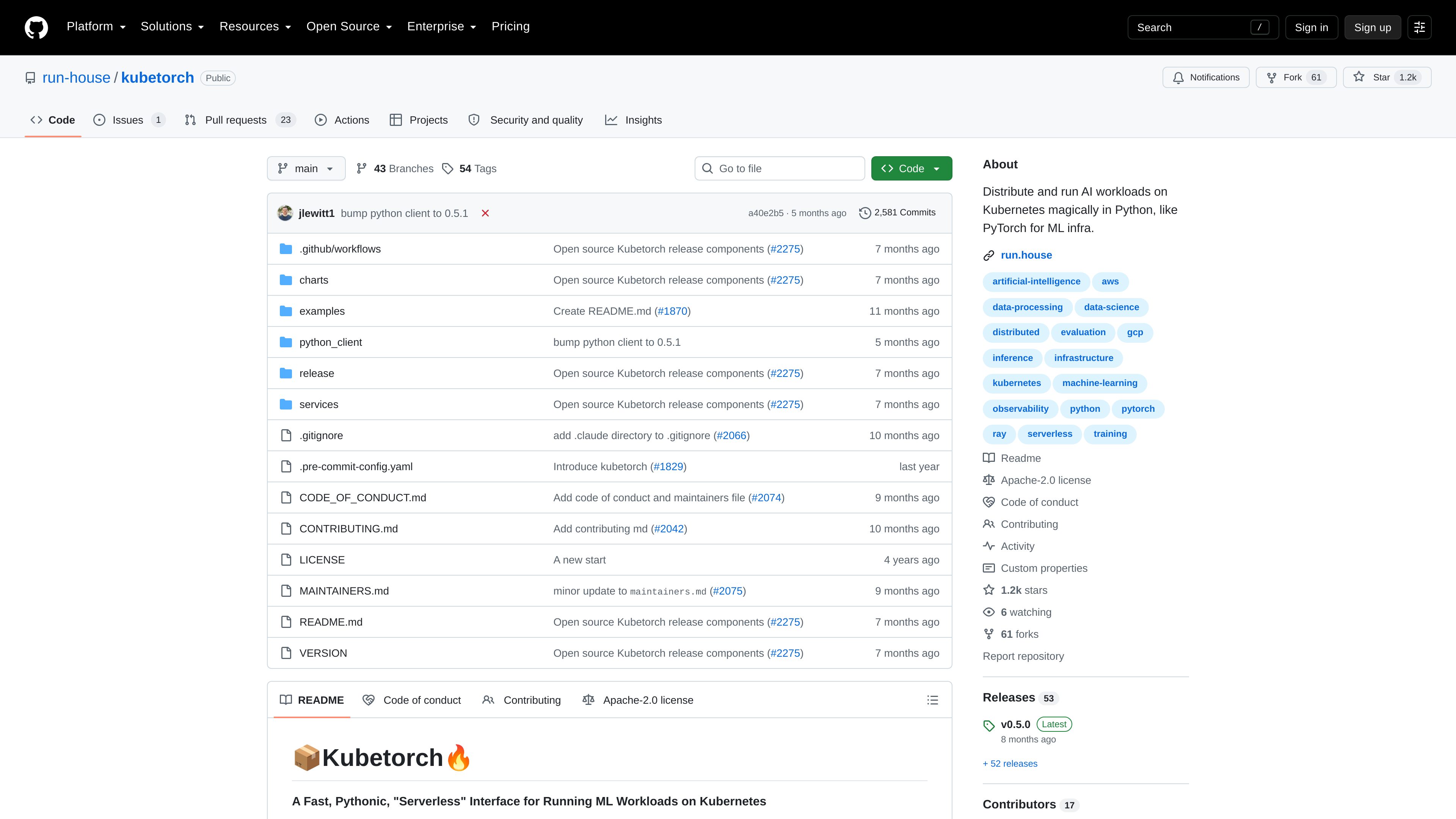
The project focuses on making cluster-backed ML development feel closer to using a local process pool. Its README says that it does not require a local runtime or code serialization, and that logs, exceptions, and hardware faults are propagated back to the caller in real time. The repository describes resource allocation, bin-packing, dynamic scaling, and programmatic fault handling as part of its workload-management approach.
Kubetorch is installed through a Python client and a Helm deployment. The repository includes the client, chart, controller and datastore services, workload base images, release scripts, examples, and documentation. The documented workflow starts with a Python function and a compute definition, sends the function to remote Kubernetes compute, and returns its result to the calling process.
Define a local Python function, attach it to a Kubetorch compute object, and call it so the work runs on Kubernetes rather than in the local process.
Use cluster resources from an IDE, notebook, CI pipeline, or production code through the Python interface, without requiring a separate local runtime or code-serialization workflow.
The project states that logs, exceptions, and hardware faults are propagated back to the caller in real time, helping developers observe remote ML work while it runs.
Kubetorch describes intelligent resource allocation, bin-packing, and dynamic scaling for matching workloads with available Kubernetes compute.
The README identifies built-in fault handling, error recovery, and resource adjustment as mechanisms for responding to execution failures.
The repository supplies a Python client, Helm chart, controller and datastore services, workload base images, and release scripts for deploying the system.
ML developers can iterate on compute-intensive applications from local Python code while executing the workload on cluster resources. The project claims iteration times of 1–3 seconds for complex applications such as reinforcement learning and distributed training.
Teams can use the Python interface as a way to run distributed training workloads on Kubernetes, keeping the calling workflow in Python while using remote cluster compute.
The repository lists inference and distributed evaluation among its relevant workload areas, making Kubetorch applicable to batch or service-side ML tasks that need Kubernetes resources.
Because the interface can be called from CI pipelines and production code, engineering teams can reuse Python-based remote workload definitions beyond interactive notebook development.
Kubetorch is an open-source Python interface and Kubernetes deployment for building, iterating on, and running machine-learning workloads on cluster infrastructure.
The documented example defines a Python function, creates a `kt.Compute` object, sends the function to that compute with `kt.fn(...).to(compute)`, invokes the returned remote function, and receives its result.
The README shows installing the client with `pip install "kubetorch[client]"` and installing the Kubernetes components with the Kubetorch Helm chart from the project’s OCI registry.
The project says Kubetorch can be used from Python environments including IDEs, notebooks, CI pipelines, and production code.
No Kubetorch-specific prices or plans are included in the provided source. The README mentions a fully managed serverless platform available by contacting the project, while the separate GitHub pricing page describes GitHub plans rather than Kubetorch.

coldiq.com
ColdIQ is a unified GTM data API for Claude Code, AI agents, and developers. It lets teams search leads, enrich contacts, find emails, and access multiple data providers through an API, MCP server, or agent interface.

pytorch.org
An open-source machine learning framework for building and running AI models.

arcee.ai
Open-weight foundation models for developers building AI across device, on-premises, and cloud environments.