
Document ingestion and structuring
Axion processes sources such as PDFs, reports, presentations, spreadsheets, scanned files, images, graphs, and tables, converting information into structured, machine-readable data.

AI infrastructure for enterprises that grounds model answers in expert knowledge and measures how they are produced.
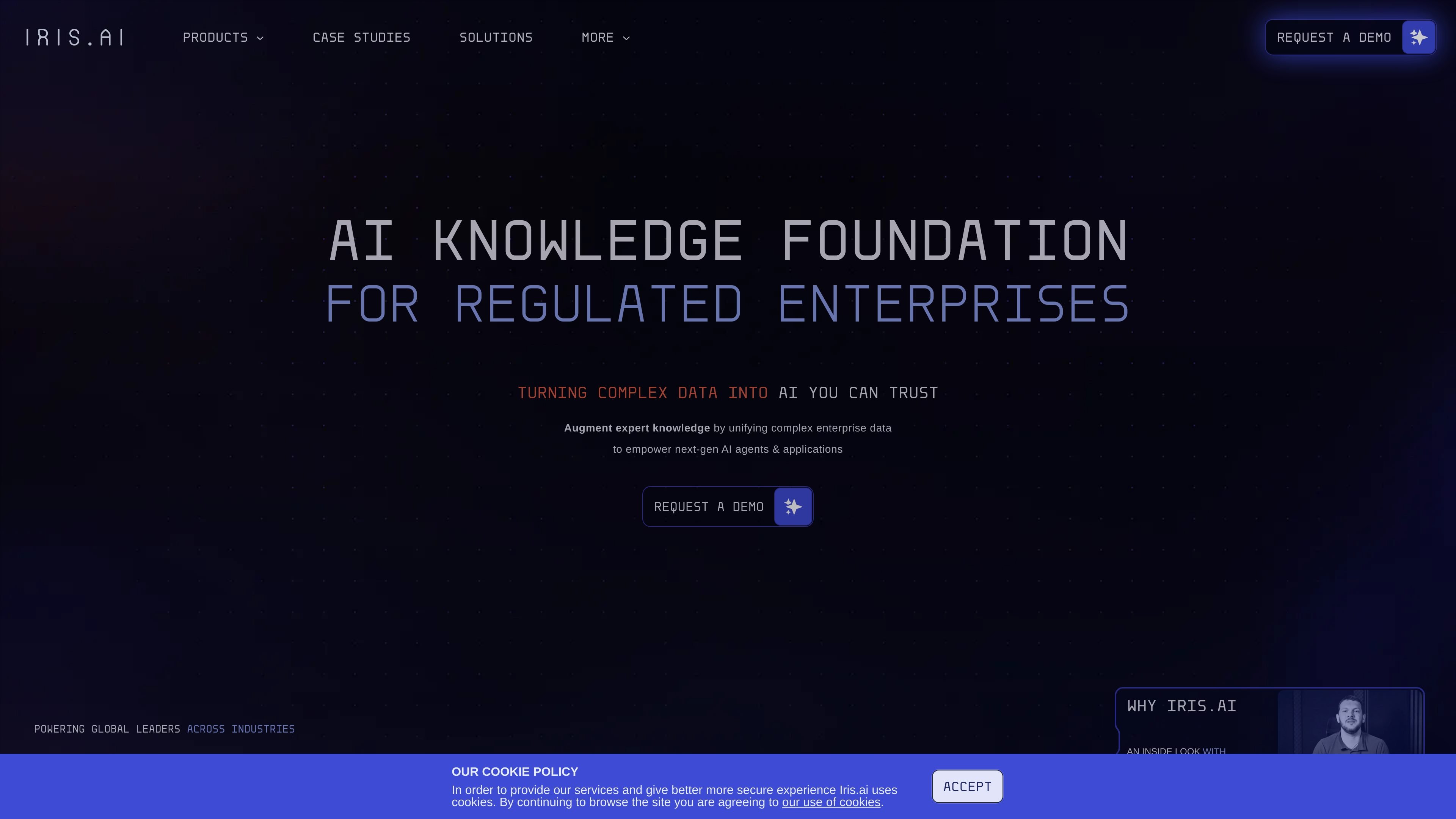
Iris.ai provides AI infrastructure for organizations working with complex, document-heavy knowledge. Its systems prepare enterprise information for AI workflows, control the material a model can use, and measure how answers are produced. The offering includes Axion for document understanding and data structuring, Neuralith for enterprise knowledge and agent workflows, and RSpace for research and development intelligence. Iris.ai is aimed at teams that need to work with internal documents and domain-specific information while keeping answers tied to source material.
Axion processes sources such as PDFs, reports, presentations, spreadsheets, scanned files, images, graphs, and tables, converting information into structured, machine-readable data.
Documents are divided into retrievable segments and enriched with metadata, supporting search and retrieval for AI applications.
Axion offers industry-specific schema templates, including for patents, legal contracts, clinical trials, and financial statements, alongside options for custom schemas.
Iris.ai describes systems that control what information a model reads and provide relevant context for applications such as retrieval-augmented generation and AI agents.
Evaluation metrics and monitoring frameworks are available to track AI workflow performance and assess how changes to data affect outputs.
The platform can work with customer-provided models or Iris.ai models. Its RAG-as-a-Service offering can be deployed in the cloud or on premises.
Research teams can search published papers and patents, conduct literature reviews, and monitor new developments relevant to product work or regulatory requirements.
Organizations can enrich and index internal document collections, then make the resulting knowledge available through RSpace tools for staff who need to act on it.
AI developers can use Iris.ai’s data preparation, retrieval, evaluation, and agent infrastructure to build production workflows over large document collections.
Teams handling international patent or other document libraries can extract and organize information across languages; Axion states support for more than 68 languages.
Axion handles documents and other sources including PDFs, Word, Excel and PowerPoint files, plain text, HTML, scanned files, and images containing text. The solution pages also describe processing graphs and tables.
Yes. Iris.ai says customers can connect their own models or use Iris.ai models. Axion’s enterprise offering also lists custom model adapters for proprietary in-house models.
Iris.ai states that its RAG-as-a-Service can be deployed in the cloud or on premises.
The site describes use by research and development teams, enterprise knowledge-management teams, and AI application developers, including organizations in manufacturing, life sciences, energy, and telecom.
Os dados de tráfego são apenas para referência.

www.selfjev.dev
SelfJev is a self-hosted 4B decision model for turning text, images, and questions into typed answers with probabilities. It helps developers run structured classification, routing, review, and policy workflows on infrastructure they control.

invisibletech.ai
Enterprise AI infrastructure combining governed data, workflows, agents, evaluations, and expert support.

devnagri.com
Sovereign language AI infrastructure for regulated enterprises building multilingual workflows.

glama.ai
Glama is a registry and infrastructure platform for discovering, evaluating, and connecting to Model Context Protocol (MCP) servers, connectors, clients, and tools. It supports browsing open-source and remote MCP entries, with hosted access and gateway features described on the site.