
Local metered-traffic proxy
Routes supported LLM API calls through localhost and writes local event records for the traffic the proxy observes.

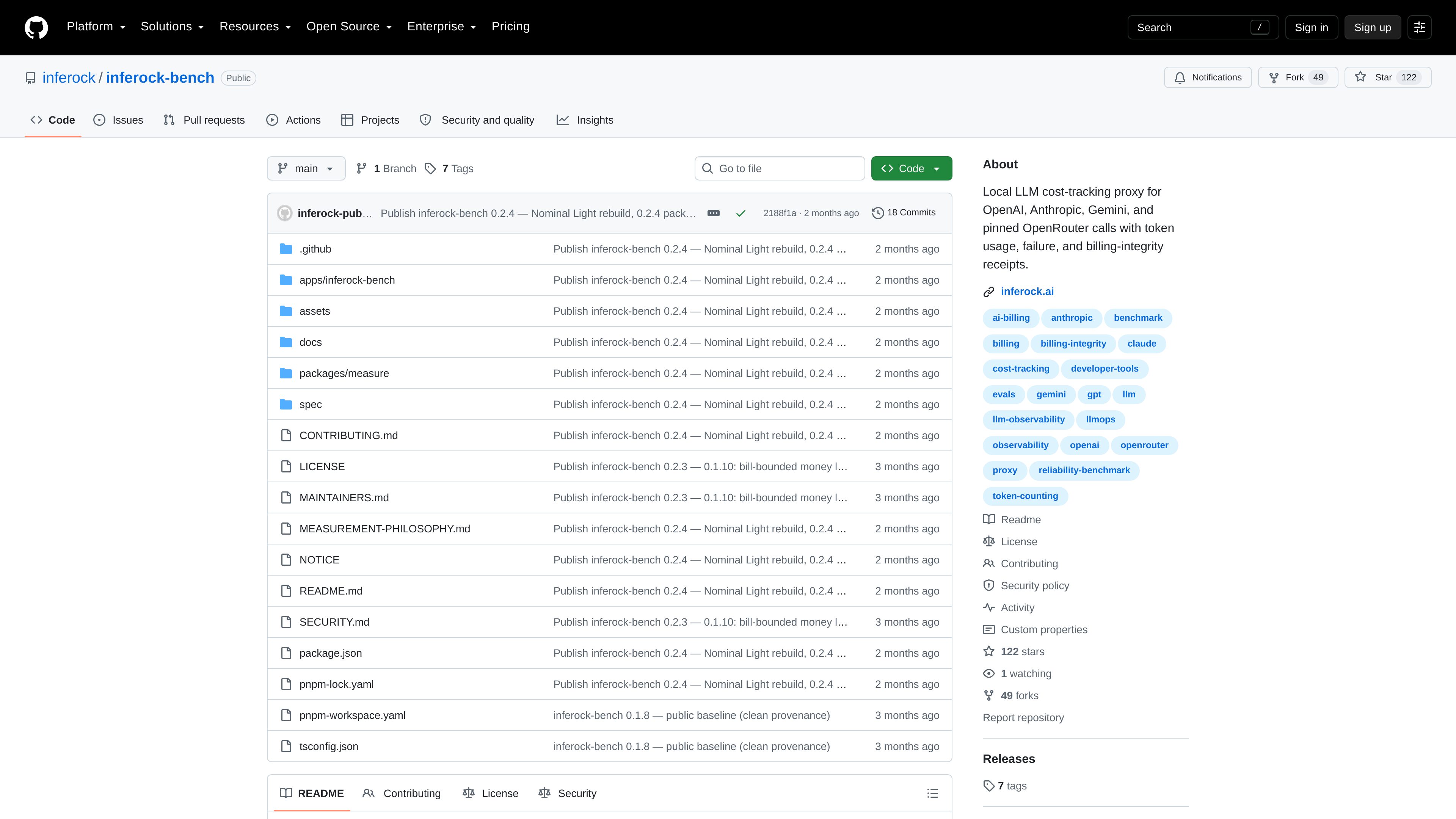
inferock-bench is a local diagnostic proxy for tracking LLM API usage, provider-reported costs, failures, and billing-integrity signals. It helps developers inspect calls to OpenAI, Anthropic, Gemini Developer API, and pinned OpenRouter endpoints using locally stored receipts.
inferock-bench is a local diagnostic proxy for metered LLM API traffic. It routes calls through localhost, records event data, and produces local receipts that compare provider-reported usage, pricing evidence, delivery outcomes, and billing-integrity signals.
The project is designed for investigating token usage, API failures, and questions about whether unsuccessful calls may still affect a bill. Its measured provider planes include OpenAI, Anthropic, Gemini Developer API, and pinned OpenRouter endpoints. Receipts distinguish observed facts from calculated interpretations and show when a check was not openable rather than treating it as clean.
The proxy only covers calls it actually sees. It is not a complete invoice audit, a provider-spend cap, or evidence about traffic that bypasses localhost.
Routes supported LLM API calls through localhost and writes local event records for the traffic the proxy observes.
Captures provider-reported token counts, pricing evidence, request and response metadata, status, timing, and retry evidence.
Surfaces signals including billed-empty output, refusals, truncation, token-recount mismatches, duplicate request IDs, cache-discount-at-risk evidence, and provider-fault retries.
Marks each surface as watched-clean, signal, or not-openable, making unopened checks visible instead of implying that they passed.
Renders receipts from stored event records using the shipped @inferock/measure grading code and a stamped grading version.
Supports measured planes for OpenAI, Anthropic, Gemini Developer API, and pinned OpenRouter endpoints spanning selected model families and observed hosts.
Route calls locally and compare observed provider usage and pricing evidence with a matching invoice when reviewing unexpected charges.
Use delivery and retry signals to investigate whether refusals, empty output, truncation, or provider faults occurred on calls that may still have billing consequences.
Inspect provider-reported token counts and request metadata for supported OpenAI, Anthropic, Gemini, or pinned OpenRouter traffic during development and testing.
Use receipt categories for provider spend, bill-bounded money loss, time loss, and invoice-check exposure without combining unlike measurements into one headline.
For calls routed through its local proxy, it records provider-reported usage, pricing evidence, request and response metadata, status, timing, retry evidence, and detector signals.
The repository identifies four measured provider planes: OpenAI, Anthropic, Gemini Developer API, and pinned OpenRouter endpoints covering selected models and observed hosts. Other coverage is described as extensible, not as measured today.
The source states that provider keys are not sent to Inferock by the local benchmark. The proxy attaches keys to provider requests, and receipts are local unless the user chooses to share them.
No. It cannot observe traffic that bypasses the proxy, cap spending across unseen calls, or explain a monthly bill without the matching invoice. Its dollar figures are calculations from observed events under published assumptions.
Receipts expose a not-openable coverage state instead of presenting an unopened check as clean. This distinguishes observed results from unavailable evidence.
Os dados de tráfego são apenas para referência.

wokey.ai
Wokey AI provides a single API key for models from providers including Anthropic, OpenAI, Moonshot AI and xAI, with compatible endpoints and locally verifiable response proofs.

cometapi.com
CometAPI is a unified, OpenAI-compatible API layer for accessing more than 500 text, image, video, and audio models through one key. It helps developers and teams compare models, centralize billing, and switch providers without maintaining separate vendor integrations.

trustedrouter.com
TrustedRouter is an OpenAI-compatible AI gateway for routing requests across hundreds of models and providers. It is designed for developers and teams that need configurable privacy routing, provider failover, and a verifiable prompt path.

www.hopscotchlabs.ai
Hopscotch is a unified API for accessing 500+ AI models from providers including Anthropic, OpenAI, and Google. It helps developers and teams switch models, configure fallbacks, and control spending through shared keys, teammate limits, and workspace limits.

www.newapi.ai
New API is an open-source, self-hosted AI gateway for developers and teams. It provides a unified OpenAI-compatible endpoint for connecting multiple AI providers, selecting models, configuring channels, and monitoring usage on their own infrastructure.

aimlapi.com
AIMLAPI provides one API and billing key for accessing a catalog of AI models for chat, reasoning, image, video, audio, voice, search, embeddings, code, and related tasks. It is intended for developers and teams that want to compare and use models from multiple providers through a common platform.