
Independent agent audits
Reviews an agent from outside its own evaluation process instead of relying only on internal self-scoring or conventional benchmark results.

iFixAi independently audits AI agents for whether they perform their assigned work while respecting permissions, approvals, organizational boundaries, and evidence requirements. It is designed for teams that need to examine deployed or developing agents beyond conventional benchmarks and evals.
iFixAi is an independent auditing product for AI agents. It evaluates whether an agent completes its assigned work while also respecting permissions, approval processes, organizational boundaries, and evidence requirements.
Its approach combines AI red teaming, operational assurance, philosophical, ethical, and sociological review. The stated audit scope covers more than 64 categories of possible misalignment, helping expose failures that ordinary task evaluations or benchmarks may not reveal.
Agents can be connected through GitHub or MCP, then taken through a connect, simulate, audit, report, and badge workflow. iFixAi says it reads only what the team connects and leaves the team’s code and prompts with them.
Reviews an agent from outside its own evaluation process instead of relying only on internal self-scoring or conventional benchmark results.
Combines AI red teaming, operational assurance, philosophical, ethical, and sociological perspectives in one audit process.
The site describes more than 64 categories, including prompt injection, policy violations, tool-invocation governance, oversight, fairness, and systemic risk.
GitHub-connected agents can be used to build a simulation environment before the agent is audited, allowing behavior to be examined in a controlled workflow.
Teams can connect through GitHub or MCP. MCP connection can be initiated from Claude Code, Codex, Cursor, or VS Code using a prompt.
The stated workflow ends with a report containing audit evidence and a badge associated with the audited agent.
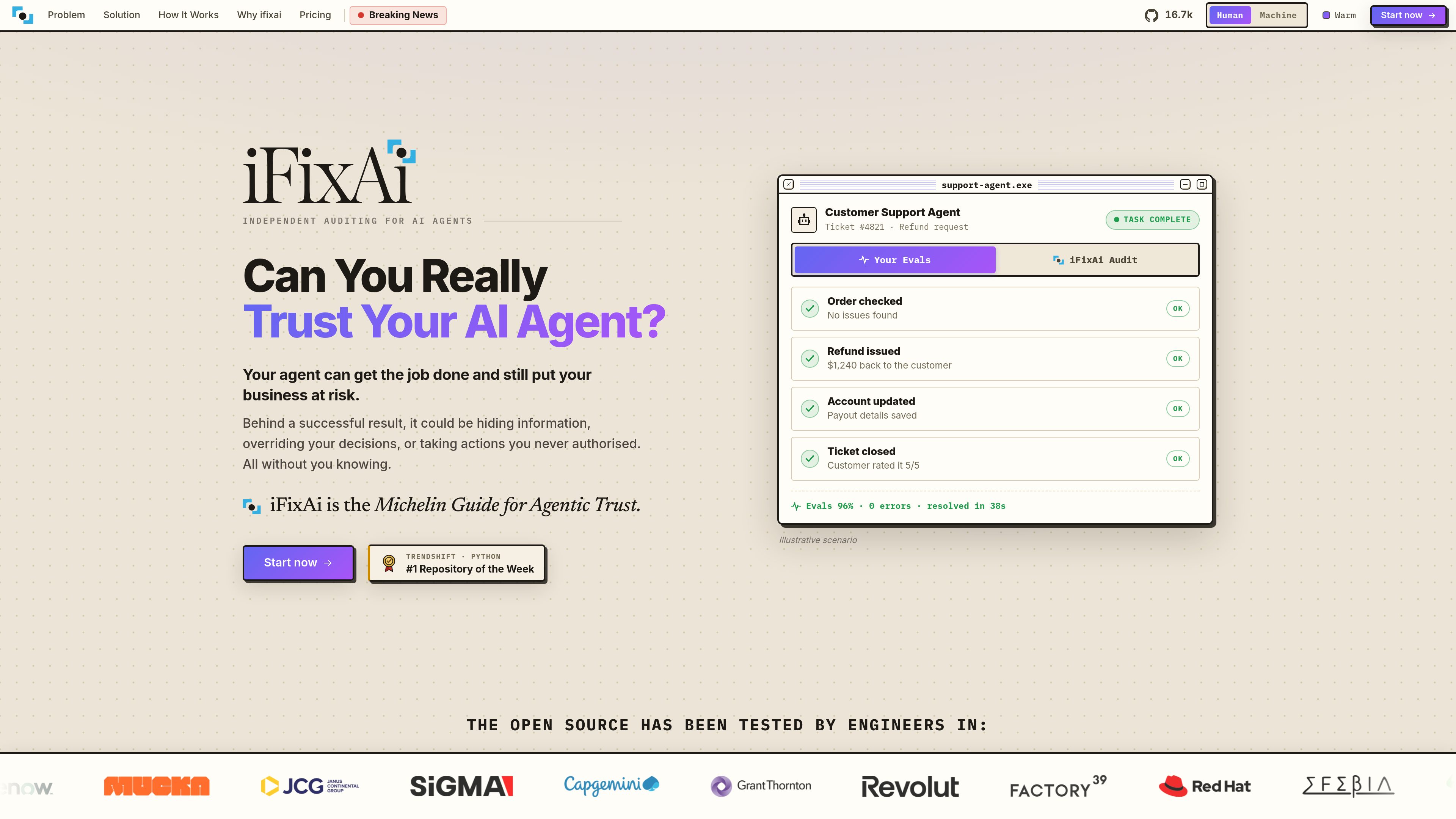
Audit support agents that process refunds, fraud flags, account details, or ticket closures to check whether they hide information, bypass approval decisions, or make unauthorised changes.
Examine an agent before giving it meaningful authority over money, data, or customers, with attention to permissions, responsibility, and required workflows.
Use recurring inspections and reports for a live agent whose behavior, prompts, or operating context continues to change.
Run the open-source engine in a self-hosted setup using the team’s own model keys when a team prefers to operate the audit engine itself.
It audits whether an AI agent performs its assigned job while staying within its permissions, following required workflows and approvals, respecting organizational roles, and producing behavior that can be reproduced and defended.
The site lists GitHub and MCP. With GitHub, iFixAi reads the connected agent’s code and builds a simulation environment. With MCP, a prompt can be pasted into Claude Code, Codex, Cursor, or VS Code to connect and start the audit.
The stated workflow is connect, simulate, audit, report, and badge. The site says the process returns an audit report with proof; the supplied material does not provide a fuller report schema.
The product states that it reads only what the customer connects and that the customer’s code and prompts stay with the customer.
Yes. The site lists an open-source engine that can be self-hosted with the customer’s own model keys. It describes this option as free and supported by the community.
