
Document and handwriting recognition
Process photos, scans, and PDFs containing printed text, handwriting, tables, checkboxes, signatures, readings, crossings-out, and other marks found on used forms.

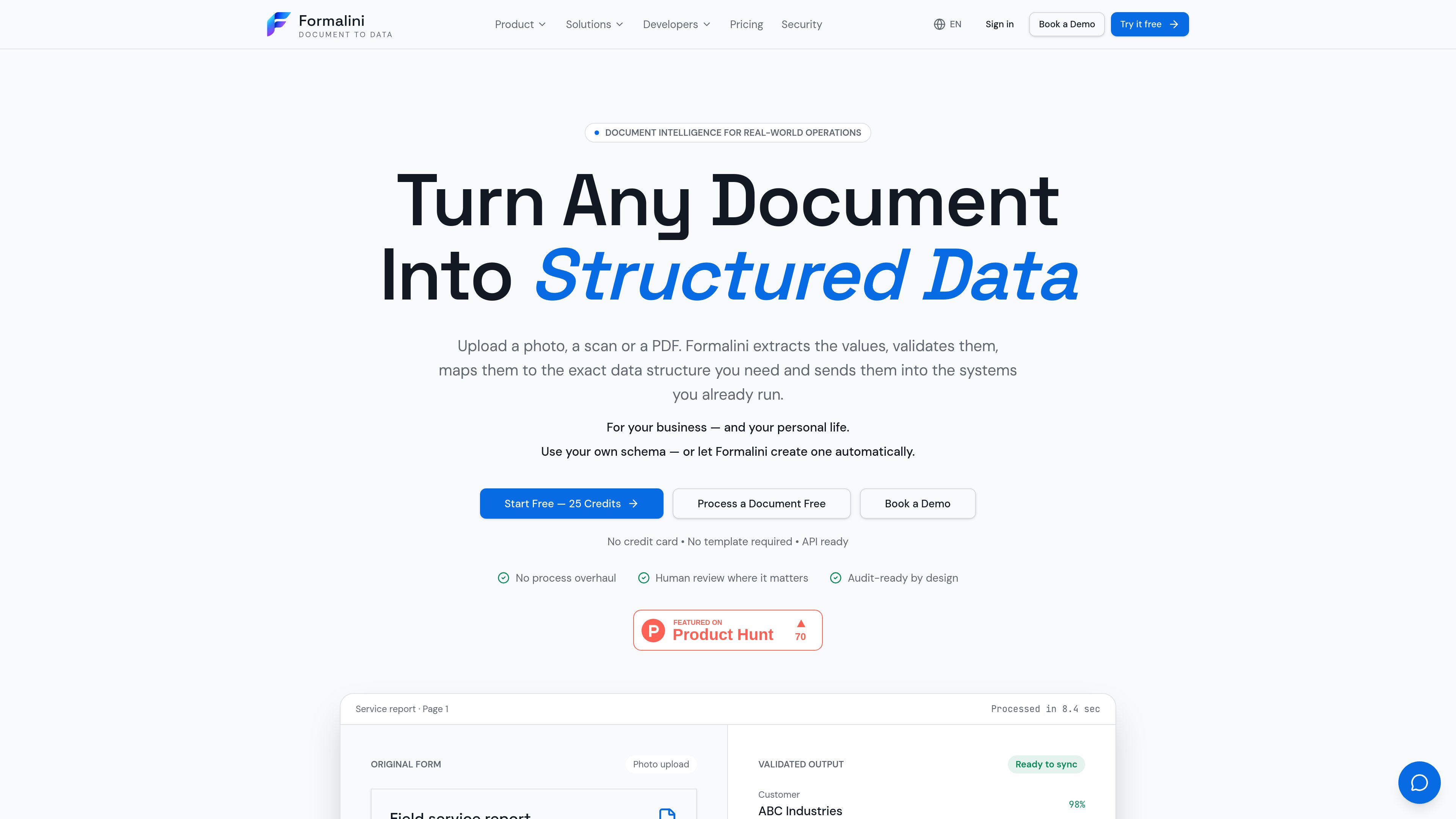
Formalini turns photos, scans, PDFs, and other documents into structured data using a user-defined or automatically generated schema. It supports validation, human review, and delivery through JSON, CSV, APIs, and webhooks.
Formalini is a document intelligence platform that converts photos, scans, PDFs, and other paperwork into structured data. It reads printed and handwritten content, tables, checkboxes, signatures, readings, and marks, then maps the results to a schema supplied by the user or generated automatically.
The platform provides a controlled path from capture to approved output: extract values, apply validation and business rules, route uncertain fields for human review, and export or deliver approved data. Each value can be traced to its location in the source document, while corrections are recorded for later audit.
Business users can send results as JSON or CSV, use the REST API, or receive signed webhooks. Common document workflows include field-service reports, inspection forms, maintenance logs, invoices, purchase orders, applications, healthcare forms, delivery notes, and proof-of-delivery records. Formalini also includes a personal vault for organizing receipts, expenses, warranties, renewals, and other uploaded documents.
Process photos, scans, and PDFs containing printed text, handwriting, tables, checkboxes, signatures, readings, crossings-out, and other marks found on used forms.
Map extracted values to the exact structure a business system expects, or let Formalini create a schema automatically. Form templates can preserve a recurring document layout.
Apply business rules before export and attach a confidence score to each extracted value. Unclear values are flagged instead of being silently treated as correct.
Reviewers can inspect the source location behind a field, correct flagged values, and retain a record of who changed what and when.
Download batches as JSON or CSV, or send approved results to existing systems through the REST API, signed webhooks, or automation workflows.
Use scoped bearer-token API keys to list and retrieve documents, upload files, correct fields, and trigger workflow events. The API provides status filters, pagination limits, rate-limit headers, and documented examples in curl, JavaScript, Python, PHP, and C#.
Capture labour hours, parts used, engineer signatures, and customer sign-off from handwritten job sheets. Office staff can review exceptions while approved records move into maintenance or ERP workflows.
Convert inspection checklists and maintenance logs into records containing pass/fail marks, measured readings, asset numbers, defect notes, meter readings, and next-service dates.
Extract supplier details, invoice and purchase-order numbers, dates, line items, quantities, totals, tax, and references into structured data for finance or purchasing processes.
Process delivery notes, waste notes, and proof-of-delivery documents, including quantities, references, times, signatures, and shipment-related matching information.
Use the personal vault to organize receipts, expenses, warranties, renewals, and expiry dates, with extracted dates, amounts, names, and categories available for search and review.
The service accepts photos, scans, and PDFs. The free document processor supports JPG, PNG, and PDF uploads up to 10 MB and reads the first three pages for its free runs. The pricing information also lists Word, Excel, CSV, JSON, and text as chargeable document types.
No. Formalini can create a schema automatically, or you can provide your own schema. Recurring forms can also be described with form templates so copies return in a consistent structure.
Each extracted value receives a confidence score. Business rules can be applied before export, and low-confidence or invalid values can be routed to a human review queue. Corrections replace the original value used by the API and are recorded in the document's audit trail.
Formalini provides JSON and CSV export, a REST API, and signed webhooks. The site shows API or automation connections for systems such as SAP, ServiceNow, Salesforce, Power Automate, UiPath, ERP, and CRM workflows, while the API documentation describes scoped keys and document endpoints.
Yes. The site offers document processing without an account and a Free plan at €0 with a limited monthly allowance, JSON/CSV export, API access, two form templates, and 100 MB of storage. Paid plans increase volume and storage; exact limits vary by plan.
Os dados de tráfego são apenas para referência.

landing.ai
Document processing APIs for developers building structured, traceable data pipelines.

zyte.com
Web scraping APIs and managed data delivery for teams collecting web data.

mixpeek.com
Multimodal data infrastructure that turns files in object storage into searchable, structured data.

www.diffbot.com
Diffbot transforms unstructured public web content into structured data for AI applications. Its APIs and agent skills support web search, page extraction, crawling, entity resolution, natural-language processing, and Knowledge Graph research.

webscraping.ai
Web scraping API for developers to retrieve web content and extract structured data with AI.

microsoft.github.io
GraphRAG is a research project and data pipeline for extracting structured information from unstructured text with language models, then using graph-based context to support question answering over private data.