
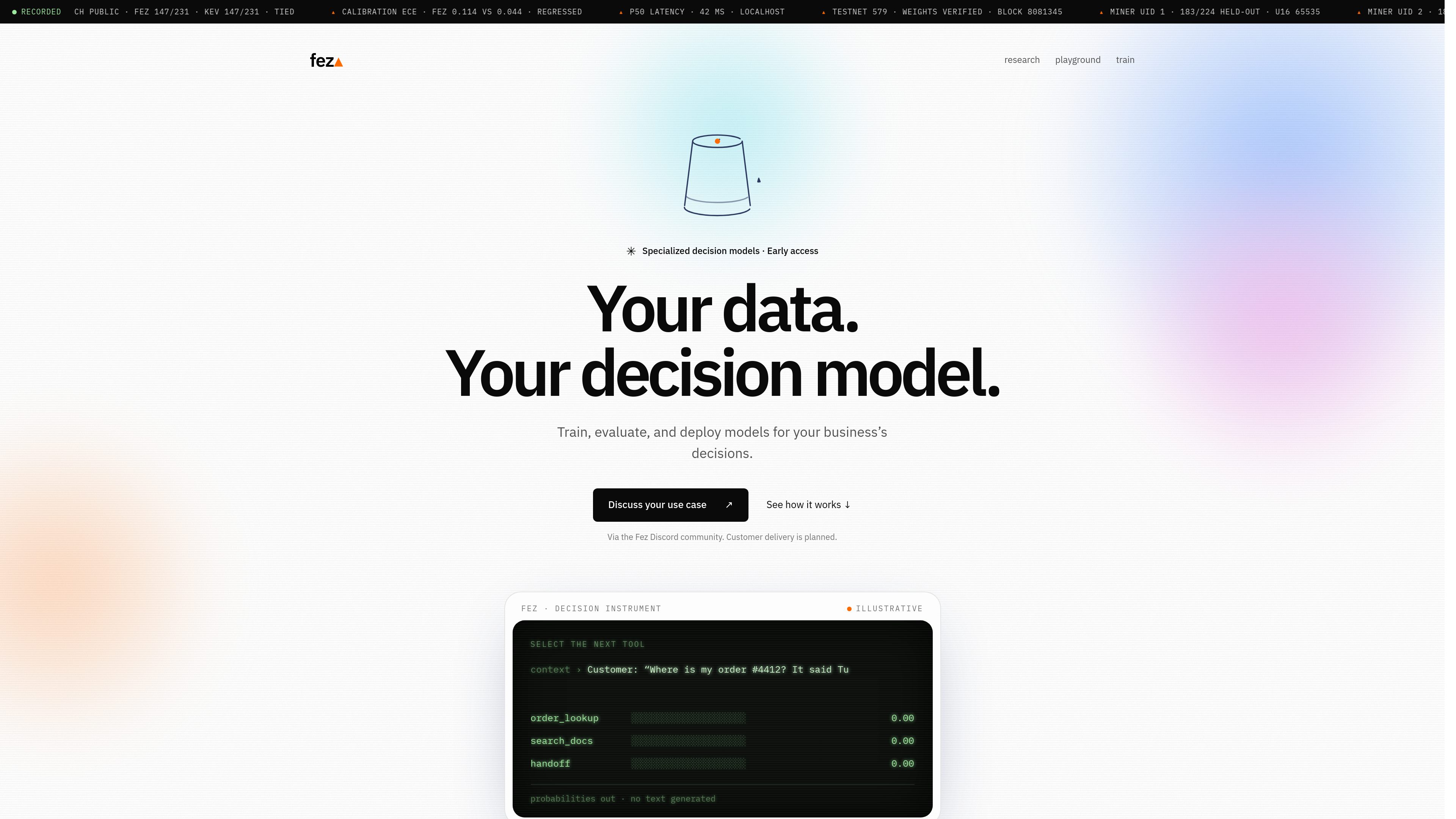
Structured probability outputs
Fez returns probabilities for defined decisions rather than a generated text answer. This supports downstream logic that needs a choice, score, or confidence distribution.

Fez is an experimental decision-model platform that turns workflow context into probabilities for model routing, tool selection, escalation, and support triage. It helps teams train and evaluate specialized models for repeated decisions in AI systems.
Fez is an experimental platform for training and evaluating specialized decision models for business workflows. Its core interface is context in, probabilities out: instead of generating a full response, a model estimates the available actions or outcomes. This is intended for repeated decisions such as model routing, tool selection, escalation, and support triage.
The documented workflow uses authorized labeled examples, acceptance criteria, training jobs, and evaluation results. Fez also provides a playground where users can supply text or JSON context, define choice, yes/no, or score decisions, and inspect the probability assigned to each option.
Fez 0.8B is described as an experimental model. Published research includes benchmark and training-to-testnet evidence, but the site says the measurements are diagnostic, hosted cost has not been measured, and the checkpoint comparison does not establish a production SLA. Customer delivery is planned; the training dashboard is currently a development preview.
Fez returns probabilities for defined decisions rather than a generated text answer. This supports downstream logic that needs a choice, score, or confidence distribution.
The product can evaluate whether a request should remain with a smaller model or be sent to a larger model, reserving larger-model calls for cases that need them.
Given agent context, Fez can score candidate tools or next actions without requiring a full language-model response for every selection.
The development preview is designed for labeled datasets, acceptance criteria, training jobs, and inspection of evaluated model artifacts.
Users can test text or JSON context and define decisions as choices, yes/no questions, or scores. The playground displays the probability of every option and sends requests to the connected Fez checkpoint.
The research area records benchmark metrics including accuracy, Brier loss, calibration-related measurements, confidence mistakes, and localhost latency, with stated methodological limitations.
An AI application can classify whether a request is short and well specified enough for a smaller model or requires a larger model for ambiguity, long context, or multi-step reasoning.
An agent can use the decision output to select among available tools, such as looking up an order, searching documents, or handing a case off, without generating prose for the selection step.
Teams can label outcomes to assess whether an agent should continue, retry, stop, or ask a person for review before taking its next action.
The playground documents support-oriented decisions including routing a customer request, checking urgency, and scoring tone. These examples can be expressed as structured choices or scores.
Fez is designed to return structured probabilities for defined decisions. It does not generate a text answer for each decision, and the playground can show the probability of every available option.
The documented workflow starts with authorized labeled examples and acceptance criteria, followed by training and evaluation. The training dashboard is a development preview for submitting datasets, following jobs, and inspecting evaluated artifacts.
The site describes customer delivery as planned and labels the training interface as not yet a launched training service. The available material does not document a generally available hosted service or deployment interface.
The playground identifies the connected model as Fez 0.8B, experimental. It says answers come from that connected Fez checkpoint and that there is no fallback model.
No. The site says its benchmark measurements are diagnostic, the comparison does not establish a production SLA, hosted cost was not measured, and customer cost savings have not yet been measured.

huggingface.co
Hugging Face Inference Providers gives developers a way to compare supported models across infrastructure providers using model availability, pricing, context limits, latency, throughput, and capability indicators.

fastrouter.ai
An OpenAI-compatible gateway for routing, evaluating, and governing access to 200+ AI models.

eachlabs.ai
each::labs provides a single API for orchestrating more than 600 AI models, with routing, fallback handling, observability, and usage-based pricing. It is designed for teams building and operating production AI applications across video, image, audio, and text workflows.

piapi.ai
PiAPI is a unified platform for generating video, images, audio, 3D assets, and LLM outputs through a model catalog, playground, APIs, CLI, and MCP server. It is designed for developers, AI agents, and automation workflows that need access to multiple generative models.

wiro.ai
Wiro AI is a unified API and model marketplace for running image, video, audio, language, and other AI models. Developers can use one API key to test models, execute tasks, and build workflows and agents.

trustedrouter.com
TrustedRouter is an OpenAI-compatible AI gateway for routing requests across hundreds of models and providers. It is designed for developers and teams that need configurable privacy routing, provider failover, and a verifiable prompt path.