
API-connected workflows
Embed versioned REST API capabilities between source records and downstream claims, ERP, or data systems. Confirm the required connections, permissions, data formats, and implementation scope during evaluation.

Enterprise AI workflows for claims processing, with configurable review and decision records.
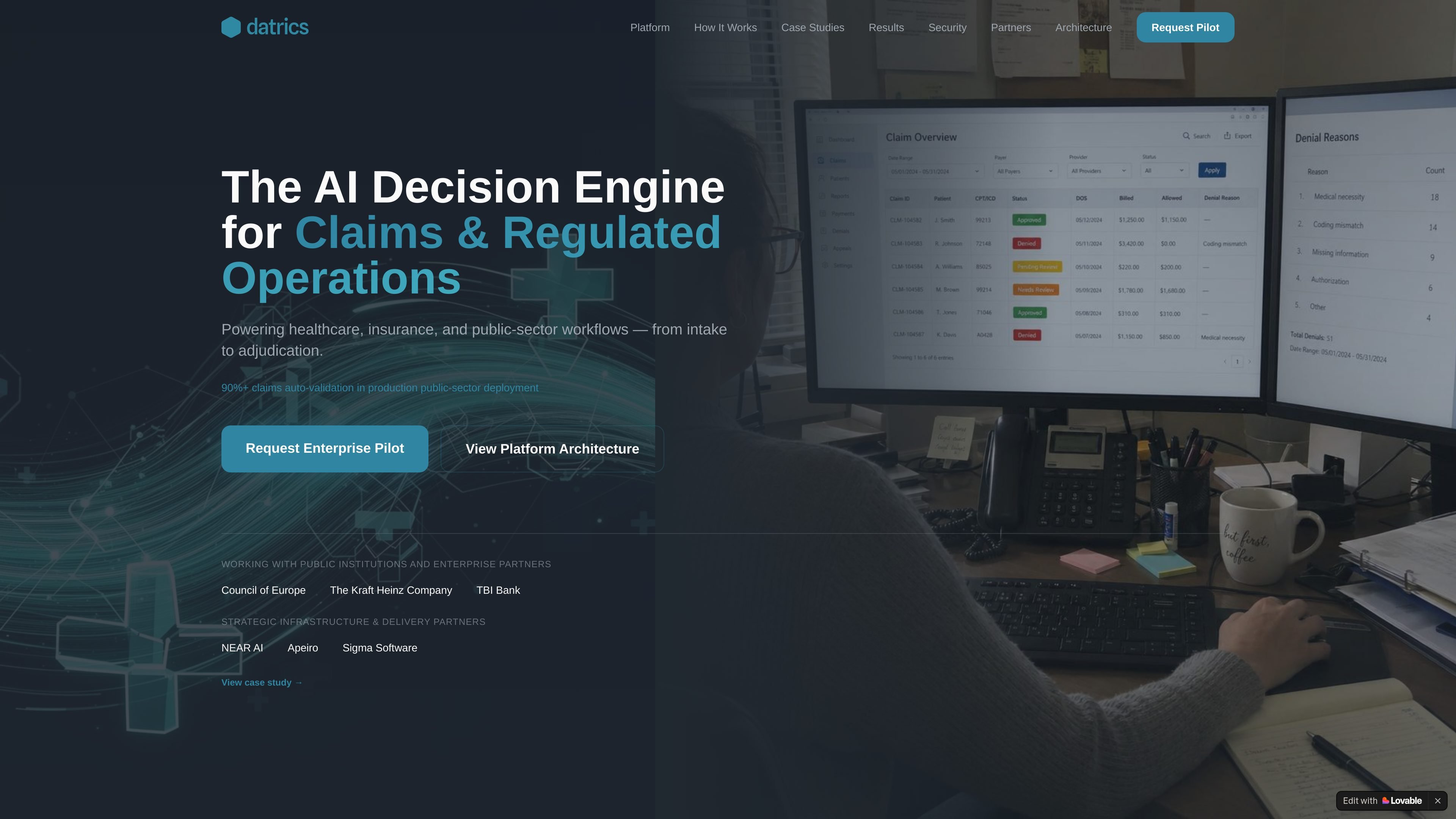
Datrics is an enterprise AI decision engine for claims and regulated operations. Claims, records, and supporting documents enter an API-connected workflow for extraction, normalization, validation, and downstream processing. The engine combines deterministic rules, machine learning, and large language models, with human-readable explanations and audit records.
Organizations configure review and approval steps for high-stakes cases rather than treating a generated score or explanation as a final legal or clinical determination. Healthcare and insurance workflows include benefit-code automation, medical-document extraction, and post-adjudication audit. A reported public-sector implementation applied the platform to damage assessment and reimbursement planning; that example does not establish universal accuracy or results for every claims program.
Embed versioned REST API capabilities between source records and downstream claims, ERP, or data systems. Confirm the required connections, permissions, data formats, and implementation scope during evaluation.
Combine configured rules, machine-learning assessments, and language-model steps to support validation and operational decisions. Validate the selected logic against the organization’s actual policy and data.
Retain decision rationales and records of actions or transformations for review. An explanation or audit trail helps inspect a result; it does not by itself establish accuracy or compliance.
Route high-stakes or exceptional cases through human review and approval workflows. Define who can approve decisions and what evidence they need before allowing a workflow to affect claims outcomes.
Evaluate SaaS, private-cloud, or on-premise deployment for the relevant environment. Confirm data handling, residency, integration, and control requirements for the selected agreement.
Extract and normalize relevant claim and medical-document information, then apply configured benefit or validation rules. Qualified staff should review material exceptions and verify important outputs against source records.
Use decision records and workflow controls to support post-adjudication review. Check the applicable policy and source evidence rather than treating an automated result as proof that a claim was correctly handled.
The reported institution combined damage claims and supporting datasets to support assessment and fund-allocation planning. Evaluate that approach for your program’s evidence, rules, and human oversight; its reported results are specific to that implementation.
Yes. It is designed as an embedded decision layer with REST APIs for ingestion and downstream processing. Evaluate the required data connections, workflow configuration, and human approvals with the implementation team.
Do not assume that. The reported public-sector implementation included no-code data integration for analysts, while the platform also uses APIs and configurable decision workflows. Confirm the actual setup and technical responsibilities for your deployment.
No. The case concerns a particular institution and claims program. Its automation, timing, and accuracy figures are reported implementation outcomes, not guarantees for another dataset, industry, or decision policy.
Formal certifications are described as in progress, with detailed controls available under NDA. HIPAA-aligned, GDPR-ready, and SOC 2 roadmap language is not proof that a chosen deployment meets every applicable requirement. Complete the appropriate security and regulatory review.
Request a paid enterprise pilot. Define the claims workflow, data and integration scope, review controls, success criteria, and commercial terms before proceeding. Confirm the rollout schedule rather than assuming a marketing timeline applies to your program.
Os dados de tráfego são apenas para referência.

www.docsumo.com
Docsumo is an intelligent document processing platform for lending, insurance, healthcare, finance, and eligibility workflows. It collects, classifies, extracts, verifies, and analyzes document data, then routes exceptions and sends structured results to business systems.

www.invofox.com
Invofox extracts structured JSON from PDFs and images, including invoices, payslips, contracts and other documents, through a single API for document-processing workflows.