
SQL lineage reverse-engineering
Analyzes SQL queries and models to identify interdependencies and visualize data dependencies, including DDL, CTAS, views, and DML statements.

An AI-native data design workspace for tracing SQL relationships, modeling systems, and collaborating on technical documentation.
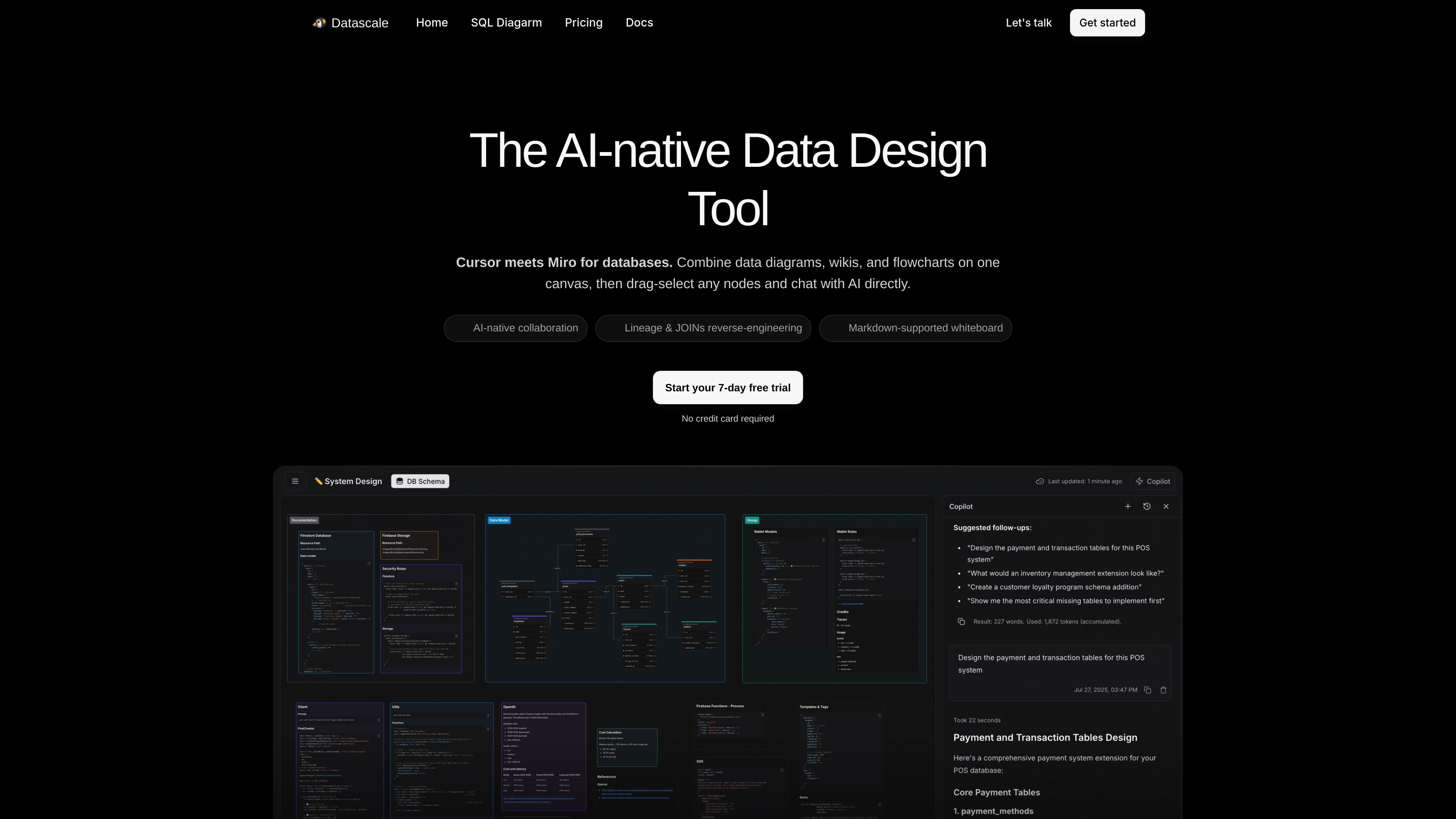
Datascale is an AI-native data design workspace for software engineers and data professionals. It combines data diagrams, ER diagrams, flowcharts, Markdown-supported notes, and wikis on a shared canvas.
The product reverse-engineers relationships and dependencies from SQL and existing table schemas, including relationships implied by joins. Users can select tables or other nodes on the board and work with an AI Copilot in the context of their design. Datascale is intended for planning systems, documenting data models, investigating lineage, and discussing architectural trade-offs without changing existing code or migrating a framework.
Analyzes SQL queries and models to identify interdependencies and visualize data dependencies, including DDL, CTAS, views, and DML statements.
Uses actual joins to map cross-table relationships and can surface implicit primary-key and foreign-key relationships where those constraints are not explicitly defined.
Combines data diagrams, ER diagrams, flowcharts, Markdown notes, and wikis on one canvas for system design and documentation.
Lets users drag-select tables or nodes and chat with AI directly on the board to ask questions, refine designs, and co-design in context.
Helps turn rough notes into design documents, PRDs, and data specifications, and provides feedback on architecture, data models, and communication.
Boards can be made public and embedded elsewhere for sharing visual system and data designs.
Software engineers can plan or refactor system designs while keeping data structures, diagrams, and supporting notes together on the same canvas.
Data engineers can inspect how tables and transformations relate across existing SQL, including downstream dependencies and relationships inferred from joins.
Teams can use lineage views to understand which data assets depend on a table or transformation before making a design or query change.
Engineering and data teams can expand an initial idea into system designs, analytics workflows, PRDs, or data specs with assistance from the Copilot.
Teams can publish boards or embed them in other contexts when they need to communicate data models and lineage with collaborators or customers.
Yes. Datascale reverse-engineers dependencies from SQL-based transformations, including DDL, CTAS (CREATE-TABLE-AS-SELECT), views, and DML (INSERT INTO) statements.
The product describes its SQL visualization workflow as requiring no migrations or framework changes. It uses SQL queries and table schemas as the starting inputs.
Yes. Datascale can detect primary-key and foreign-key relationships implied by joins, including relationships that are not explicitly defined in the schema.
A canvas can contain data diagrams, ER diagrams, flowcharts, Markdown-supported notes, and wikis. Boards can also be made public and embedded elsewhere.
Datascale offers a 7-day free trial, and the website states that no credit card is required to start it. Paid pricing is presented as monthly or yearly per-user billing.
Os dados de tráfego são apenas para referência.