Native caption retrieval
Fetches manual or automatic YouTube caption tracks without starting audio generation. A requested language can be supplied using a two- or three-letter ISO code, optionally with a regional code.

Capslane is a YouTube transcript API that retrieves native captions and generates timestamped transcripts when captions are unavailable. It is designed for server-side applications that need a consistent transcript response, asynchronous jobs, and workspace-based usage controls.
Capslane is a server-side YouTube transcript API for retrieving native captions or generating timestamped transcripts when captions are unavailable. It accepts a video ID or supported YouTube URL and returns either text or structured transcript segments.
The API supports native, automatic, and generation modes. Automatic mode tries native captions first and starts generation only after confirming that no usable caption track is available. Accepted generation requests are handled asynchronously through a job ID, while cached, native, and generated results follow the same response structure.
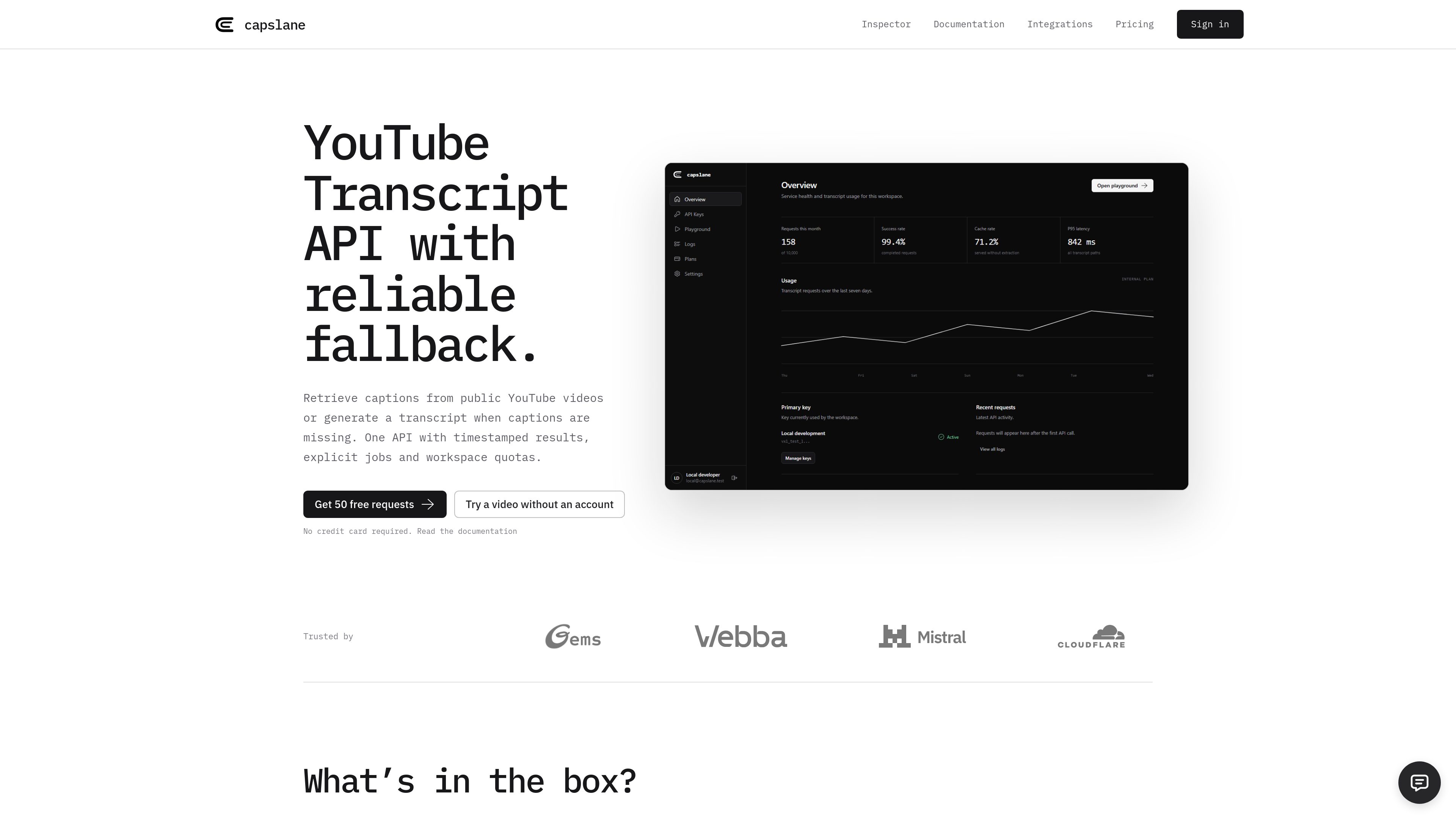
Capslane is built for applications that need transcript retrieval inside a video analysis, search, or automation workflow. Server-side API keys, workspace quotas, request history, usage visibility, and a shared transcript cache provide operational controls for integrating the service into an application.
Fetches manual or automatic YouTube caption tracks without starting audio generation. A requested language can be supplied using a two- or three-letter ISO code, optionally with a regional code.
Automatic mode tries native captions first and starts an asynchronous generation job only after Capslane confirms that no usable caption track exists. Generate mode can start or reuse a generation job directly.
Immediate responses return timestamped segments by default, including text, offsets, durations, and language. The text parameter can instead return one string for completed responses, while job results remain segmented.
Native, generated, and cached transcripts use the same response structure. The source and cached fields indicate how the result was obtained, and polling an asynchronous job does not reserve another usage unit.
Authentication uses workspace API keys in the x-api-key header. Workspaces provide monthly request limits, API key management, request history, usage information, and a shared transcript cache.
Retrieve transcript text or timestamped segments as input for video analysis, question answering, or other content-processing features. Applications can handle immediate results and continue with a job ID when generation is accepted.
Use native, segmented transcripts with millisecond offsets and durations to connect searched text with locations in a video. This supports workflows where users need to find and select footage by transcript content.
Add transcript retrieval to a server process or automation flow using the REST API, JavaScript or Python SDKs, LangChain, n8n, or MCP-connected agent tools documented by Capslane.
Use automatic mode for user-submitted or catalog videos where some videos have captions and others do not. Native results can be returned immediately, while videos without usable captions proceed through asynchronous generation.
In automatic mode, Capslane confirms that no usable caption track exists and then starts an asynchronous transcription job. The initial response includes a job ID, which the application polls until the transcript is ready.
Create a server API key in the Capslane workspace and send it in the x-api-key header on every API request. The documentation recommends storing the key in a server environment variable and not exposing it in browser or mobile code.
Yes. Pass a preferred two- or three-letter ISO language code, optionally followed by a two-letter region such as en or fr-FR. If that track is unavailable, Capslane returns the first available transcript and lists the other languages.
An accepted generation request returns HTTP 202 with a jobId, status, and requestId, but no content yet. The application retains the job ID and polls the job until it completes, fails, or expires.
Each accepted transcript request reserves one monthly unit, whether the result is native, generated, or served from cache. Polling an asynchronous job does not reserve another unit, and monthly usage resets, including for annual subscriptions.
Os dados de tráfego são apenas para referência.