
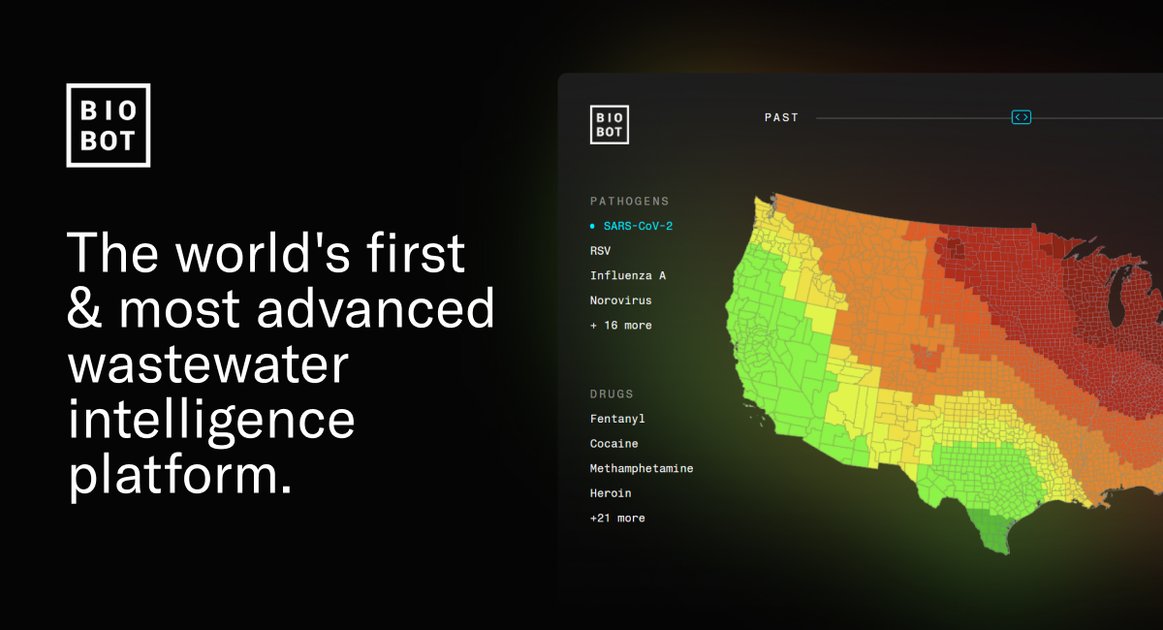
Monitor a broad range of health signals
Track more than 50 trends across respiratory and gastrointestinal pathogens, arboviruses, other pathogens of public health importance, and substances including opioids and stimulants.

Wastewater intelligence for public health teams, healthcare systems, and life science organizations.
Biobot is a wastewater intelligence platform for analyzing biological and chemical signals at population level. It monitors more than 50 health trends across pathogens, substances, and treatment medications. Public-health and health-sector teams can compare geographic patterns and use modeled disease activity for planning. Biobot Advance adds weekly ZIP- and county-level data, interactive dashboards, CSV download, and API delivery for pharmaceutical and life science workflows.
Wastewater signals describe communities, rather than diagnosing a person. Geographic models extend a network of sampled treatment sites; a modeled ZIP or county view is not the same as direct sampling in every location. Professionals should assess data coverage, uncertainty, and other epidemiological or clinical evidence before making health decisions.
Track more than 50 trends across respiratory and gastrointestinal pathogens, arboviruses, other pathogens of public health importance, and substances including opioids and stimulants.
Use changes in wastewater signals as an early-warning input alongside testing and hospitalization data. Earlier signals are useful for surveillance, without guaranteeing that every outbreak is detected in advance.
For state and local public health teams, modeled results can be viewed for specific ZIP codes or counties to help identify local patterns and anomalies.
Compare local results with regional and national trends to put community-level activity in context and coordinate responses across jurisdictions.
Biobot Advance provides predictive disease-activity models for locating areas of rising activity and planning trials, resources, or campaigns. Substance-use monitoring tracks community trends; it is not evidence of an individual diagnosis or a guaranteed drug-use forecast.
Biobot Advance supports interactive dashboards, CSV downloads, and API ingestion into internal analytics systems. Data cadence, scope, and access should be selected for the intended organizational use.
State and local health departments can monitor disease activity, identify emerging increases, and use localized trends to guide communication and response.
Public agencies can use wastewater signals as an early-warning input when anticipating outbreaks, including activity associated with influenza, COVID-19, measles, RSV, and norovirus.
Health teams can use geographic patterns and comparisons with regional or national activity to direct response resources toward communities where trends are rising.
Use community-level substances and treatment-medication trends as one input to evaluating prevention or treatment programs. Interpret them with other evidence; wastewater does not reveal an individual’s substance use or predict an individual overdose.
Pharmaceutical and life science teams can use Biobot Advance disease-activity models to plan trial regions, research, or geographic campaigns. Check modeled coverage and performance for the specific decision; forecasts do not guarantee faster enrollment or better campaign results.
The signal menu covers more than 50 trends, including respiratory and gastrointestinal pathogens, other public-health pathogens, substances, and treatment medications. Examples include influenza, RSV, SARS-CoV-2, norovirus, fentanyl, cocaine, and methamphetamine. Confirm the data scope for your program.
The platform serves government public-health teams, healthcare systems, and pharmaceutical or life science organizations. Biobot Advance provides disease-forecasting data and analytics delivery for pharmaceutical and life science work.
Modeled ZIP- and county-level views can be compared with regional and national trends. The collection network samples treatment sites, while models extend geographic coverage. Biobot Advance data are updated weekly; do not treat every displayed location as a separately sampled site.
Wastewater findings concern circulating signals at community level, rather than who is carrying them. They are not individual test results or diagnoses. This population scope does not by itself establish a guarantee about all account, website, or linked-system data handling.
Use trends to organize outbreak surveillance, communications, or resource planning, then assess coverage and uncertainty alongside other evidence. These are decision-support signals for professionals, rather than automatic medical or public-health decisions.
Os dados de tráfego são apenas para referência.