
Fresh workers each cycle
Sends a bounded goal to fresh Codex workers so each cycle starts with clean context instead of continuing from a long, tangled chat thread.

AgentLoop é uma ferramenta local de loop de programação que envia objetivos delimitados a novos workers, revisa os resultados com um crítico independente e itera até atender aos padrões definidos no projeto. Foi criada para trabalho autônomo em um repositório local, não em um workspace hospedado.
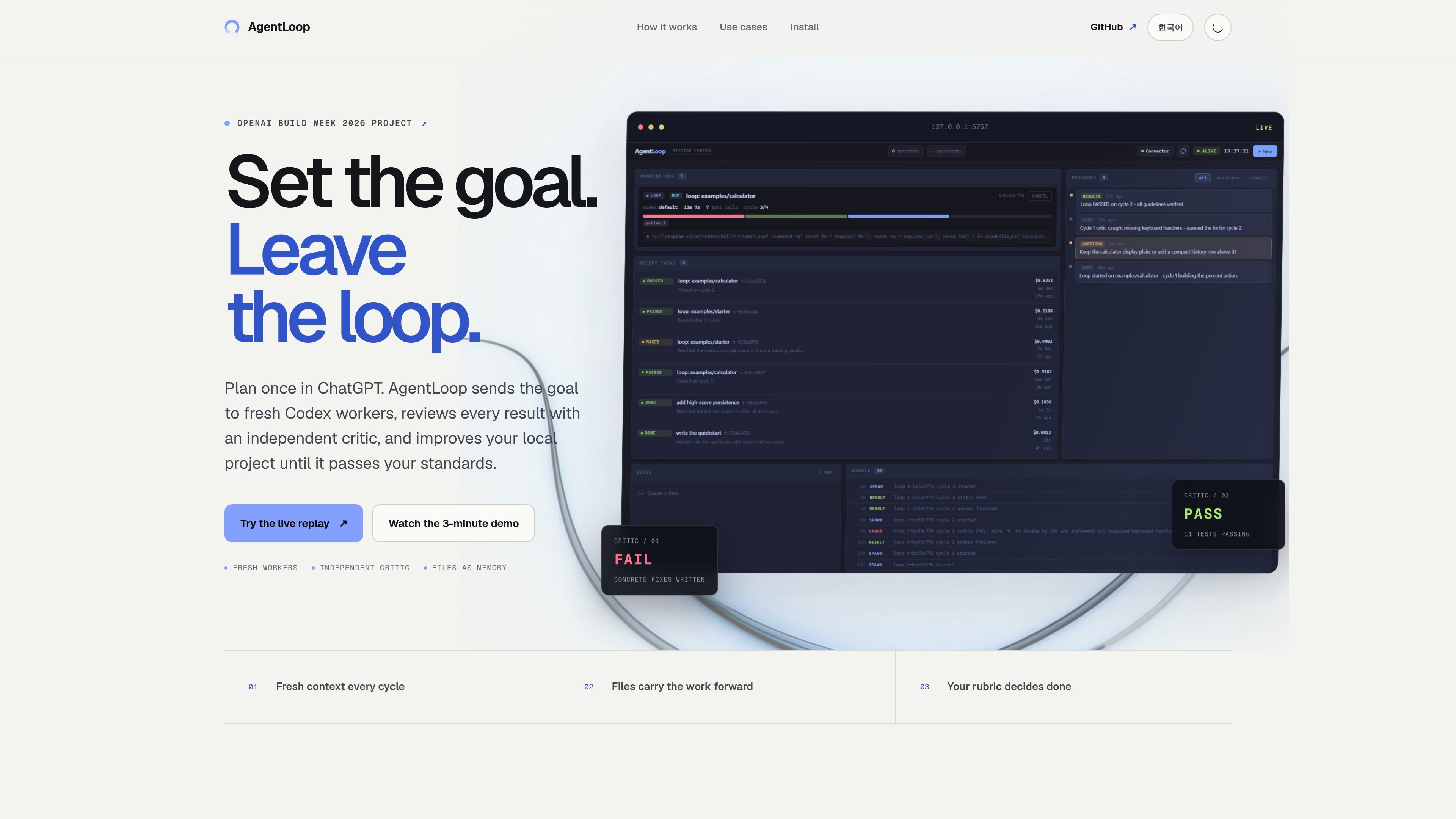
AgentLoop is a local coding loop tool that automates handoffs between planning, implementation, and review. The homepage describes it as “unattended local coding loops” with fresh workers, an independent critic, and standards applied on every cycle.
The intended workflow is to set the goal once, keep the rubric in GUIDELINES.md, and let the system keep iterating on the local project until the critic and your standards agree the work is done. It is presented as a local-first engine that runs in the repository where the code lives.
Sends a bounded goal to fresh Codex workers so each cycle starts with clean context instead of continuing from a long, tangled chat thread.
Uses a separate critic process to review results independently, so passing tests are treated as evidence rather than the only stopping condition.
Carries project files, logs, and feedback forward between cycles so the work can continue in the local repository without the user relaying every message.
Loads the definition of done from GUIDELINES.md, letting the project’s standards persist across iterations instead of living only in prompts.
Runs locally with Node.js 18+, Git, and an authenticated Codex CLI, and the source says it does not require an npm install or hosted workspace.
Provides observability through cycle logs, verdicts, transcripts, cost, file handoffs, and an interactive replay/dashboard view.
Assign a scoped feature and let the loop build, review, and refine it against acceptance criteria stored in your project files.
Use the worker/critic cycle for code changes that must preserve existing behavior while updating data handling, routes, or file formats.
Run an unattended pass on brittle areas of the codebase to add fixes, regression coverage, and documentation alignment.
Hand off a UI, copy, or developer-experience cleanup task when you want iterative polishing without staying in the loop for each step.
AgentLoop is described as running unattended local coding loops: you set a goal and standards once, then it sends work to fresh Codex workers, has an independent critic review the result, and carries evidence forward into the next cycle.
The source says it runs where your code lives and requires Node.js 18+, Git, and an authenticated Codex CLI. It also says there is no npm install and no hosted workspace.
The homepage describes a workflow where you define the finish line in ChatGPT, put your rubric in GUIDELINES.md, and let AgentLoop handle the worker/critic loop until the work passes your standards.
The site positions it for bounded coding work such as feature work, migrations, hardening passes, and product polish, especially when you want to avoid manually babysitting each handoff.
The pricing URL in the provided source returns a 404, so the collected pages do not confirm any pricing details.
Os dados de tráfego são apenas para referência.

pi.dev
Pi Coding Agent é um agente de programação baseado em terminal para desenvolvedores que buscam um fluxo de trabalho CLI extensível, com uso interativo e programático, instruções de projeto, ramificação de sessões e amplo suporte a provedores de modelos.

hoplite.sh
Hoplite é uma plataforma de agentes de programação que executa tarefas em ambientes de desenvolvimento isolados e pode abrir pull requests quando elas são concluídas. Foi criada para equipes que desejam delegar o trabalho em repositórios a agentes, com feedback e aprovações em tempo real.

superset.sh
Superset é uma ferramenta para desktop que permite executar vários agentes de programação com AI em paralelo na sua própria máquina. Separe o trabalho em Git worktrees isolados, revise alterações e avance nas tarefas sem esperar por um agente de cada vez.

traycer.ai
Traycer AI é uma ferramenta de desenvolvimento orientada por especificações para planejar, fornecer contexto e verificar fluxos de trabalho de programação com IA.

www.clarkchat.com
Clark Labs oferece Clark Agent para trabalho web autônomo baseado na nuvem e Clark Code para tarefas de programação locais ou baseadas em SSH. A plataforma também fornece um gateway de API compatível com OpenAI para chamar modelos Clark ou encaminhar modelos de ponta por meio do Clark.

opencodesuper.app
OpenCode Superapp é um espaço de trabalho nativo para Mac que permite usar modelos de IA locais, auto-hospedados ou na nuvem junto com programação, automação do navegador, voz, extensões, widgets e acesso remoto seguro. É voltado a quem busca um ambiente OpenCode local-first sem precisar de uma conta.