
AI crawler access checks
Reviews robots.txt rules, AI-crawler access, sitemaps, noindex directives, soft 404s, and page bloat to identify barriers to discovery.

Checks whether AI agents can find, interpret, and cite a web page.
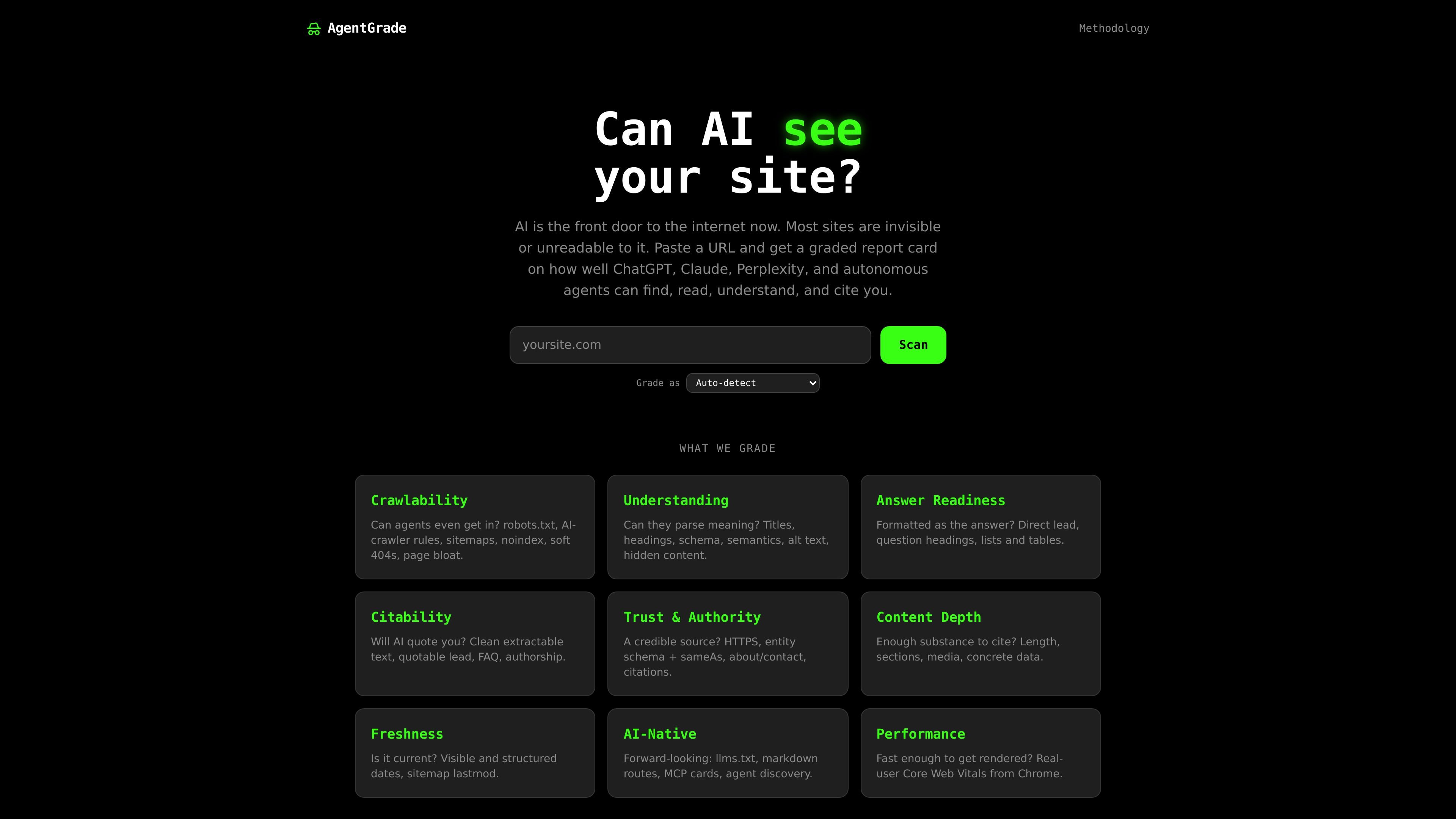
AgentGrade is a web-based page assessment tool for evaluating how accessible and usable a website is to AI agents and answer engines. Submit a URL to receive a score from 0 to 100 and an A–F grade, with findings across areas such as crawlability, machine understanding, answer readiness, citability, trust, content depth, freshness, AI-oriented discovery, and performance. The assessment is intended to show which page characteristics help or hinder AI systems in finding, interpreting, and citing its content. AgentGrade distinguishes this work from conventional SEO audits, which primarily focus on search rankings.
Reviews robots.txt rules, AI-crawler access, sitemaps, noindex directives, soft 404s, and page bloat to identify barriers to discovery.
Fetches pages without running JavaScript and checks whether content, headings, metadata, and structured data are present in the HTML available to many AI crawlers.
Assesses features such as direct leads, question headings, lists, tables, extractable text, FAQs, and authorship that can affect whether content works as an answer or can be cited.
Checks signals including HTTPS, entity schema and sameAs, about and contact information, citations, substantive sections, concrete data, and visible or structured dates.
Looks for llms.txt, markdown page routes, MCP cards, and agent discovery signals.
Auto-detects a page type or lets the user choose among general page, content/article, marketing/landing page, and API/app. Grades are weighted for the selected type; performance checks use real-user Core Web Vitals from Chrome.
Scan a page that is not appearing in AI-generated answers and inspect whether crawler rules, noindex settings, or content rendered only by JavaScript could limit access.
Assess an article’s headings, lead, lists, tables, and extractable content to identify structural opportunities for answer engines.
Choose the appropriate page type to evaluate a landing page or homepage against criteria weighted for that format, rather than article-length expectations.
Use the report to review items such as sitemap dates, llms.txt, markdown routes, structured data, and page performance when assessing a site’s readiness for AI discovery.
Paste a page URL into AgentGrade. It fetches the page without running JavaScript and returns a graded report card.
The score runs from 0 to 100 and is also expressed as an A–F grade. It summarizes page readiness across weighted categories related to AI crawling, interpretation, answering, citation, trust, and other signals.
Yes. AgentGrade auto-detects the page type, and the Grade as picker offers general page, content/article, marketing/landing page, and API/app. The weighting varies by type.
It stores submitted website URLs with timestamps to understand usage and improve the service. It says it does not store the report or the user's IP address.
No. AgentGrade focuses on whether AI systems can crawl, parse, and cite a page, including whether its content is available without JavaScript. This overlaps with SEO but addresses different signals from blue-link ranking audits.
Os dados de tráfego são apenas para referência.

www.aiogeoprotocol.com
AIO.GEO audits whether AI crawlers and generative answer engines can access, parse, understand, and cite a public website. It helps developers, agencies, content teams, and governance teams identify structural issues, apply dry-run fixes, rescore changes, and produce verifiable receipts.

jevseo.vercel.app
jev-seo is an open-source Rust command-line toolkit for auditing websites and local content for SEO and generative engine optimization. It also tracks rank changes, gates CI checks, and exposes its capabilities through a 15-tool MCP server for coding agents.