
Verifiable data storage
Walrus is presented as a platform for secure storage and verifiable data, aimed at builders who need data to stay available and traceable.

Verifiable data platform for AI and onchain finance developers, with portable memory for AI agents
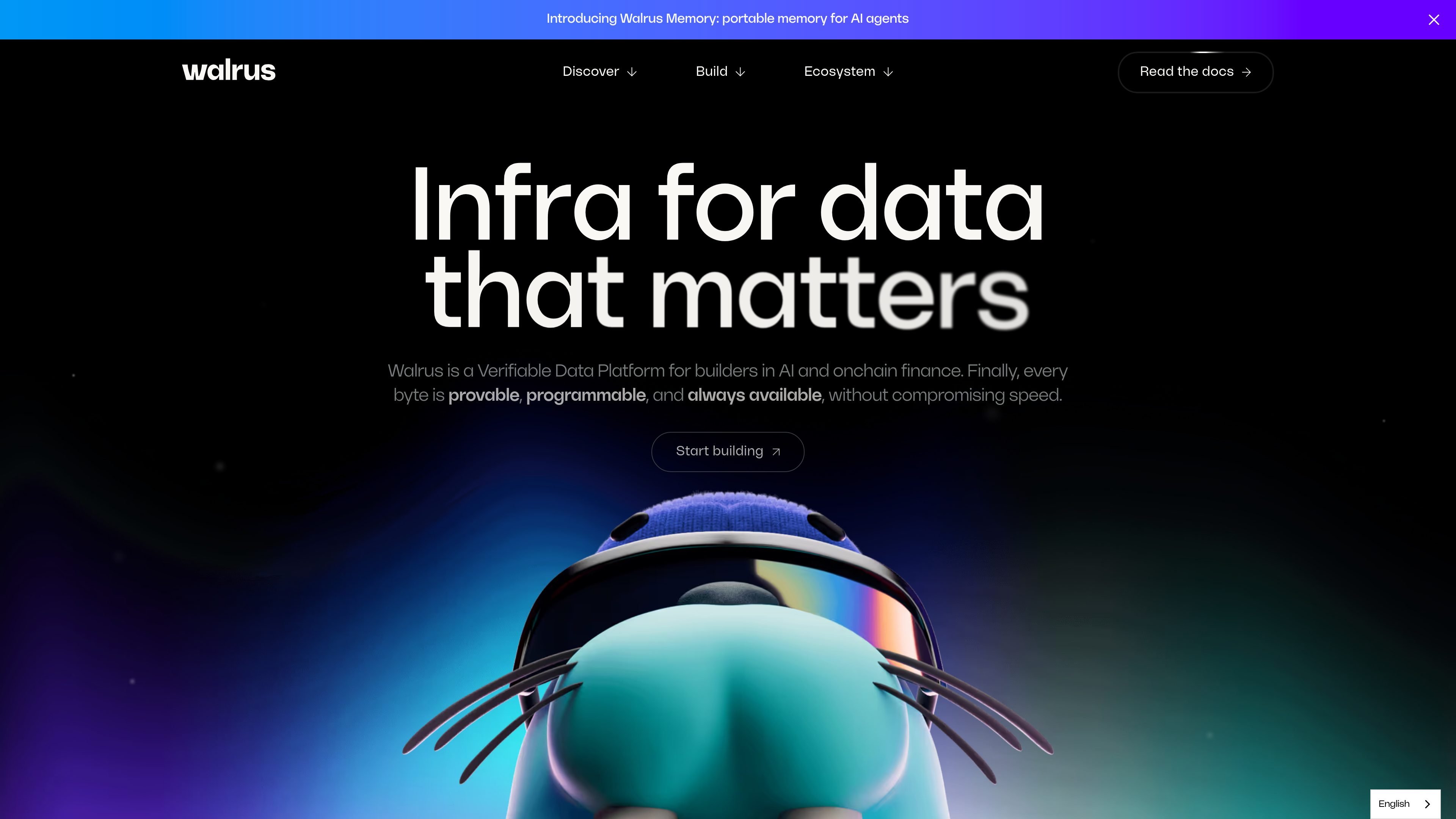
Walrus is a verifiable data platform for developers building in AI and onchain finance. Its homepage positions the product around storage that is always available, programmable through smart contracts, and verifiable through tracked file history and IDs.
The site also introduces Walrus Memory, a portable memory layer for AI agents that can be used across apps and sessions. Across its use-case pages, Walrus is framed as infrastructure for verified AI data, verifiable data markets, and real-time protection use cases that depend on trusted data and controllable access.
Walrus is presented as a platform for secure storage and verifiable data, aimed at builders who need data to stay available and traceable.
The site says smart contracts can control who can access data and what they can do with it, giving builders programmable access control.
Walrus says every file gets a verifiable ID and tracked history, so teams can prove where data came from and how it changed.
The homepage describes the platform as private by design, with control over exactly who can see data.
Walrus Memory adds portable agent memory that can move across apps and sessions, and the page shows integrations with AI clients and app code examples.
The WAL token is described as the economic heart of the network, used to pay for storage and secure the network through staking.
Build AI systems that depend on trusted inputs and outputs. The AI use-case page says Walrus can help developers store verifiable training datasets, authenticate workloads, and link responses back to the model, prompt, and training data used.
Create data marketplaces where provenance and permissions matter. Walrus is described as a layer for verifiable provenance, programmable terms, and granular access control so data can be published and sold with defined usage rules.
Use Walrus Memory when an agent needs memory that follows it across tools and sessions. The product page shows setup for AI clients and application code for shared memory workflows.
Support always-on services that need real-time authentication of websites and interactions. The homepage frames Walrus as useful for protecting online transactions and reducing exposure to bad actors.
Walrus Memory is positioned as a portable memory layer for AI agents. The product page says it can be added to AI clients such as Claude Code, Cursor, Codex, and Gemini CLI, and it also shows Python and TypeScript examples for application integration.
Walrus is described as a Verifiable Data Platform for builders in AI and onchain finance. The site frames it around secure storage, verifiable data, programmable access control, and always-available data.
The AI use-case page says Walrus can help with verifiable datasets, verifiable AI outputs, agent identity and memory, and authenticated workloads. The data markets page adds verifiable provenance, programmable permissions, and data monetization workflows.
The pricing page at the provided URL currently returns a 404 page not found. The site does not expose pricing details in the collected sources.
Traffic data is for reference only.

sequel.sh
Sequel is an AI data analyst and secure data layer for agents. It connects databases, warehouses, analytics platforms, spreadsheets, and SaaS tools so Claude, Cursor, ChatGPT, and other MCP-capable agents can answer questions using shared data connections and definitions.

pages.edgeone.ai
EdgeOne Makers deploys web apps and AI agents on Tencent EdgeOne, combining hosting, functions, storage, runtime, sandbox tools, memory, observability, and built-in models.
www.simular.ai
Simular is an autonomous computer platform that uses AI agents to operate real computers and automate digital workflows. It serves individuals, builders, operators, and businesses that need to automate tasks across desktop applications and websites, including workflows that do not expose traditional APIs.

www.lyzr.ai
OpenController is Lyzr’s control plane for discovering, evaluating, governing, and monitoring AI agents, models, tools, data, and workflows across an enterprise AI estate. It is intended for teams managing agents across clouds, frameworks, runtimes, and environments.

workato.com
Enterprise integration and orchestration for agentic AI

harproject.dev
HAR HQ is a team governance and observability layer for organizations running coding agents with HAR. It standardizes verification, tracks AI-related work and spend, and helps engineering teams review and improve agent workflows.